Key Takeaways:
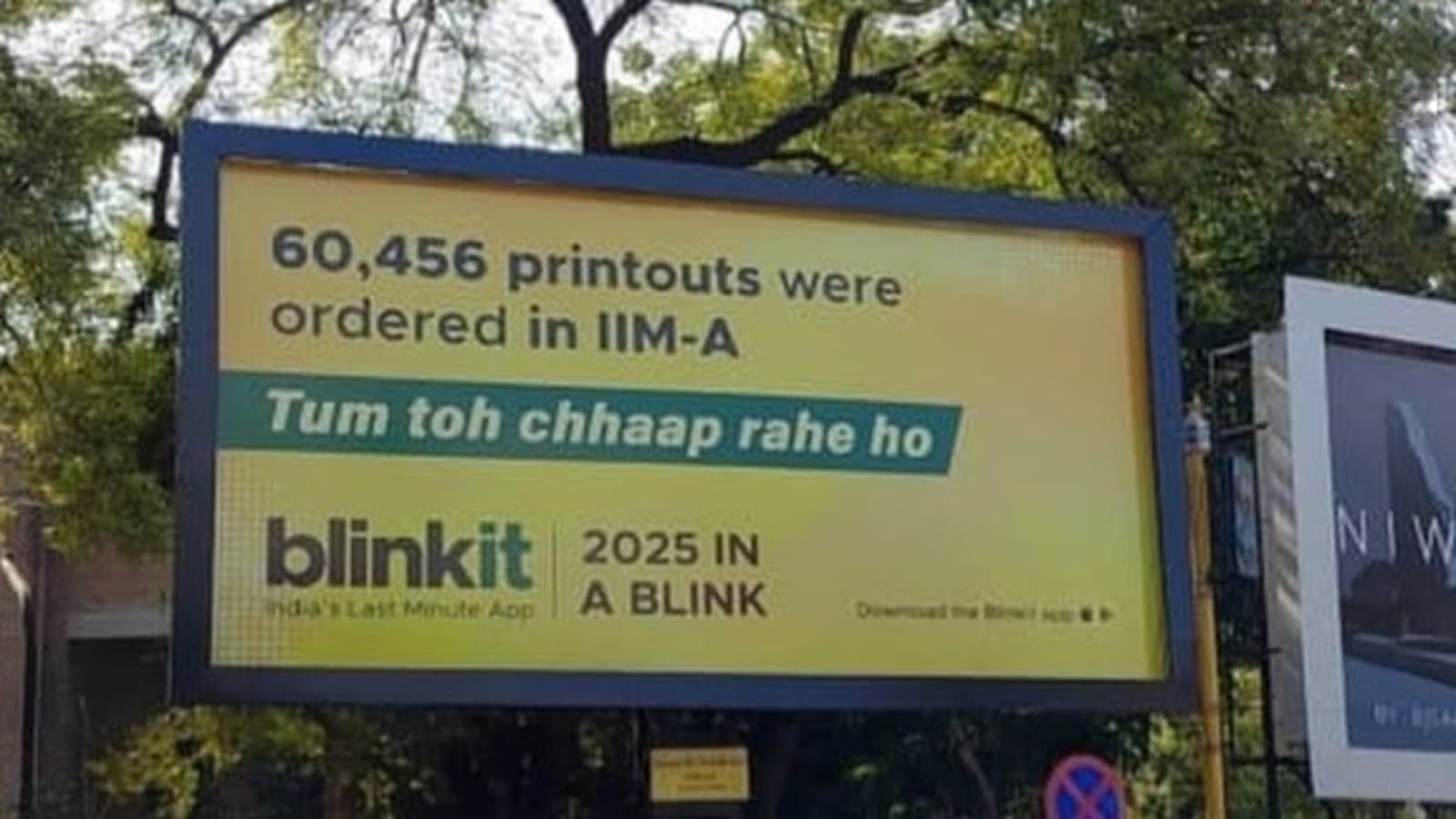
- Blinkit billboards reveal IIM Ahmedabad students ordered over 60,000 print-outs in 2025, averaging about 165 per day.
- The campaign uses everyday ordering data, turning hyperlocal insights into humorous campus snapshots.
- A billboard comparing XLRI and IIM Calcutta showed XLRI students ordered twice as many mixers, fuelling social media buzz.
- Students and alumni praised the campaign for relatable humour and clever use of data to tell brand stories.

Blinkit’s latest outdoor campaign has put a playful spotlight on campus habits at some of India’s leading management schools. One billboard revealed that students at the Indian Institute of Management Ahmedabad ordered more than 60,000 print-outs in 2025 — a figure that works out to roughly 165 print-outs a day. The statistic has since become a talking point on social media and among alumni circles, offering a light-hearted glimpse into the rigours of management education.
IIM Ahmedabad print-outs highlight academic workload
The IIM Ahmedabad statistic is presented without judgment but it speaks to the paper-heavy routines that persist at many higher-education institutions. Blinkit’s creative team chose to illustrate campus life by converting transactional data into bite-sized humour. Rather than focusing on rankings or placement figures, the campaign compares mundane ordering habits across campuses to create memorable, shareable content.
Another billboard in the set drew attention by comparing XLRI – Xavier School of Management, Jamshedpur, with the Indian Institute of Management Calcutta. It showed that XLRI students ordered twice as many mixers as their IIM-Calcutta counterparts. The ad closed with a tongue-in-cheek line in Hindi asking “Kyun nahi ho rahi padhai?” which roughly translates to “Why isn’t the studying happening?” The quip helped the campaign go viral, particularly among management-student communities on LinkedIn and Twitter.
Social media users have responded enthusiastically. Several alumni and students described the hoardings as “inside jokes” that carried the right mix of nostalgia and relevance. One LinkedIn user observed that Blinkit effectively moved the rivalry out of classrooms and onto public display, while another praised the ads for investing in cultural nuance rather than generic messaging. The ads have appeared in multiple Indian cities, amplifying local references into national conversations.
Marketing professionals say the campaign succeeds because it leverages real behavioural data to create cultural touchpoints. By using everyday orders as narrative devices, Blinkit has shown how brands can resonate with young, digitally native audiences without resorting to broad slogans. The result is marketing that feels conversational and grounded in lived experience.
Some commentators have also noted secondary debates the campaign raises, including environmental considerations linked to heavy printing and how digital workflows might reduce reliance on paper. While the billboards do not offer solutions, they open space for discussion about the efficiency of academic practices and the role technology can play in streamlining student life.
For now, the campaign’s humour-driven approach appears to have achieved its aim: it generated attention, sparked conversations and drove social sharing among a demographic that values wit and authenticity. Blinkit’s campus rivalry series proves that small datasets, when used creatively, can tell larger stories about culture and routine.
Whether the IIM Ahmedabad print-outs statistic prompts institutional change or simply earns a laugh, it has succeeded as a piece of contemporary brand storytelling — and it has given students, alumni and observers another reason to discuss the daily realities of campus life.