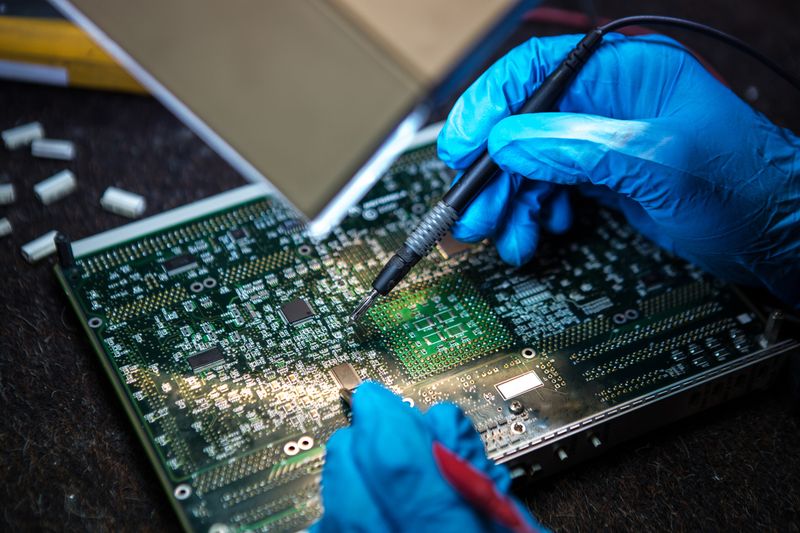
The Indian government has cleared 22 proposals under the Electronics Component Manufacturing Scheme (ECMS), signalling a substantial push to deepen domestic electronics production. The tranche carries a projected investment of Rs 41,863 crore and is expected to generate 3,967 direct jobs.
Three of the newly approved projects are located in Haryana. The successful applicants from the state are Signum Electronics Ltd, India Circuits Pvt Ltd and ATL Battery Technology (India) Pvt Ltd. Their projects include manufacture of multilayer printed circuit boards and lithium-ion cells geared to digital applications.
India electronics manufacturing set for expansion
The approvals are geographically diverse, with selected units spread across Andhra Pradesh, Karnataka, Madhya Pradesh, Maharashtra, Tamil Nadu, Uttar Pradesh and Rajasthan. Officials said this distribution reflects the government’s aim to promote balanced industrial growth and to broaden the electronics manufacturing base beyond established clusters.

With this round of clearances, the ECMS has now approved 46 applications across 11 states. The cumulative committed investment under the scheme stands at Rs 54,567 crore, with direct employment estimated at about 51,000 people. Policy makers and industry leaders say the scheme is designed to strengthen domestic supply chains and cut reliance on imports for critical electronic components.
Speaking about the approvals, the Minister for Electronics and Information Technology, Ashwini Vaishnaw, said the programme had reinforced India’s electronics manufacturing ecosystem and was enabling a greater share of domestic demand to be met locally. He added that the measures would support the development of higher-value manufacturing capabilities.
Vaishnaw emphasised the need to build strong structural foundations now, noting India’s favourable demographic profile for decades to come. He outlined a support model in which industry would carry the greater share of investment, with the government providing a smaller but strategic contribution. The approach follows the 80 per cent industry and 20 per cent government support model used by several East Asian economies.
Officials highlighted that the ECMS anchors policy interventions across design, quality assurance, skilling and domestic sourcing. The intent is to foster an industrial culture in which firms invest in research and development, workforce training and local supplier networks. Industry observers say that success in these areas would boost competitiveness and resilience in global supply chains.
Analysts said the approvals are timely as global electronics demand and strategic concerns over supply-chain security have prompted many countries to expand local production. The projects for multilayer PCBs and Li-ion cells are particularly notable because they address components that are central to consumer electronics, electric vehicles and digital infrastructure.
Looking ahead, the government’s next steps include monitoring implementation, encouraging private investment in design and testing facilities, and scaling up training programmes. If the projects proceed as planned, they will not only create jobs but also help to attract further investment into India’s electronics sector.
The ECMS approvals underscore the government’s priority to make India a significant manufacturing hub for electronics while reducing import dependence and supporting long-term economic growth.
Key Takeaways:
- India approves 22 projects under the Electronics Component Manufacturing Scheme, with projected investment of Rs 41,863 crore, advancing India electronics manufacturing.
- Three approvals are in Haryana for multilayer PCBs and Li-ion cells, creating nearly 4,000 direct jobs.
- Approvals span eight states and raise cumulative ECMS investment to Rs 54,567 crore, supporting supply-chain localisation.
- Government will back design, skilling and quality improvements with an industry-led 80:20 support model to reduce import dependence.