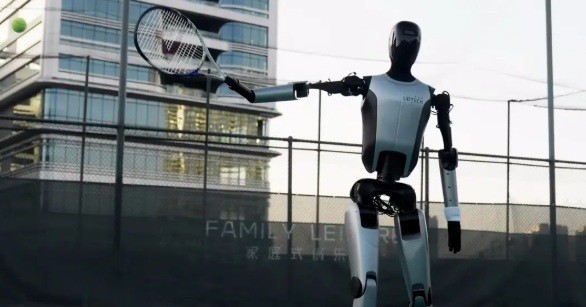
A video circulating online has drawn attention to a Chinese humanoid robot capable of performing remarkably precise tennis strokes. At first glance the demonstration resembles a simple exhibition, but closer inspection reveals the technical sophistication required for a robot to track, predict and respond to a fast-moving ball in real time.
Chinese humanoid robot tennis performance and technical demands
The clip highlights several interdependent systems working together. The robot must capture visual input, estimate the ball’s trajectory, maintain balance while shifting weight and execute rapid, coordinated limb movements. Any latency in sensing or control could ruin the shot, because the dynamics of tennis allow little time for course correction.
Engineers face a trio of challenges when adapting humanoid platforms to racket sports. First, perception: cameras and sensors must detect the ball against complex backgrounds and in varying light conditions. Second, prediction: software must forecast where the ball will be in fractions of a second, translating that estimate into an optimal interception point. Third, actuation and balance: the robot must reposition its body and accelerate its arm while remaining stable, then follow through in a way that mimics human biomechanics.

While the video does not disclose the robot’s maker or the exact control architecture, the performance suggests tight integration between vision systems, low-latency control loops and rapid motor responses. Such integration is often developed in research labs and advanced manufacturing centres where robotics teams iterate on hardware and software to reduce lag and improve accuracy.
Beyond the spectacle, demonstrations like this serve multiple functions. They advance core robotics research by testing perception and motion planning under demanding conditions. They provide testbeds for human–robot interaction scenarios where machines must operate safely in proximity to people. And they may influence commercial applications, from sports training aids and rehabilitation devices to robotic assistants that require dynamic movement capabilities.
There are, however, clear limitations and questions to address. Performance in a controlled demonstration does not automatically translate to reliable operation in everyday environments. Real matches introduce unpredictable spins, variable court surfaces and human opponents who alter pace and tactics. Safety remains paramount; autonomous systems operating near humans must include fail-safes and comply with regulations that differ across jurisdictions.
Interest in robotic sports demonstrations also reflects wider geopolitical and economic trends. China has invested heavily in robotics research and industrial automation, and public demonstrations can showcase national capabilities in advanced technology. For observers within the BRICS and partner network, such breakthroughs may signal opportunities for collaboration in research, education and industry.
As the technology matures, engineers and policymakers will need to balance innovation with robust testing and clear safety standards. For now, the viral video stands as a striking example of how far humanoid robotics has come, and it raises expectations about the near-term applications of machines that can see, predict and move with impressive speed and precision.
Key Takeaways:
- A viral video shows a Chinese humanoid robot executing precise tennis strokes, demonstrating advanced perception and motion control.
- The demonstration highlights real-time visual tracking, ball trajectory prediction and rapid coordinated movement.
- Engineers say such advances could benefit robotics research, sports training and human–robot interaction while raising safety and regulatory questions.