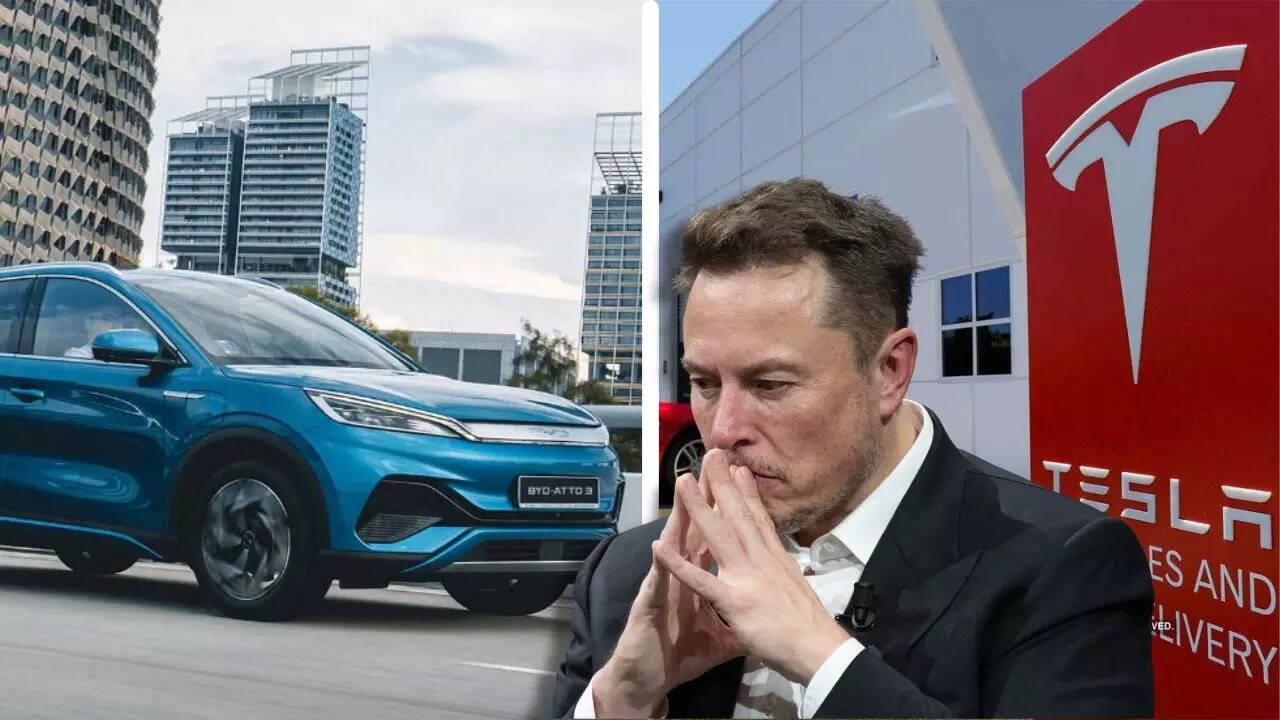
Chinese automaker BYD has overtaken Tesla to become the world’s largest seller of electric vehicles in 2025, according to a report by Global Times. BYD’s surge in pure electric vehicle sales, paired with steady overall deliveries, marks a notable shift in the global EV market.
BYD reported total vehicle deliveries of 4.6 million units in 2025, up 7.7 per cent from the previous year. Crucially, sales of pure electric vehicles rose 28 per cent to 2.25 million units, reflecting robust demand and expanding production capacity across the company’s model range.
By contrast, Tesla recorded 1.63 million vehicle deliveries in 2025, an 8.6 per cent decline year on year. The firm’s annual production also slipped by 6.7 per cent to 1.73 million units, a downturn that has intensified competitive pressure from rivals in Asia and Europe.

BYD becomes world’s largest EV seller
The change of leadership in the EV market is being attributed to the rising competitiveness of China’s new-energy vehicle manufacturers. Industry figures say Chinese firms benefit from a tight industrial ecosystem that links parts suppliers, battery makers and vehicle assemblers in a way few other countries can match.
Cui Dongshu, secretary-general of the China Passenger Car Association, told Global Times that Chinese EV companies continue to invest heavily in research and development and are advancing core technologies rapidly. He pointed to manufacturing scale, supporting infrastructure and targeted policy incentives as additional strengths that have helped BYD expand output and sales.
China’s supply chain remains central to the global EV industry, the report added. Tesla, despite being an American company, depends substantially on its China-based gigafactory to meet delivery targets. As Chinese manufacturers deepen their industrial and supply networks, analysts expect them to retain an edge in global deliveries over the coming years.
Market observers also note that BYD’s product strategy — covering a broad range of price points and vehicle types, including internal combustion hybrids as well as pure electrics — has helped it capture a wide swathe of buyers at home and abroad. The company’s ability to scale battery production and vehicle assembly quickly has been a decisive factor in taking market share from established rivals.
For Tesla, the decline in deliveries raises questions about how the company will respond to intensifying competition. Its reliance on large-scale production facilities outside the United States has been highlighted as both an advantage and a vulnerability, given the centrality of China’s component supply and manufacturing expertise to the global EV value chain.
Investors and policymakers will watch the coming quarters closely. If BYD sustains its momentum, the company’s success could accelerate technological competition, reshape global EV supply chains and influence the strategic choices of international automakers. For China, BYD’s rise underlines the country’s growing influence in a sector that is central to the transition to low-emission transport.

Key Takeaways:
- BYD becomes world’s largest EV seller after reporting 2.25 million pure electric vehicle sales in 2025.
- Tesla saw an 8.6% decline in deliveries, while BYD’s total vehicle deliveries rose 7.7% to 4.6 million units.
- Analysts point to China’s integrated supply chain, R&D investment and policy support as drivers of BYD’s lead.
- The shift highlights the growing global competitiveness of Chinese new-energy vehicle manufacturers.