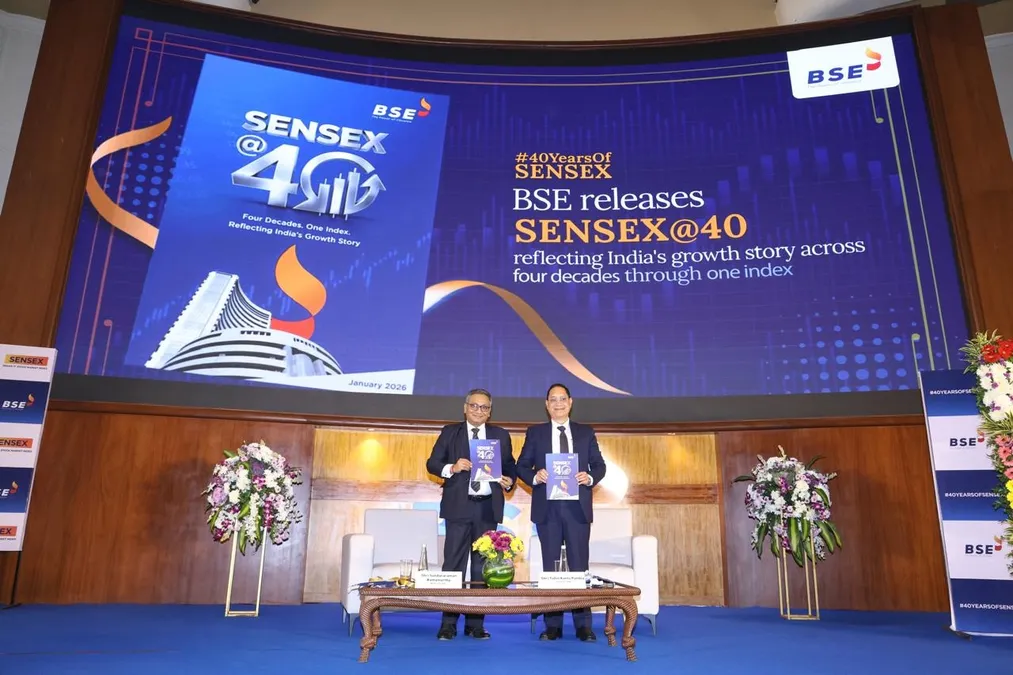
BSE Limited marked the 40th anniversary of the SENSEX on Friday, celebrating the index that has tracked India’s equity market through four decades of reform, growth and increasing investor participation. Launched in 1986 as India’s first stock market index, the SENSEX comprises 30 companies drawn from multiple sectors and represents almost 40% of the country’s market capitalisation.
SENSEX 40th anniversary highlights market milestones
The index, reviewed twice yearly in June and December, was originally calculated on a market-capitalisation basis. Since 1 September 2003, BSE moved the SENSEX to a free-float market-cap methodology, aligning it with the approach used by most global benchmarks. That shift helped widen the index’s appeal among domestic and international investors and supported the growth of passive investment products linked to the SENSEX.
Today the SENSEX underpins more than 20 exchange traded funds and index funds that collectively manage roughly Rs 2.5 lakh crore. In recent years the SENSEX has also become the foundation for a growing derivatives market. Index options and futures tied to the benchmark have expanded rapidly, reflecting increasing sophistication among market participants and rising demand for risk management tools.

Performance since inception has been notable. The SENSEX has delivered a compounded annualised growth rate of 13.4%, broadly mirroring India’s nominal GDP growth over the same period. The index has endured a range of market cycles, from bouts of volatility to sustained rallies, and has served as a barometer for the nation’s economic progress and regulatory reforms.
The anniversary was observed at an event attended by senior market officials and stakeholders, including Shri Tuhin Kanta Pandey, Chairman of the Securities and Exchange Board of India, and Shri Sundararaman Ramamurthy, Managing Director and Chief Executive Officer of BSE Ltd. Mr Pandey said the SENSEX has mirrored India’s economic transformation and the development of its capital markets over the last four decades. Mr Ramamurthy described the milestone as a celebration of the exchange’s journey from a closed market to a technology-driven ecosystem and reiterated BSE’s commitment to meeting evolving market needs.
Market participants point to several structural changes that have supported the SENSEX’s role as a leading benchmark. These include improved market infrastructure, enhanced disclosure standards, broader retail participation and the rise of passive investing. The transition to a free-float methodology in 2003 and the development of exchange-traded products have both contributed to the index’s wider usability for portfolio construction and benchmarking.
Looking ahead, the SENSEX is expected to remain central to India’s capital markets. Its composition and governance are reviewed periodically to ensure the benchmark remains representative of the market. For investors and policymakers alike, the 40-year milestone offers a moment to reflect on past reforms and to consider the next phase of growth as India seeks deeper capital markets and broader participation across investor classes.
Key Takeaways:
- The SENSEX celebrates its 40th anniversary, reflecting four decades of capital market development.
- The index represents nearly 40% of India’s market capitalisation and uses a free-float methodology since 2003.
- Over 20 ETFs and index funds track the SENSEX, managing around Rs 2.5 lakh crore in assets.
- SENSEX 40th anniversary highlights sustained returns with a 13.4% CAGR since inception.