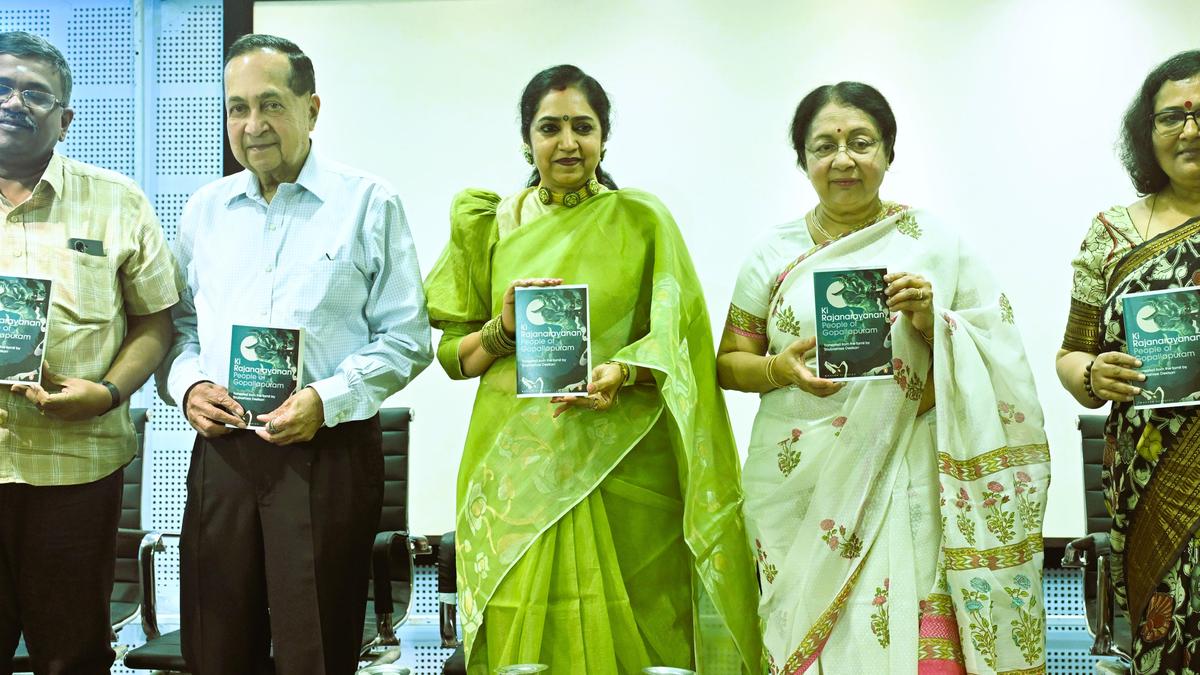
At a lit event in Chennai on Saturday, Chennai South Member of Parliament Thamizhachi Thangapandian described translating the works of the late Tamil writer Ki. Rajanarayanan as more difficult than translating the great epics. Speaking at The Hindu Lit for Life unplugged programme, she said the task demanded more than linguistic skill; it required an ability to convey dialect, texture and culture.
Ki. Rajanarayanan translation presents unique challenges
Ms Thangapandian was commenting on journalist Shubashree Desikan’s English translation, The People of Gopallapuram, from Ki. Rajanarayanan’s Gopallapurathu Makkal. “To translate Ki.Ra is perhaps the most difficult task; it is even harder than translating great epics because, when you translate an epic, you are translating formal language. But when you translate a work like Ki.Ra, full of dialectical nuances, you are translating sound, smell, texture, you are translating a culture,” she said. She praised Desikan’s commitment and sincerity and suggested a lesser translator might have sanitised the book.
Ms Thangapandian described the work as “eternal” and expressed gratitude to the State government for supporting the introduction of such writings to the English-reading public. She said the book acts as a mirror to people and histories that mainstream accounts have often overlooked. “When you hold this book, you are not holding paper. I’m holding a handful of black soil. If you listen closely, you can hear the heartbeats of people who have been silent for too long in the pages of mainstream history,” she said.

N. Ram, Director of THG Publishing Private Ltd, commended the Tamil Nadu Textbook and Educational Services Corporation (TNTB and ESC) for what he called an unusual programme. Mr Ram said publishing bold regional works with government backing was a rare initiative and credited politicians who allowed creative freedom. He warned against an environment of censorship, saying that creative liberties were under pressure amid rising communal tensions in parts of the country. “To bring out these bold works, and provide financial and infrastructural support is special,” he added.
Mini Krishnan, coordinating editor of TNTB and ESC, made the case for sustained institutional support for languages. She pointed out that while much effort goes into protecting wildlife or monuments, universities and public bodies were doing too little to protect languages and ensure students learn them. She argued that translation is foundational to civilisation, noting that mathematics, astronomy and science spread through translators working across Arabic, Greek and Latin traditions.
Dr T.S. Saravanan, honorary advisor to TNTB and ESC, was among other speakers at the event. The gathering combined literary appreciation with a policy argument: translations such as The People of Gopallapuram not only broaden readership but also preserve regional memory and identities. Participants stressed that careful translation, which retains dialectical and sensory detail, can expand the reach of regional voices without erasing their distinctiveness.
Attendees said the project illustrates how government support for translation and publishing can serve a larger cultural purpose. By making such works available in English, the organisers argued, readers across India and beyond gain access to narrative worlds that have been marginalised in mainstream historiography. The event concluded with a call for continued investment in translation as a means of cultural preservation and democratic expression.
Key Takeaways:
- Chennai South MP Thamizhachi Thangapandian said Ki. Rajanarayanan translation is harder than translating great epics because it conveys dialect, sound and smell.
- Shubashree Desikan’s translation of Gopallapurathu Makkal, The People of Gopallapuram, was praised for preserving cultural texture.
- TNTB and ESC support for English editions was commended as an unusual government initiative to protect languages.
- Speakers warned that creative freedom must be protected to allow bold voices and minority writers to be heard.