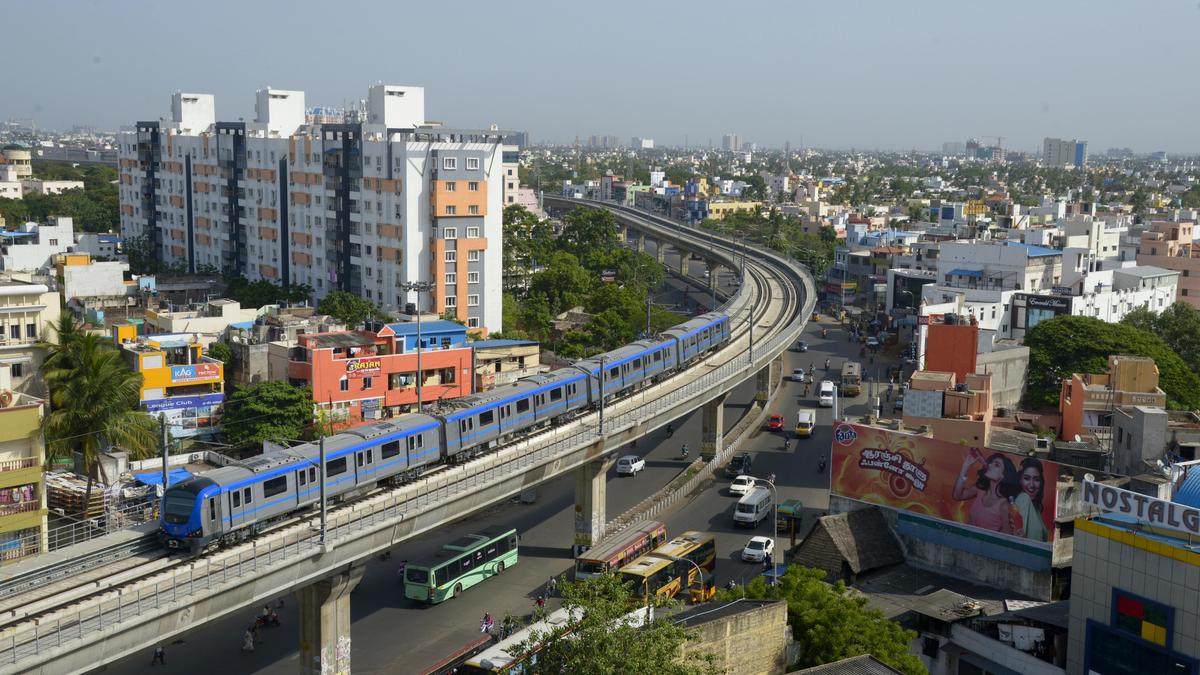
Chennai Metro Rail has marginally increased train frequency on a high-demand stretch and introduced additional peak-hour trips, a move aimed at easing congestion for commuters and students across the city.
Chennai Metro peak-hour services expanded on Washermanpet–Alandur stretch
The change affects the short loop running from Washermanpet to Alandur via Guindy, part of corridor 1, which was identified two years ago as carrying a large share of the system’s working commuters and student passengers. Trains on that section previously ran on a 3-3-6 minute pattern during weekday peak periods. Over the last few days that pattern has been tightened to 3-3-3 minutes, meaning three consecutive services arrive at three-minute intervals, cutting average wait times and smoothing passenger flow.
On corridor 1 the overall peak-hour frequency between Wimco Nagar and Chennai airport is now a train every six minutes on weekdays. Other services, including Chennai Central to St. Thomas Mount on corridor 2 and the inter-corridor run from Chennai Central to Chennai airport via Koyambedu, continue to operate at a 12-minute frequency.

Officials said the revised pattern has allowed the metro operator to add 30 trips a day, taking the network from 722 daily trips to 752. “We recently received a new timetable for additional services,” a Chennai Metro Rail Limited staff member said. “Train operators are clocking some additional man-hours, but it is within their permissible limits to manage this schedule.”
The Washermanpet–Alandur stretch is served by several high-footfall stations, including Chennai Central, High Court, Washermanpet, Thousand Lights and Guindy. The quicker intervals on that loop should directly benefit office-goers who use those stations in the morning and evening peaks.
Transport planners and city officials view the incremental changes as a pragmatic response to rising demand. Rather than investing immediate resources in new rolling stock or infrastructure, optimising timetables and reallocating trips offers a rapid way to lift capacity and reduce crowding during critical hours.
Commuters welcomed the change. A professional who regularly travels from Washermanpet to Guindy said the shortened headway has already reduced the stress of morning travel and improved predictability. Students and shift workers dependent on morning and evening services are likely to experience similar gains.
Chennai Metro’s phase-I and phase-I extension together cover 54 km across two corridors. Network managers continue to monitor load patterns and will adjust services as required, officials added. Any further increases in frequency will depend on fleet availability and operator schedules, but the recent timetable tweak demonstrates an operational flexibility that can be scaled up if demand persists.
For now, the modest improvement in peak-hour frequency represents a tangible benefit for thousands of daily travellers, reducing wait times on a critical work and education corridor and smoothing peak-hour flows across the broader metro network.
Key Takeaways:
- Chennai Metro peak-hour services on the Washermanpet–Alandur stretch moved from a 3-3-6 to a 3-3-3 frequency pattern during weekday peaks.
- An extra 30 trips have been added, increasing daily services from 722 to 752 trips, benefiting professionals and students.
- The change shortens wait times on corridor 1 between Wimco Nagar and Chennai airport to six minutes on weekdays, and 12 minutes on other corridors.
- Chennai Metro Rail Limited says the additional man-hours for operators remain within permissible limits as the network responds to growing demand.