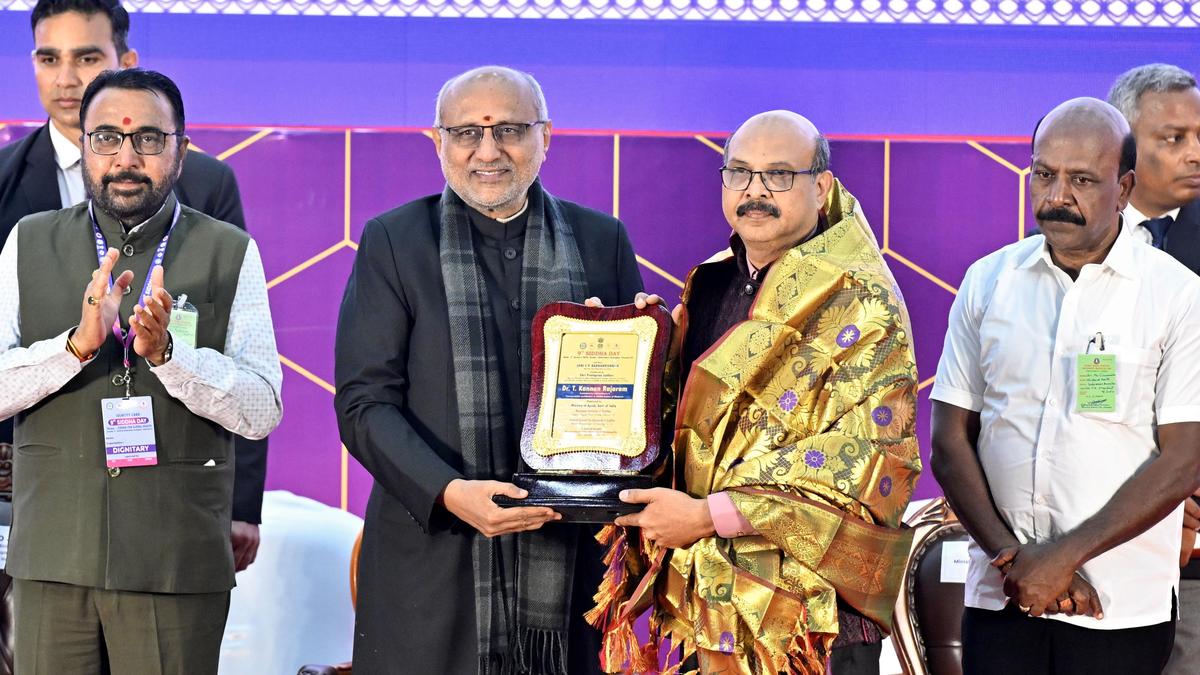
Students and scholars of Siddha were urged to embrace research that seeks lasting cures for chronic and incurable diseases at the 9th Siddha Day celebrations held at the National Institute of Siddha (NIS). The event, organised by the NIS under the Ministry of AYUSH in association with the Central Council for Research in Siddha (CCRS), brought senior government officials together to outline fresh support for the traditional system.
Siddha research India advances with official backing
Vice President C.P. Radhakrishnan told attendees that he has asked the Central government to boost research and provide financial help to scholars. He encouraged students to take up research as a lifetime ambition with the aim of finding permanent remedies for conditions that currently lack cures. The theme of the day was “Siddha for Global Health”, reflecting an ambition to extend the reach of Siddha beyond national borders.
Prataprao Jadhav, Minister of State with independent charge of AYUSH, Health and Family Welfare, urged that Siddha medicine become evidence-based, globally acknowledged and accessible. He made a direct appeal to the scientific community and policymakers to pursue rigorous clinical studies and regulatory standards that would allow Siddha treatments to be considered alongside other established medical approaches.

State Health Minister Ma. Subramanian outlined recent investments, saying the State government had allocated Rs. 239 crore over the last five years to develop Ayurveda, Yoga and Naturopathy, Unani, Siddha and Homeopathy. He added that an office building costing Rs. two crore is under construction to host a Siddha Medical University on the Arignar Anna Government Hospital of Indian Medicine campus, and a 25-acre site at Madhavaram Milk Colony has been identified for the institution. The relevant Bill has been sent repeatedly through formal channels to secure final approval.
G. Senthilvel, Director of the National Institute of Siddha, noted that the Siddha Central Research Institute, a unit of the CCRS, has operated for more than half a century from ageing premises at the Arignar Anna Hospital. He requested that the land, currently owned by the Tamil Nadu government, be transferred to the CCRS to enable construction of a modern research facility. The Vice President said he would press state ministers to support the transfer.
Speakers highlighted the CCRS initiative to collect and document rare Siddha manuscripts from across India. Officials described the preservation of these texts as a priority, both for cultural conservation and as a resource for contemporary research. Joint Secretary of AYUSH Monalisa Dash and other senior officials attended the ceremony.
Observers said the combined emphasis on funding, infrastructure and manuscript documentation signals a shift towards integrating traditional knowledge with scientific methods. By encouraging evidence-based studies and improved facilities, policymakers aim to raise the international profile of Siddha and bring its practices into global health conversations.
Students and researchers were urged to pursue collaborative projects, publish peer-reviewed findings and engage with regulatory bodies to demonstrate safety and efficacy. If those efforts succeed, Siddha research India could move from local practice to wider acceptance, offering complementary options for health systems and patients worldwide.
The event concluded with commitments from officials to pursue administrative steps and funding allocations that will support the proposed university and research infrastructure. The renewed focus on Siddha research comes at a time when policymakers are keen to diversify medical approaches and promote India’s traditional systems on a global stage.
Key Takeaways:
- Vice President urges students to prioritise Siddha research and seek cures for chronic diseases, signalling a push for Siddha research India.
- Central and state officials pledged funding and administrative support, including land and a new Siddha Medical University site.
- Officials called for documentation of manuscripts and evidence-based approaches to make Siddha globally accepted.