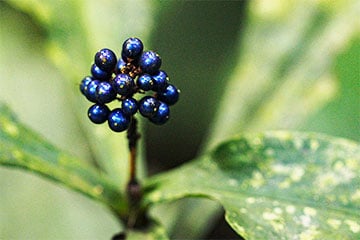
Scientists have explained why the fruit of Pollia condensata, commonly called the African marble berry, appears as a permanent metallic blue despite containing no blue pigment. Under the microscope researchers found not pigment but a highly ordered cellular structure that manipulates light.
African marble berry and its structural colour
The outer cell walls of the fruit’s skin are made from cellulose fibres wound into tight helices. Those layers stack with such precise spacing that they act as selective mirrors, reflecting light at specific wavelengths. Interference between reflected waves suppresses most colours and reinforces blue, producing an intense, metallic sheen.
What makes Pollia condensata remarkable is its efficiency. Tests show the fruit reflects about 30 percent of incident light, the highest recorded reflectance for any biological material. That places it above natural silvering produced by some animals and indicates how effective structural colour can be compared with chemical pigments.

Close inspection also reveals a pixelated effect across the fruit’s surface. Slight variations in layer thickness between adjacent cells produce tiny differences in reflected wavelength. The result is a pointillist mix of blue with occasional green or red highlights. Researchers say this optical fingerprint is unique among organic materials.
Evolutionarily the bright surface performs a clever trick. The fruit contains no nutritious flesh. It is hard, dry and flavourless, so the plant saves energy by not producing sugar-rich pulp. Instead of offering a food reward, Pollia condensata uses a visually irresistible signal to attract birds. Feathers and beaks pick up the glossy spheres, which in turn carry seeds away and promote dispersal.
Plant scientist Beverly Glover of the University of Cambridge notes that the berry manages to send a powerful, multi-coloured signal to nearby birds while conserving the plant’s photosynthetic resources. In effect the species has evolved a low-cost marketing strategy: it gains the benefits of animal dispersal without paying the metabolic price of producing edible fruit.
Beyond its ecological role, the berry’s structural colour has captured interest for materials science. The way cellulose layers produce durable, non-fading colour offers inspiration for sustainable colourants and optical materials that do not rely on chemical dyes. Such bioinspired approaches are of growing interest to researchers seeking low-impact alternatives to synthetic pigments.
For now Pollia condensata stands out as an example of nature’s engineering. Its vivid, never-fading blue is a product of geometry and microstructure rather than chemistry. The discovery underlines how much remains to be learned from biological systems and how those lessons can inform both ecological understanding and technological innovation.
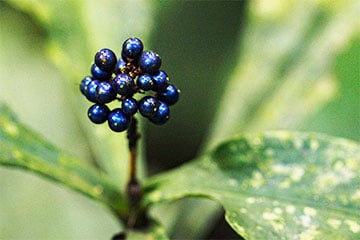
Key Takeaways:
- The African marble berry (Pollia condensata) generates intense blue through structural colour, not pigment.
- Twisted cellulose layers in the fruit reflect and amplify blue light, achieving exceptionally high reflectance.
- The berry uses visual deception to attract birds and disperse seeds despite having no nutritional reward.
- Researchers highlight the berry’s unique optical signature and evolutionary efficiency.