Key Takeaways:
- India’s rapid solar expansion has powered over 20% of the country’s generation but will produce large volumes of end‑of‑life panels.
- Solar waste in India could reach more than 12 million tonnes by 2047 without major recycling investment.
- Experts estimate the country needs about 300 recycling centres and $478m over 20 years to manage the backlog and recover valuable materials.
- Scaling formal recycling offers an economic opportunity and could prevent millions of tonnes of CO2‑equivalent emissions.

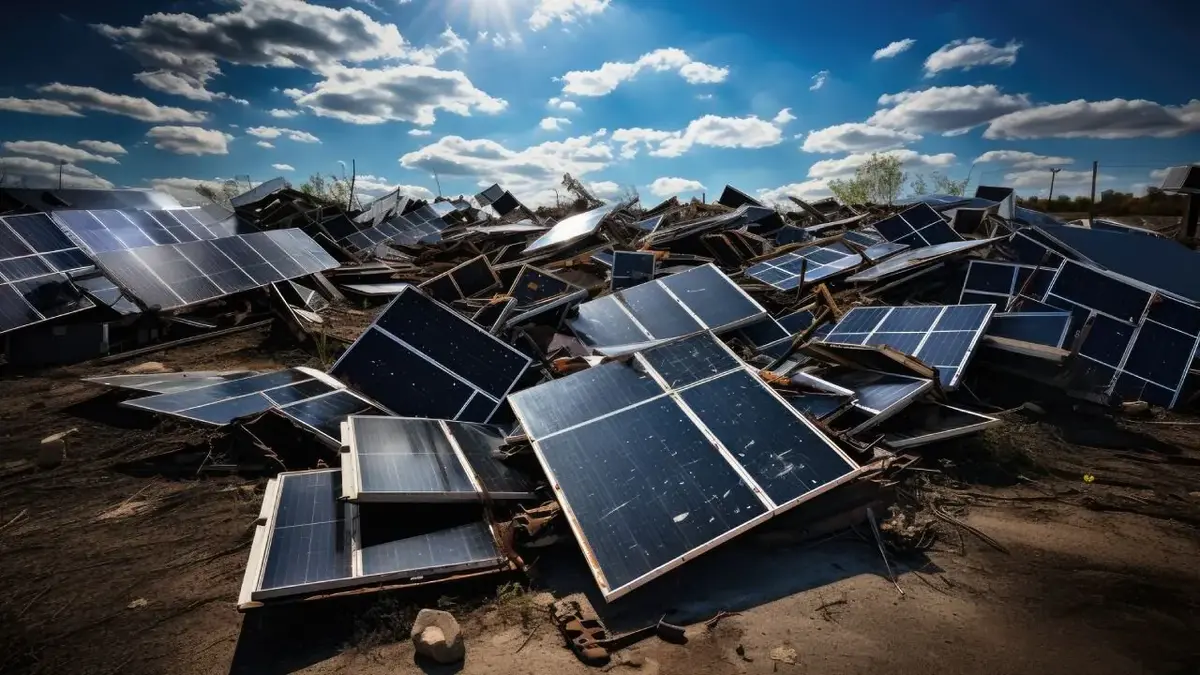
India has become one of the world’s fastest‑growing solar markets, yet its success carries a mounting environmental challenge. Government support and subsidies have helped more than 2.4 million households adopt rooftop panels and pushed solar to supply over 20% of the nation’s power capacity. At the same time, the country now faces a potential surge in photovoltaic panel waste that could exceed 12 million tonnes by 2047.
Solar waste in India demands urgent action
Current estimates put solar panel waste in 2023 at roughly 110,000 tonnes, rising to about 661,000 tonnes by 2030 and accelerating thereafter. These end‑of‑life modules contain valuable materials such as silver, copper and silicon, but if discarded or recycled informally they pose a risk to soil and groundwater and represent a loss of recoverable resources.
Industry analysts and environmental groups argue that managing this waste stream will require coordinated public policy, industry responsibility and substantial capital investment. A widely cited projection suggests India will need roughly 300 dedicated recycling centres and approximately $478 million in investment over 20 years to build a viable recycling infrastructure capable of processing the anticipated volumes.
Without formal facilities and modern recovery technologies, informal recycling presently conducted on a small scale results in the loss of precious metals and increases the chance of toxic byproducts entering the environment. Proper recycling can recover an estimated 38% of panel materials and help avoid some 37 million tonnes of carbon‑equivalent emissions, turning a looming environmental problem into a supply opportunity for new panels.
Setting up a formal recycling sector will require several parallel reforms. Extended producer responsibility (EPR) schemes that make manufacturers accountable for panels across their lifecycle would help underwrite collection and processing costs. Clear regulatory standards, technical guidance for dismantling and sorting, and incentives for private investment are also essential. Public‑private partnerships can accelerate technology transfer and scale.
Financial barriers remain significant. The capital cost for building and operating state‑of‑the‑art recycling plants is non‑trivial and will need to be balanced against the value of recovered materials and potential environmental benefits. Policymakers will have to consider blended finance models, including concessional loans and venture investment, to make projects bankable.
There is an economic upside if India moves swiftly. Advanced recycling can supply silver and silicon back into the domestic solar manufacturing chain, reducing dependency on imports and creating skilled jobs across the recycling value chain. Firms that invest early in efficient recovery processes may find new revenue streams and resilience against raw material price volatility.
Other large solar markets such as the US and China face similar trajectories, and international collaboration could accelerate best practice adoption. India can draw on foreign expertise in pyro‑ and hydro‑metallurgical recovery methods while tailoring solutions to local conditions, particularly for rooftop and distributed systems with diverse panel chemistries.
India’s solar transition has delivered clear benefits for energy security and air quality. Ensuring the sector remains sustainable requires closing the loop on panels at the end of their operational life. With targeted investment, regulatory clarity and industry cooperation, the country can convert a future environmental liability into an industrial and climate mitigation opportunity.