











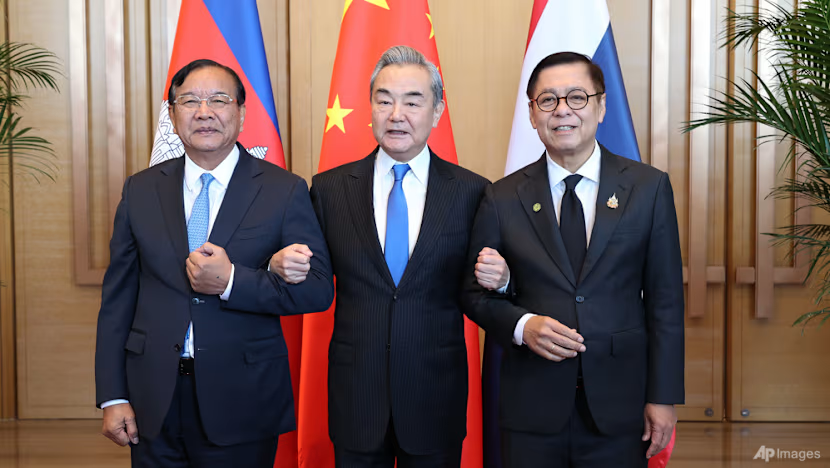
After weeks of intense fighting along their shared frontier, Cambodia and Thailand announced an immediate ceasefire at the end of December 2025 following diplomatic mediation led by China. The agreement suspends active hostilities, holds current military positions and calls for the release of detained Cambodian soldiers subject to a 72-hour observation period. Officials report only isolated, minor violations since the truce took effect.
China mediates Cambodia-Thailand ceasefire
China assumed a central role in negotiations, hosting trilateral talks in Yunnan and sending special envoy Deng Xijun to press both sides for a prompt settlement. Between 18 and 23 December, Deng met prime ministers, foreign ministers, defence ministers and senior military commanders from Phnom Penh and Bangkok, urging protection for civilians and an immediate halt to combat operations.
Foreign Minister Wang Yi also engaged in diplomatic efforts to consolidate the ceasefire, restore mutual confidence and encourage a return to normal bilateral relations. Chinese officials say Beijing facilitated direct communication between the two capitals and coordinated with the Association of Southeast Asian Nations (ASEAN) to provide multilateral oversight of the truce.

The diplomatic push included an offer of humanitarian support. Beijing dispatched supplies, medical aid and logistical assistance to help move and shelter displaced people. Chinese and ASEAN cooperation provided legitimacy to monitoring arrangements and helped guarantee protection for civilians while enabling humanitarian corridors.
Humanitarian impact and immediate needs
The conflict has produced one of the largest recent humanitarian emergencies in Southeast Asia. Combat, air strikes and heavy artillery along roughly an 800 km border displaced almost one million people. Cambodian authorities report more than 500,000 displaced, with 322,545 housed in temporary centres and many others sheltering with relatives or host communities. Thailand has evacuated around 430,000 people from high-risk zones, including thousands of children.
Humanitarian agencies and regional partners say the ceasefire opens a route for food, medical supplies and rebuilding materials to reach affected communities. Continued monitoring and access are expected to be critical as families assess damage and prepare for safe returns.
Regional stability and economic repercussions
Beyond the immediate human cost, the border clashes disrupted trade and investment across the region. Some frontier crossing points recorded drops in overland trade of more than 20 per cent during the worst periods, while companies deferred projects amid security concerns. Prices for basic goods rose in nearby areas, and small and medium enterprises felt acute supply chain strain.
Chinese mediation emphasised that stability between Cambodia and Thailand is essential for broader economic recovery and regional integration. Beijing framed its role as supporting multilateral channels and ASEAN-led mechanisms to ensure that the ceasefire becomes durable and that political dialogue resumes.
Outlook
The truce’s durability will depend on continued diplomatic engagement, robust monitoring and timely humanitarian access. China has pledged to remain engaged, providing political, logistical and aid support while encouraging both parties to pursue negotiations that address underlying disputes. ASEAN participation in observation and coordination bolstered the ceasefire’s credibility, but international humanitarian agencies caution that sustained attention will be needed to secure long‑term recovery and prevent a relapse into violence.
Historical tensions along the border, rooted in colonial-era demarcation and long-standing resource disputes, underline the need for a structured political process. For now, the ceasefire offers a fragile but necessary pause for relief efforts and a chance to rebuild trust between neighbours.
Key Takeaways:
- China mediates Cambodia-Thailand ceasefire, securing an immediate suspension of hostilities and a 72-hour observation period.
- Nearly one million people were affected; Chinese and regional aid aims to stabilise front-line communities and enable safe returns.
- ASEAN and Chinese diplomacy combined to monitor the truce and press for political talks to prevent renewed violence.








