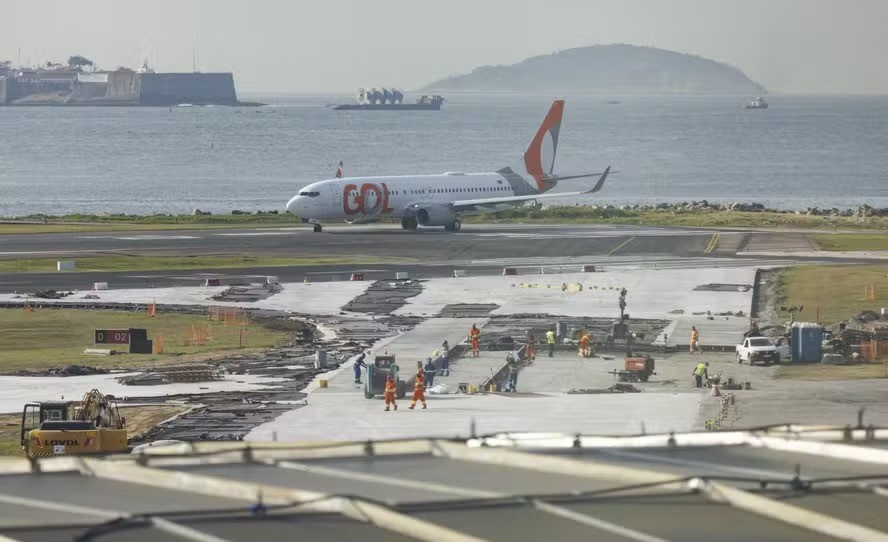
The mayor of Rio de Janeiro, Eduardo Paes, confirmed on Tuesday that no immediate increase in passenger capacity is planned at Santos Dumont Airport. The domestic terminal has operated under a cap on boardings since 2024, a measure introduced as part of a coordinated strategy with Rio’s international Galeão Airport to help restore international flows.
Santos Dumont passenger limit: federal talks set for January
Paes said the topic will be discussed with federal authorities during a meeting scheduled for the second week of January in Brasília. The consultation seeks to align municipal and federal priorities and determine whether adjustments to the passenger cap are warranted to balance local mobility and the recovery of international travel through Galeão.
The current restrictions were implemented to manage capacity across the two Rio airports and to stimulate the recovery of international services at Galeão, which had seen subdued operations in the aftermath of the pandemic and shifting airline networks. Under the arrangement, Santos Dumont’s flows were limited to concentrate larger, longer‑haul services at Galeão, while preserving convenient domestic links from the downtown terminal.

Officials say the approach aims to optimise the city’s airport system rather than permanently reduce access. However, the cap has prompted debate among local businesses, travellers and carriers that use Santos Dumont for short‑haul flights. Airlines argue that easing the limit could improve connectivity and commercial prospects for routes that feed tourism and business travel into the city centre.
For passengers, the limit has produced mixed effects. Some commuters welcome the predictability and reduced congestion at the downtown airport. Others contend that capacity constraints can push fares higher or force inconvenient connections at alternative hubs. The January meeting will give stakeholders a forum to present operational data, passenger demand trends and projections for the coming year.
Federal participation is central. Any significant modification to the Santos Dumont passenger limit requires national alignment, because broader airport policy, airspace coordination and slot allocation involve federal regulators and agencies. Paes’s outreach to Brasília indicates a desire to resolve the matter through intergovernmental negotiation rather than unilateral municipal decisions.
Local tourism bodies and business groups will be watching closely. Rio de Janeiro’s visitor economy depends on both international arrivals and efficient domestic connections. If federal and municipal authorities agree to recalibrate the limit, airlines may re-evaluate frequencies and aircraft types to match renewed demand. Conversely, maintaining the cap could continue to prioritise Galeão’s international recovery while keeping Santos Dumont focused on high-frequency domestic services.
Technical assessments likely to inform the January talks include runway and terminal capacity, noise and environmental considerations, surface access and public transport links to both airports, and the operational impact on air traffic control. Officials may also review seasonal demand patterns and planned infrastructure upgrades that could affect capacity over the medium term.
Paes’s announcement provides a timetable for clarification. The scheduled federal meeting in January should offer a clearer picture of whether the Santos Dumont passenger limit will be eased, sustained or adjusted in a phased manner. Until then, the current cap will remain in force as authorities compile data and weigh the trade‑offs between downtown convenience and international connectivity through Galeão.
Key Takeaways:
- Mayor Eduardo Paes says no immediate expansion of Santos Dumont capacity; current limits remain in place.
- Restrictions have operated since 2024 as part of coordination with Rio’s Galeão international airport.
- A federal meeting is scheduled for the second week of January in Brasília to review the Santos Dumont passenger limit.
- Any change could affect airlines, tourism and the pace of recovery at Rio’s international terminal.