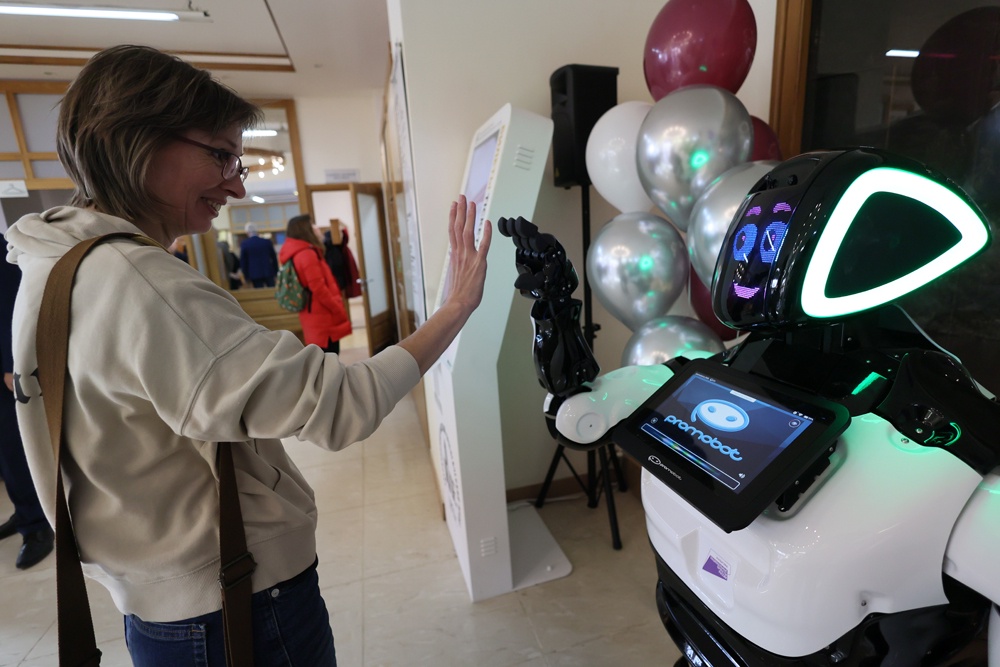
Employers and universities across Russia are treating basic artificial intelligence competencies as essential. Job applicants now commonly list familiarity with AI and machine learning on their CVs, while hiring managers increasingly include these skills among core requirements. The shift reflects employers’ interest in productivity gains and time savings that generative tools can deliver.
AI skills in Russia
Recruitment platform HeadHunter reports that more than 630 vacancies in the Sverdlovsk region this year explicitly mention neural network skills, a 68 per cent increase on the same period last year. Demand spans creative and technical roles. Designers and artists account for 14 per cent of related vacancies, social media and content managers for 9 per cent, and marketing professionals and debt-collection specialists for 7 per cent each. Sales and customer-service roles, copy editors, call-centre operators and developers also feature on employer lists.
Business leaders argue that simple digital fluency no longer suffices. Leonid Starikov, a winner of the Entrepreneur of the Year award in the IT business category, notes that where tasks once took many hours, AI tools can reduce the time to a fraction. He says designers who once spent a day on an image may now complete the initial work in about an hour using neural tools.

Universities are responding by revising curricula and permitting controlled AI use in coursework. At Ural Federal University, lecturers may use AI to create teaching materials, generate tests and check assignments. Students are allowed to use neural networks to draft an initial chapter of a thesis, provided they verify and refine the output. The university has emphasised that AI serves as an assistant rather than a replacement for scholarly work.
Several institutions have opened dedicated programmes. Yugra State University runs a master’s degree in mathematical robotics and artificial intelligence where students apply modern technologies in practice. The Ural State Mining University offers courses on prompt engineering for mining applications, machine vision and applied artificial intelligence to prepare future mining engineers for automated and remote operations at greater depths.
Educators stress that practical familiarity with generative models must be matched with critical thinking. Neural networks can produce incorrect or fabricated information known as hallucinations. Students are therefore taught to verify outputs and to cross-check facts. Additional courses on prompt engineering teach students how to craft and optimise text prompts for language models.
Data protection and digital hygiene are also central to instruction. Andrey Sozykin, director of the AI research and training centre at Ural Federal University, cautions that data submitted to foreign AI services may amount to cross-border transfer. Russian rules require localisation of personal data and notification to the communications regulator Roskomnadzor, with significant fines for non-compliance.
Legal education is adapting as well. The Ural State Law University now offers a course on artificial intelligence in the legal sphere, where students explore legal regulation of AI, data risks and compliance. Faculty teach students to use legaltech tools critically and to understand the new regulatory and ethical tasks that accompany AI adoption.
Industry and academic voices agree that AI is a tool that will multiply human productivity rather than replace professionals. Over the next decade, employers expect staff to direct, refine and control AI systems, applying sector knowledge and judgement to ensure reliable outcomes.
The trend signals a broader shift in Russia’s labour market and higher education towards digital competencies, with implications for workforce development, regulatory frameworks and the integration of AI across public and private sectors.
Key Takeaways:
- AI skills in Russia are increasingly listed on CVs and in job requirements, boosting employability across sectors.
- Sverdlovsk region saw over 630 vacancies mentioning neural network skills, a 68% year-on-year rise.
- Universities such as Ural Federal University and Yugra State University are embedding AI courses and practical training.
- Experts warn of AI hallucinations and data-security risks, urging critical thinking and compliance with Russian data localisation rules.