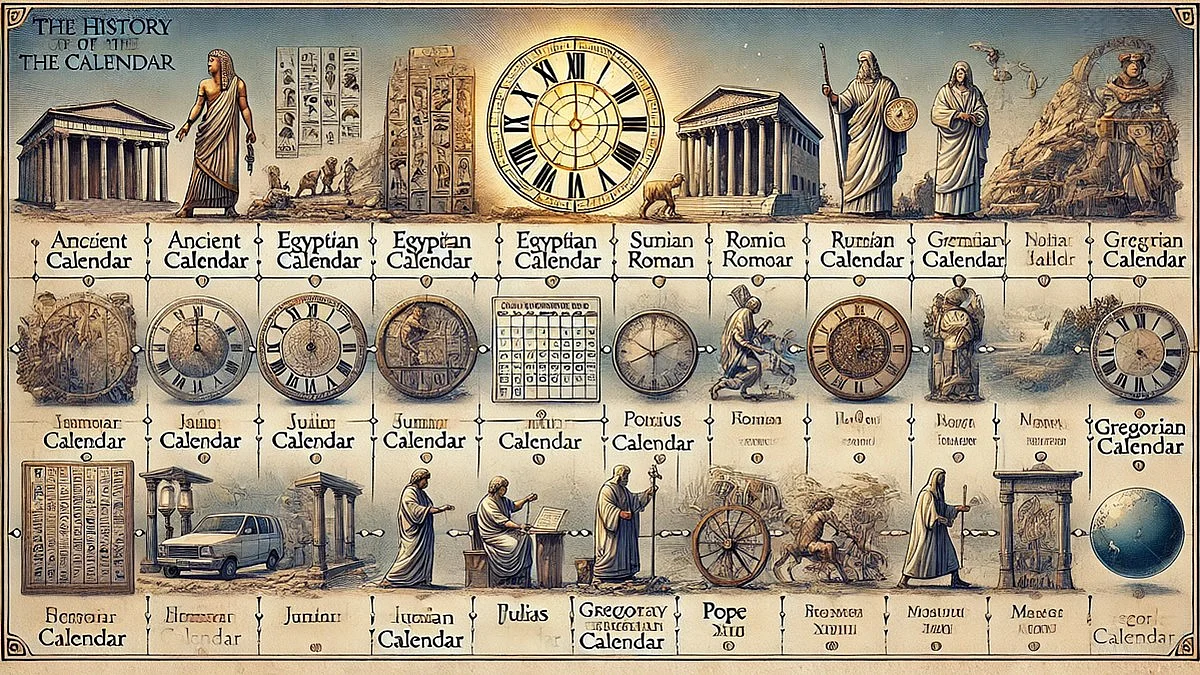
Most modern calendars mark January 1 as the start of the year, but that was not always the case. The current system — the Gregorian calendar — is a late adaptation of earlier Roman reforms and administrative needs, not a purely religious imposition. Understanding how January became New Year requires looking at both astronomical calculation and political choice.
Gregorian calendar history and its spread
The story begins with the Julian calendar, introduced by Julius Caesar in 46 BCE to regularise a messy set of local reckonings. Caesar based the year on the Sun, fixing it at 365 days with an extra day every fourth year. That rule reduced seasonal drift but left a small error that accumulated over centuries. In 1582 Pope Gregory XIII issued a reform to correct the discrepancy and align the calendar more closely with the solar year. The result became known as the Gregorian calendar.
Adoption was uneven. Catholic countries such as Italy, Spain and Portugal accepted Gregory’s changes quickly. Protestant England resisted until 1752, while Russia waited until 1918. Opposition in some quarters was as much cultural and political as doctrinal. English critics questioned why they should accept practices associated with Rome, and in many places older New Year dates persisted for centuries.

Month names carry the imprint of earlier Roman religion and politics. January honours Janus, the two-faced guardian of beginnings and transitions. March recalls Mars, the god of war; April and May link to fertility deities; July and August commemorate Julius Caesar and Augustus. Even the numerical names of September through December reflect an older Roman calendar that began in March.
But other civilisations fixed the new year according to seasonal and agricultural cycles. In India the traditional new year often falls with the month of Chaitra or tied to festivals such as Ugadi and Gudi Padwa, aligning ritual time with sowing and harvest. Babylonian, Chinese and Egyptian calendars similarly set the year to agricultural signals: the ripening of barley, the end of harsh winters, or the annual flood of the Nile.
The technical need for a standard civil calendar grew with expanding state administration, taxation and trade. A single, solar-based system simplified record keeping and fiscal planning. That practical logic helps explain why Gregorian dates now regulate international business and diplomacy. Yet cultural calendars remain powerful: communities continue to celebrate new year observances that follow lunar cycles, solar transitions or regional traditions.
Recognising the difference between a civil calendar and cultural timekeeping helps reconcile debates about modern celebrations. Using the Gregorian calendar for everyday administration does not erase the value of local New Year customs. Whether a community marks its new year in January, Chaitra, or at a seasonal threshold, the choice reflects history, culture and practical needs rather than a single religious blueprint.
In short, January 1 is a product of Roman reform and later papal adjustment that spread for administrative reasons. Ancient civilisations, including those in India, developed equally sophisticated calendars linked to nature and ritual. Appreciating both strands offers a clearer view of how societies measure time and keep tradition alive.
Key Takeaways:
- The article traces how January 1 became a global New Year, from Roman practices to Julius Caesar and Pope Gregory XIII, highlighting the role of the Gregorian calendar history.
- It explains how month names reflect Roman gods and rulers, and why some countries adopted January 1 only centuries later.
- Ancient civilisations including India, Babylon, China and Egypt set New Year by seasonal cycles, not a fixed January date.
- The piece argues that using the Gregorian calendar for practical purposes need not erase local New Year traditions.