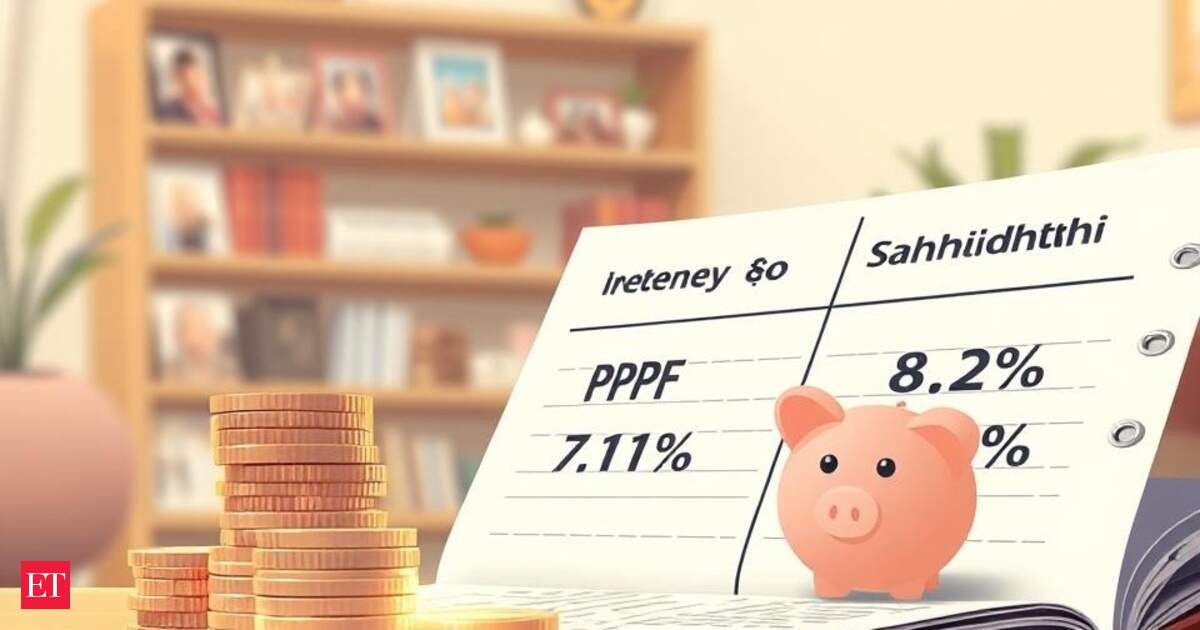
The federal government has retained interest rates on a dozen small savings schemes for the March quarter, keeping returns on the Public Provident Fund (PPF), Sukanya Samriddhi and several other instruments unchanged for the eighth successive quarter.
India small savings rates steady despite repo cuts
Deposits under the PPF will continue to earn 7.1% while the Sukanya Samriddhi account remains at 8.2% for the March quarter, according to a notification from the Department of Economic Affairs. The Senior Citizen Savings Scheme and several term deposit tenures have also been held at their current rates.
The decision comes even as the Reserve Bank of India’s Monetary Policy Committee has eased the policy stance over the past year, cutting the repo rate by a cumulative 125 basis points to 5.25%. The RBI reduced the repo rate by 25 basis points in February and April, 50 basis points in June and another 25 basis points in December.

Small savings rate decisions are typically set with reference to the expected yields on government securities of comparable tenures. Those yields have moderated in recent quarters, which, together with other fiscal considerations, has allowed the Centre to keep retail-oriented savings rates unchanged without widening the spread over market rates.
Rates that will remain unchanged for the March quarter include the Senior Citizen Savings Scheme at 8.2%, National Savings Certificate at 7.7% and Kisan Vikas Patra offering 7.5% for maturity in 115 months. Savings accounts will stay at 4%, while one-year deposits will continue at 6.9%, two-year at 7.0%, three-year at 7.1% and five-year deposits at 7.5%. The five-year recurring deposit rate is held at 6.7% and the monthly income account at 7.4%.
The Centre uses collections from small savings schemes to part-finance its fiscal deficit via the National Small Savings Fund. For FY26, the government aims to withdraw Rs 3.43 lakh crore from the fund, down from a revised estimate of Rs 4.12 lakh crore for the previous year. This reduction in planned drawdown aligns with the broader objective of lowering the fiscal deficit to 4.4% of gross domestic product in FY26 from 4.8% a year earlier.
Analysts say keeping small savings rates steady can help the government manage borrowing costs while still offering relatively attractive, government-backed avenues for household savings. It also provides predictable returns for savers reliant on these instruments for long-term goals such as retirement planning and child education.
However, observers note that real returns will depend on inflation trends. If consumer price inflation remains elevated, the effective purchasing-power gain from fixed-income savings could be constrained. The government and monetary authorities will therefore monitor inflation, market yields and fiscal targets as they set future rates.
For savers, the decision offers clarity for the near term. Those seeking tax-efficient options can continue to use PPF for long-term savings and the Sukanya Samriddhi account for girl-child education and welfare. For policymakers, the steady rates represent a balance between supporting household returns and managing public finances as government borrowing needs are recalibrated for the coming year.
Key Takeaways:
- India small savings rates remain unchanged for the March quarter, marking the eighth consecutive quarter without a change.
- Key schemes such as PPF (7.1%) and Sukanya Samriddhi (8.2%) retain current interest rates despite central bank repo rate cuts.
- The decision reflects yields on comparable government securities and supports the Centre’s plan to lower borrowing from the National Small Savings Fund in FY26.