











Key Takeaways:
- Researchers in eastern China discovered two large fossil eggs whose cavities were entirely infilled by calcite crystals rather than embryonic remains, offering a rare look at fossilisation processes.
- The eggs were assigned to a new oospecies, Shixingoolithus qianshanensis, within the Stalicoolithidae family, notable for thick, spherical shells.
- Shell structure and size point to ornithopod parents, while nearby finds in Jiangxi preserve hadrosauroid embryos, showing contrasting preservation pathways.
- The discoveries shed light on reproductive biology, burial environments and mineralisation in Cretaceous ecosystems of China.

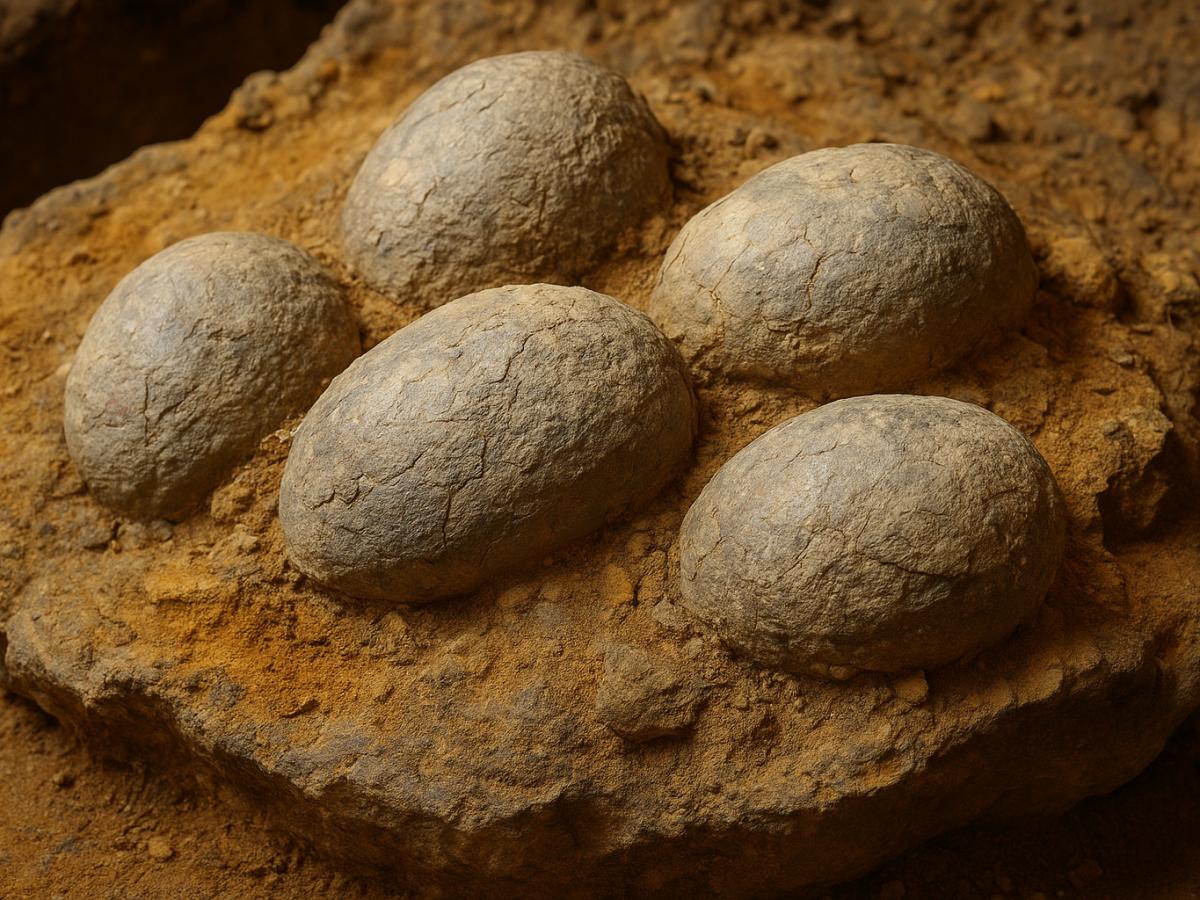
Scientists working in eastern China have uncovered two almost perfectly round fossil eggs about 13 centimetres across that challenge expectations about what might remain inside dinosaur eggs. Rather than embryonic bones, one egg was found to be largely filled with pale calcite crystals, a mineral replacement that formed over millions of years. The find opens a fresh window on how burial conditions and groundwater chemistry transform biological material into stone.
What the Chinese dinosaur eggs reveal
The specimens were recovered from the Qianshan basin and examined by a team led by palaeontologist Qing He of Anhui University and the Nanjing Institute of Geology and Palaeontology. When part of the shell had broken away it exposed a cavity completely lined and packed with light-coloured calcite. Researchers interpret this as the product of mineral-rich groundwater percolating into the empty chamber after organic tissues had decayed, with dissolved calcium carbonate precipitating as crystals over long periods.
Microscopic analysis of the eggshell helped the team place the specimens in the oofamily Stalicoolithidae, a group of thick-walled spherical eggs commonly found in clutches. The eggs were named Shixingoolithus qianshanensis. Their relatively large diameter and the dense network of microcolumns in the shell set them apart from previously described oospecies.
Although the calcite replacement erased embryonic remains in these particular eggs, the shell morphology provides clues to the likely parent. The form, size and microstructure match those associated with ornithopods, the herbivorous bipedal dinosaurs often characterised by broad snouts. Ornithopods were widespread from the Late Jurassic to the end of the Cretaceous and could reach lengths of six to nine metres. The new specimens extend knowledge of how these animals reproduced in southern China.
This discovery contrasts with recent work in Jiangxi province, where construction exposed eggs that still contain exquisitely preserved hadrosauroid embryos. Two such embryos retain tiny skulls, spines and folded limbs, offering snapshots of the earliest stages of development and behaviour. Taken together, these finds demonstrate two very different fossilisation pathways. In one case organic material survived and remained intact. In the other, organic remains were removed and replaced by minerals, preserving the shape of the chamber but not the tissues within.
Preservation in regions of China has benefitted from particular geological circumstances. Frequent volcanic ashfalls during the Early Cretaceous buried ecosystems rapidly and limited oxygen exposure, slowing decay and favouring the exceptional retention of soft tissues in some deposits. Elsewhere, variations in groundwater chemistry and sediment permeability promoted mineral infill and recrystallisation.
Researchers say both outcomes are valuable. Eggs preserving embryos yield direct evidence of development, posture and growth. Mineralised eggs such as the Qianshan specimens document post-burial processes, sedimentary environment and diagenetic chemistry. Together these records refine reconstructions of reproductive strategies across different dinosaur groups and palaeoenvironments.
For now, the calcitised eggs are a reminder that fossils do not always retain the biological detail scientists hope to find, but they can reveal otherwise invisible aspects of the ancient world. The team behind the study plans further fieldwork and laboratory analysis to map the distribution of similar eggs and to better understand the interplay between burial conditions and fossil preservation in China’s rich Cretaceous basins.








