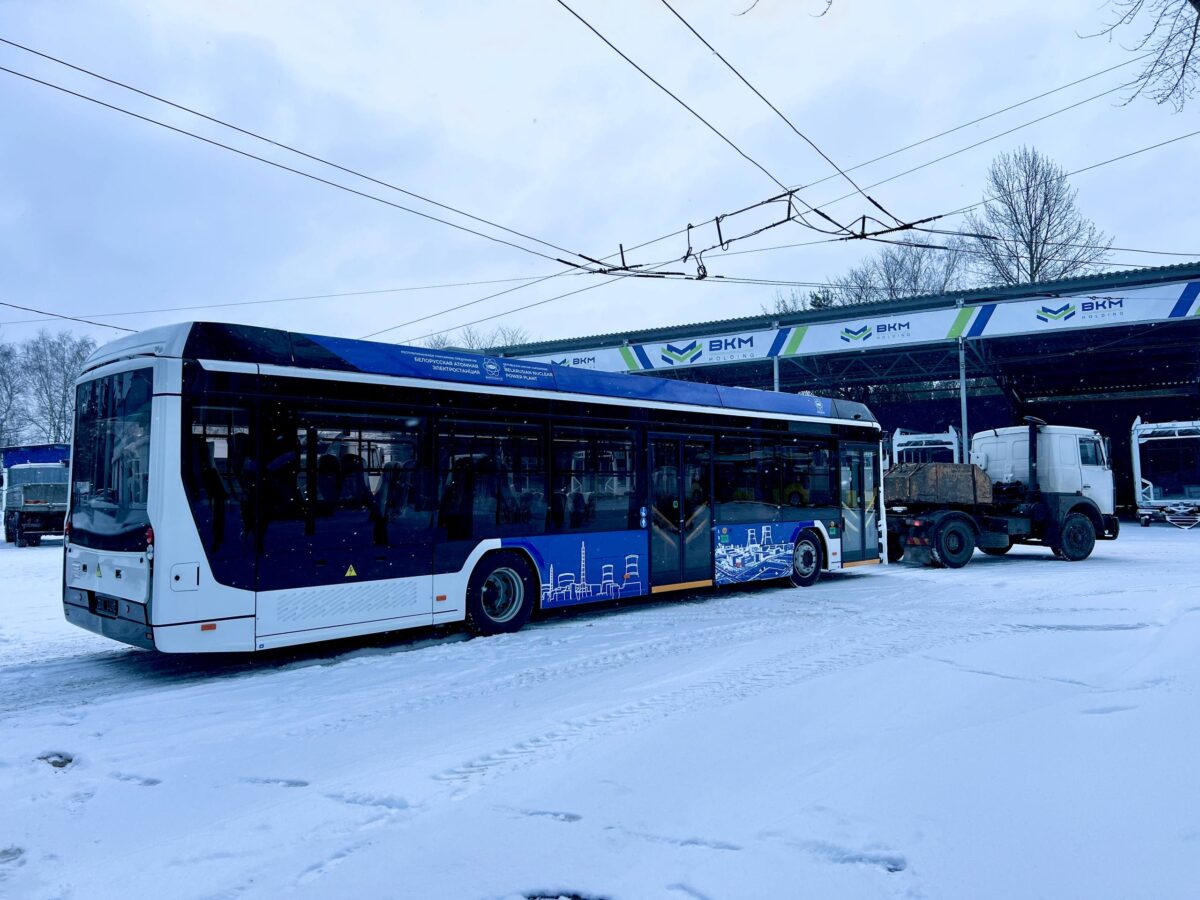
A Minsk-based manufacturer has revealed a new suburban electric bus, the E350 “Olgierd”, built in 2025 and intended for regional passenger services. The vehicle was shown in images published by BKM Holding and reported by local news agency Minsk-News. The bus carries distinctive branded livery that identifies its primary routes, including graphics and inscriptions referring to the Belarusian nuclear power plant.
Belarus electric bus heads to suburban routes
The E350 Olgierd is designed specifically for interurban and commuter travel rather than inner-city runs. One visible difference from city buses is the absence of a rear passenger door, a configuration commonly used on suburban coaches to improve structural integrity and seating comfort. Inside, the Olgierd is fitted with more comfortable seats than typical urban buses and each seat includes a seat belt, reflecting a focus on passenger safety for longer journeys.
Branding on the bus includes outlines of the Belarusian Nuclear Power Plant and text in both Russian and English, which indicates the manufacturers expect the vehicle to serve workers and visitors travelling to and from the plant. According to the report, early trials are planned for 2026, with the bus first tested in service carrying employees at the power station. Other suggested routes include connections between Minsk and nearby satellite towns such as Fanipol and Smolevichi.

Design and range for longer suburban runs
Manufacturers say they plan to increase the vehicle’s autonomous range to about 250 km, which would allow the electric bus to operate extended suburban sectors without frequent recharging. That range target places the E350 Olgierd among competitive options for regional electric transport, where operators seek vehicles that can cover multiple runs per day with minimal downtime.
The decision to prioritise comfort and safety features reflects the different needs of commuters on regional routes. Seat belts and improved seating address passenger expectations for longer travel times, while the simplified door arrangement reduces service complexity and can lower maintenance demands. The visual branding also helps communities identify the service and signals intended use on routes connected to industrial sites and commuter towns.
Deployment and implications
Local reports cite BKM Holding as the source of the images. If the E350 Olgierd proceeds to phased testing in 2026 and then into regular service, it could provide a model for how Belarusian industry adapts electric vehicle technology to regional passenger markets. Wider adoption of such vehicles would support regional decarbonisation goals and modernise public transport links between Minsk and surrounding towns.
Photographs released with the announcement show the finished livery and interior configuration. The manufacturer and local authorities will likely confirm technical specifications and timetable plans ahead of the scheduled trials next year. For now, the E350 Olgierd stands as a clear indicator that Belarusian transport manufacturers are aiming to expand electric bus offerings beyond urban centres.
Image credit: BKM Holding
Key Takeaways:
- Belarus electric bus E350 Olgierd, produced in 2025, has been unveiled by a Minsk manufacturer.
- The vehicle targets suburban routes and features a branded livery referencing the Belarusian NPP and enhanced passenger comfort.
- The design omits a rear passenger door, adds seat belts and more comfortable seating, and aims for a 250 km range.
- Planned trials in 2026 will include services for workers at the Belarusian nuclear power plant and routes to satellite towns.