











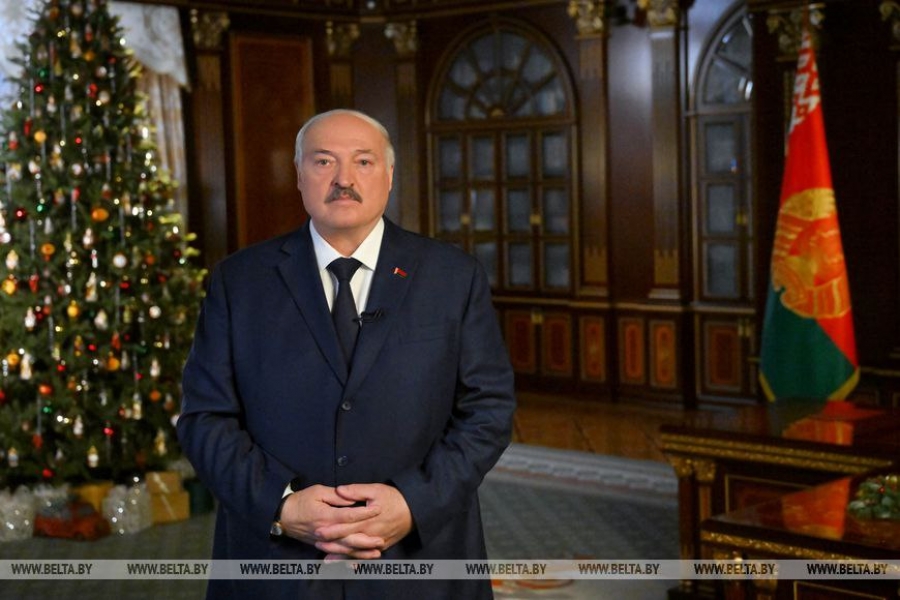
State media footage released ahead of Belarus’s New Year address showed President Alexander Lukashenka contacting Defence Minister Viktor Khrenin by government line moments before entering the studio to record his speech. The brief, staged-looking exchange underlined the regime’s focus on security and its desire to project control as the country begins 2026.
Lukashenka New Year address
In the clip, Lukashenka asks Khrenin how things stand and specifically refers to “adversaries, rivals and, God forbid, enemies,” noting that while some people celebrate, those in uniform must remain alert. He passed on greetings to service personnel before moving on to record his address — a speech that largely echoed familiar themes from previous years.
The recorded message emphasised stability, national unity and gratitude. Lukashenka thanked the “enormous Belarusian family,” praising workers for a reportedly record harvest and recognising security forces as the guarantors of national peace. He framed these achievements as products of collective effort and an enduring habit of mutual support he described with the Belarusian term talaka.

Reflecting on what he called a difficult international environment, the president said Belarus had been pressured to adopt “foreign laws” and endure economic and political storms. He contrasted that pressure with what he presented as Belarusian resilience and a preference for creation over destruction, unity over provocation, and dialogue over shouting.
Addressing citizens directly, Lukashenka urged people to consider a single, practical pledge for the year ahead. “Before you raise your glasses, I ask you, wherever you are — in Braslav or Loev, in Khatynsk or Malaryta — think: ‘What will I do in the new year for my Belarus?’ Make just one promise and, believe me, the country will change,” he said.
The president devoted a section of the address to praising women, saying that without love for women and girls there can be no true love. He then proposed that 2026 be declared the Year of the Belarusian Woman, calling for recognition of women’s special role in society.
Analysts say the sequence — a visible call to the defence minister followed by a patriotic speech — is consistent with a broader pattern of carefully staged messaging from Minsk. The footage emphasises loyalty and preparedness within the military while underscoring the regime’s narrative of national cohesion in the face of external pressure.
Internationally, the address offers little by way of new policy signals. It reinforces existing themes: the centrality of state institutions, the value of social solidarity, and the mobilisation of patriotic sentiment. Domestically, the appeal to collective responsibility and the symbolic Year of the Belarusian Woman aim to shape public sentiment for the months ahead.
As Belarus navigates its foreign relations and internal dynamics, such public displays serve multiple purposes: reassuring supporters, signalling resolve to opponents, and reminding the population of official priorities. The presidency’s decision to highlight agriculture, security and family values frames the new year in terms that resonate with core constituencies.
For now, the recorded address and the surrounding imagery add to a steady stream of state messaging intended to present continuity and control as Belarus enters 2026. Observers will watch whether the declared priorities translate into concrete measures over the coming year.
Key Takeaways:
- State media showed President Alexander Lukashenka making a government call to Defence Minister Viktor Khrenin ahead of his pre-recorded speech.
- The short exchange emphasised vigilance, greetings to service personnel and the need to monitor “adversaries, rivals and enemies” during the holiday period, reflecting security concerns.
- In his address Lukashenka praised unity, hailed a record harvest and announced 2026 as the Year of the Belarusian Woman.








