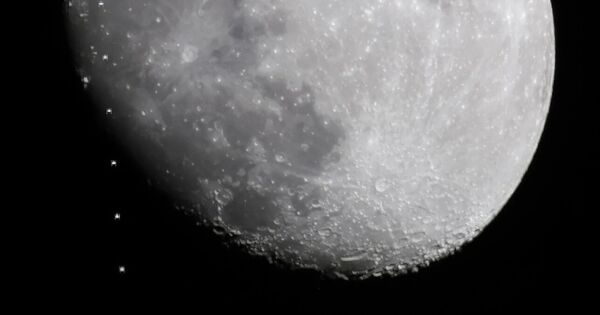
A stacked composite photograph taken over Beijing on 31 December 2025 captured the Chinese space station moving across the face of the Moon, offering a rare and dramatic view of the country’s orbital infrastructure. The image, released on 1 January by Xinhua and credited to photographer Wang Zicheng, quickly circulated across social and traditional media, drawing attention to China’s expanding presence in low Earth orbit.
China space station seen transiting the Moon
The composite image shows the space station silhouetted against the lunar disk, recorded as it passed between observers on the ground and the Moon. While such transits are a predictable aspect of orbital mechanics, the photograph is notable for its clarity and timing. Images like this highlight both the station’s regular operations and the way public interest in space activity can be heightened by a single compelling frame.
China’s modular space station has been the focus of sustained investment and frequent missions in recent years. Built to support research across multiple scientific disciplines and to host crewed missions, the facility has also become a symbol of national scientific achievement. The transit photograph serves as a reminder of the station’s visibility and its role in China’s wider space ambitions, which include robotic lunar exploration and enhancements to orbital infrastructure.

Photographs of fast-moving orbital objects require careful planning. Ground-based observers must account for the station’s speed, the Moon’s position, local atmospheric conditions, and the precise timing of the pass. The resulting stacked composite combines several exposures to produce a single image that clearly depicts the craft’s path. The technique is commonly used by amateur and professional astrophotographers to document satellites and human-made objects in orbit.
Beyond its technical merits, the image also has soft-power implications. Visual evidence of a functioning national space station contributes to public perception of technological competence and can bolster international prestige. It may also stimulate interest in science and engineering careers among younger audiences and provide a platform for educational outreach about orbital operations and space science.
Experts note that while a single photograph does not convey operational detail, it does serve as a public-facing piece of evidence that orbital activities are ongoing. The image complements routine official updates about crewed rotations, cargo deliveries and scientific experiments conducted on board.
The timing of the photo—captured on the final day of 2025 and released on New Year’s Day—gave it symbolic resonance. It offered the public an evocative visual to mark the turn of the year and to reflect on developments in China’s space programme. As the nation continues to pursue lunar probes, satellite deployments and station operations, images such as this provide a tangible connection between orbital work and people on the ground.
Photographer credit was given to Wang Zicheng of Xinhua. The image joins a growing archive of high-profile photographs that document human activity beyond the Earth and the increasing accessibility of orbital observation to both professional and amateur communities.
Key Takeaways:
- A composite image taken in Beijing on 31 December 2025 shows the China space station transiting the Moon.
- The photograph underlines China’s growing capabilities in human spaceflight and orbital operations.
- The image generated wide public interest and reflects China’s investment in space science and technology.