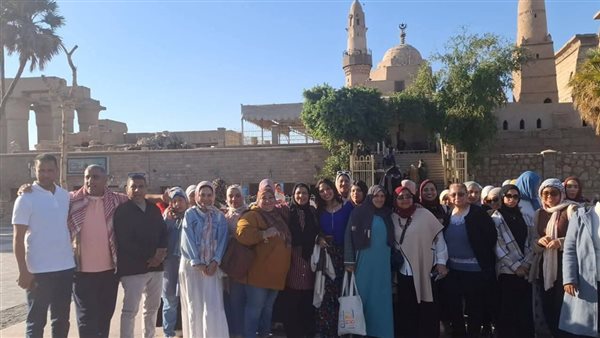
Delegates from border governorates visited Luxor’s historic religious sites on Tuesday as part of the 23rd Cultural Forum for Border Girls and Women, run under the Ahl Misr cultural project and overseen by Egypt’s Ministry of Culture.
Ahl Misr cultural festival visits Luxor’s key sites
The day’s programme began with a guided visit to the Cathedral of the Virgin Mary, opened in 1909 and recognised as a prominent Coptic landmark in Upper Egypt. Father Armanious Farid, the cathedral’s priest, outlined the church’s three principal sanctuaries and pointed to the notable religious icons on display, including an image of Christ at the Last Supper. Visitors were shown the central sanctuary dedicated to the Virgin Mary, the sanctuary of Archangel Michael and the martyr Abu Shafiq, and the western sanctuary named for Saint Bishoy and Saint Menas. The group also toured the nearby Monastery of Saint Mark, which houses the saint’s shrine and functions as an important site of pilgrimage for the Coptic community.
The delegation then moved to the Abu al‑Hajjaj al‑Aqsari Mosque, where Sheikh al‑Hajjaj Mohammed Ahmed, the mosque’s prayer leader, described its significance as a major Sufi centre. He emphasised the mosque’s long historical and spiritual heritage and noted the striking proximity of the mosque to the ancient Luxor Temple, a juxtaposition that illustrates Luxor’s layered civilisational and religious history.

The visit forms part of a broader strand of activity that will continue through 4 January in Luxor. The forum is organised by the General Authority for Cultural Palaces under the supervision of the Ministry of Culture and is held under the patronage of Dr Ahmed Fouad Henu, Minister of Culture, with Major General Khaled El‑Laban presiding over the authority responsible for the event.
Dr Hanan Moussa, head of the Central Administration for Studies and Research and chair of the forum’s executive committee, oversees the academic and logistical framework, while the programme is implemented through the Directorate of Women’s Culture in cooperation with the South Upper Egypt Cultural Region, managed by Mahmoud Abdelwahab, and the Luxor culture branch under Hussein Al‑Noubi.
Some 110 girls from a range of border and coastal governorates attended, including New Valley, North Sinai, South Sinai, the Red Sea governorate’s Shalatin, Halayeb and Abu Ramad districts, Matrouh and Aswan, together with participants from Cairo and Luxor. The forum combines field visits with arts and crafts workshops, literary sessions, awareness meetings and psychological support circles designed to build resilience and cultural literacy among young women from frontier communities.
Dr Dina Howeidy, Director General of the Directorate of Women’s Culture and executive director of the Ahl Misr project for women, joined the group for the visits and photographed the delegation as they marked the day with a commemorative group image.
Launched as part of the presidential programme to strengthen national awareness, the Ahl Misr project targets children, youth and women in border governorates. Its objectives include promoting cultural inclusion, supporting talented young people and reinforcing a sense of belonging among communities that lie on Egypt’s frontiers. The initiative pairs on‑site heritage exposure with capacity‑building activities, aiming to create sustained cultural engagement in regions that are often underserved.
Organisers said the forum’s mix of heritage encounters and practical workshops is intended to broaden participants’ horizons, encourage cross‑community understanding and provide tools for cultural participation when they return to their home governorates.
Key Takeaways:
- The Ahl Misr cultural festival brought 110 young women to Luxor to visit key religious and historic sites.
- Participants toured the 1909 Cathedral of the Virgin Mary and the Sufi‑linked Abu al‑Hajjaj al‑Aqsari Mosque, highlighting Egypt’s interfaith heritage.
- The programme forms part of the Ahl Misr initiative to strengthen national awareness and cultural inclusion in border governorates.
- Workshops, psychological support and cultural activities accompany field visits to empower border communities.