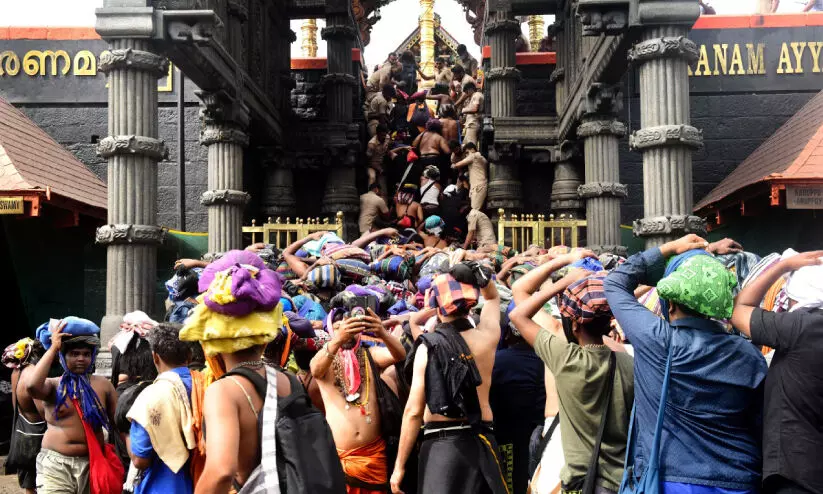
The Kerala State Child Rights Commission will visit Sabarimala on Thursday morning to assess the difficulties faced by child pilgrims arriving at the shrine during the Makara Vilakku season. The delegation, led by chairman K. V. Manojkumar and members B. Mohankumar and K. K. Shaju, will hold an official inspection at the sanctum to examine queuing arrangements, crowd congestion and other practical hardships affecting children.
Sabarimala child pilgrims: Key concerns
Commission officials said their primary concern is that children who accompany adults for darshan are often forced to wait for hours in overcrowded queues, which are not set up with their needs in mind. While a significant proportion of devotees arrive with children, the existing queue system is not child‑friendly: separate lines are impractical because of their length, and segregated arrangements have provided limited benefit in the past.
During the visit the commission will consult temple administrators, duty officers and local authorities to identify feasible short‑term improvements and longer‑term measures. Potential recommendations may include priority windows for families with young children, shaded waiting areas, water and medical aid points, staggered entry timing and clearer signage to reduce confusion and crowding.

Temple sources confirmed that neyyabhishekam, a principal offering to Lord Ayyappa, is being performed in the early hours. Neyyabhishekam is scheduled from 03:30 to 07:00 and again from 08:00 to 11:00. The ritual is a major draw for devotees who receive the sanctified oil as prasadam following the ceremony. The commission’s visit coincides with this active festival period, when visitor numbers swell and logistical pressures rise.
Officials also pointed to the recent kalabhabishekam, the first held after the shrine reopened following Makara Vilakku. Performed before the noon puja, the ceremony saw traditional rites led by the chief priest and accompaniment by temple functionaries and administrative officers.
Separate but related concerns centre on the Tiruvabharana procession route, which spans roughly 83 kilometres from Pandalam to Sannidhanam. The route includes about 43 kilometres of populated areas and 40 kilometres of forest. Encroachment, erosion and poor road surfaces have narrowed parts of the traditional path, which historically ranged from five to 42 metres in width. Local bodies and public works departments retain responsibility for maintaining the stretches that pass through village and municipal areas.
With the procession days approaching, activists and devotees have urged urgent remedial work to restore the path to a safe and passable condition. Court intervention and prior clearance efforts have addressed some encroachments, but officials acknowledge that full remediation remains incomplete. Thousands of devotees traditionally walk the Tiruvabharana route to reach the shrine, and organisers say timely repair work is essential to protect pilgrims and maintain the procession’s continuity.
The Child Rights Commission’s inspection is expected to produce practical recommendations tailored to the festival context. Authorities and temple managers will need to balance ritual schedules with enhanced crowd management and child welfare measures to ensure that families and young devotees can participate safely during one of the region’s busiest pilgrimage periods.
Key Takeaways:
- India’s Child Rights Commission will inspect Sabarimala to assess difficulties faced by child pilgrims during Makara Vilakku season.
- Commission aims to review queuing arrangements, crowd management and child-specific facilities to reduce waiting-time hardships.
- Temple rituals continue, with neyyabhishekam schedules and the first kalabhabishekam after reopening noted.
- Authorities urged to repair and clear the 83 km Tiruvabharana procession route ahead of the ceremony to ensure safe passage for devotees.