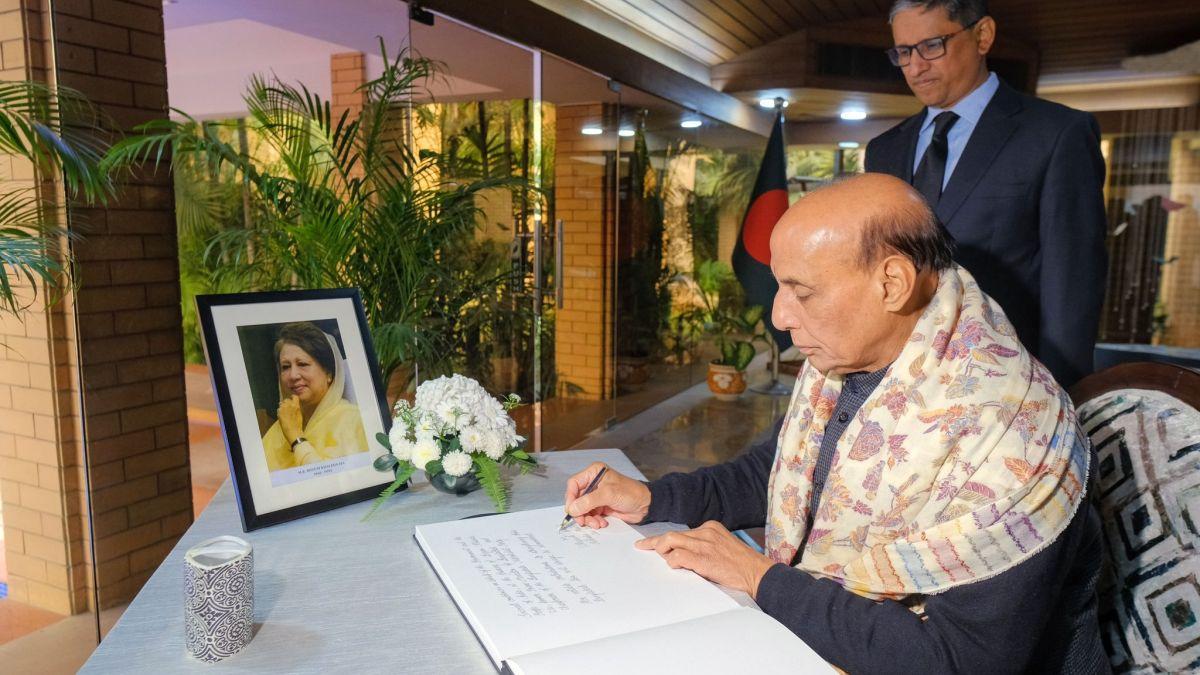
Defence Minister Rajnath Singh on Thursday visited the Bangladesh High Commission in New Delhi and signed the official condolence book following the death of former Bangladesh prime minister Khaleda Zia. Singh posted a photograph of the visit on X, noting he had expressed “profound sorrow” at the passing of the BNP chairperson and extended his thoughts to her family and the people of Bangladesh.
Zia, who served as Bangladesh’s first woman prime minister and was a long-standing leader of the Bangladesh Nationalist Party, died in Dhaka early on Tuesday at the age of 80 after a prolonged illness. Her death marks the end of a significant chapter in Bangladeshi politics, where she was a dominant figure for several decades.
India Bangladesh relations and diplomatic courtesy
The visit by Mr Singh, a senior minister in Prime Minister Narendra Modi’s cabinet, is a customary expression of condolence that serves both a personal and diplomatic purpose. Signing the condolence book at an embassy or high commission is a conventional way for visiting leaders to communicate sympathy and maintain cordial interstate ties. In this instance, the gesture underlines continuing cooperation and respectful engagement between India and Bangladesh.

Official condolences from India come amid a period of mourning in Bangladesh, where political parties and public figures have reflected on Zia’s legacy. While her political career was marked by both staunch support and controversy, her role as a former prime minister renders her passing of national significance. Indian leaders’ public expressions of sympathy are likely intended to reassure Dhaka of steady bilateral relations even as Bangladesh processes this transition.
Context and implications for bilateral ties
India and Bangladesh share deep historical, economic and cultural links, and high-level condolences are a standard diplomatic response to an event of this nature. Although a condolence visit does not in itself signal policy shifts, it helps sustain the channels of communication and goodwill necessary for cooperation on issues ranging from trade and connectivity to security and development projects.
Diplomatic courtesies such as signing condolence books also provide an opportunity for officials to reiterate commitments to existing bilateral initiatives. In recent years the two countries have worked on cross-border connectivity, energy cooperation and coordination on regional security. Public expressions of sympathy help preserve an atmosphere in which such practical collaboration can continue.
Khaleda Zia’s legacy and regional reaction
Khaleda Zia led Bangladesh through several key moments in its post-independence history and remained a central figure in domestic politics long after her terms in office. Reaction within Bangladesh has been mixed, reflecting the country’s polarised political landscape, but international messages of condolence, including Singh’s visit, are intended to focus on respect for the office she once held and on solidarity with the nation.
For India, the move is consistent with diplomatic norms and an effort to sustain stable ties with a close neighbour. As Bangladesh mourns, such visits underline the pragmatic diplomacy that tends to characterise relations between the two countries.
Key Takeaways:
- Defence Minister Rajnath Singh visited the Bangladesh High Commission in New Delhi to sign the condolence book following the death of former prime minister Khaleda Zia.
- The gesture reflects ongoing diplomatic engagement and respect between India and Bangladesh, reinforcing India Bangladesh relations.
- Khaleda Zia, former BNP chairperson and Bangladesh’s first woman prime minister, died aged 80 after a prolonged illness.
- India’s message conveyed solidarity with Zia’s family and the people of Bangladesh during a period of national mourning.