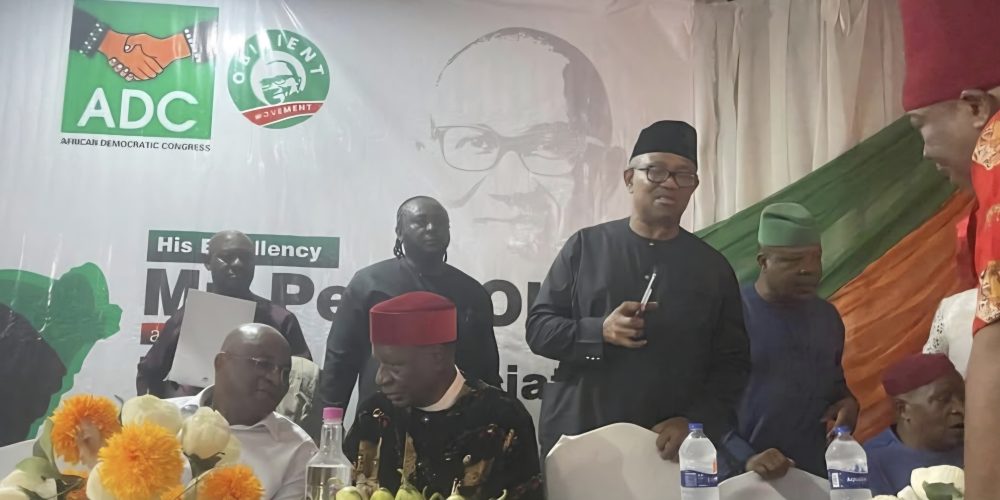
Peter Obi, the Labour Party’s presidential candidate in 2023, has officially defected to the African Democratic Congress (ADC), announcing the move in Enugu on Wednesday, 31 December. The former Anambra governor said his decision was driven by a desire to “transform and rescue Nigeria” ahead of the 2027 election.
Obi addressed supporters and party figures at the Enugu event, saying that the end of the year marked the beginning of a renewed effort to secure credible elections and a change in the country’s direction. “We are ending this year with the hope that in 2026 we will begin a rescue journey,” he declared, and vowed to resist electoral malpractice “by every lawful means in 2027.”
Peter Obi joins ADC and the path to 2027
The public nature of the defection, attended by prominent political figures, underlines its strategic intent. Former Senate President and ADC National Chairman David Mark was present, as were former Sokoto State Governor Aminu Tambuwal and several former governors from the South-East. Their attendance signals an effort to broaden the opposition’s reach across regional lines.

Obi called on opposition leaders to unite “as a family” under the leadership of David Mark, framing the move as part of a coalition-building effort rather than an individual manoeuvre. The event also drew former Deputy Speaker Emeka Ihedioha and a number of senators and members of the House of Representatives, including Ben Obi, Victor Umeh, Tony Nwoye, Gilbert Nnaji, Enyinnya Abaribe and Sam Egwu.
Political analysts say the defection could reshape how opposition forces organise ahead of 2027. Joining the ADC provides Obi with access to an established party structure and a platform backed by a coalition of influential politicians, potentially improving coordination among opposition figures who supported him in 2023.
Supporters at the announcement described the move as pragmatic. By aligning with the ADC, Obi may seek to convert the momentum from the 2023 election into a broader political movement that is better equipped to challenge the incumbent administration’s hold on national politics.
Obi’s emphasis on resisting rigging “by every lawful means” highlights the campaign focus for the next electoral cycle: strengthening processes for transparency and accountability while mobilising civic engagement. How the ruling party and electoral institutions respond will shape the contest in 2027 and determine whether the emerging opposition coalition can translate unity into electoral success.
Critics will likely scrutinise the alliance for coherence and longevity. Political coalitions in Nigeria have frequently shifted ahead of major elections; sustaining unity beyond headline announcements has historically been difficult. Questions remain about policy coordination, candidate selection and regional balance within the new alignment.
For now, the ADC event in Enugu represents a clear moment of reorganisation within Nigeria’s opposition. With less than three years until the 2027 election, the coming months will show whether this realignment produces durable change or is an early manoeuvre in a longer series of political repositionings.
Key Takeaways:
- Peter Obi joins ADC in a high-profile defection announced in Enugu on 31 December.
- The move is framed as the start of a rescue effort for Nigeria ahead of the 2027 election.
- Senior figures including David Mark and several former governors attended the event, signalling a broad opposition realignment.
- Obi urged unified opposition under David Mark to resist electoral malpractice by lawful means in 2027.