











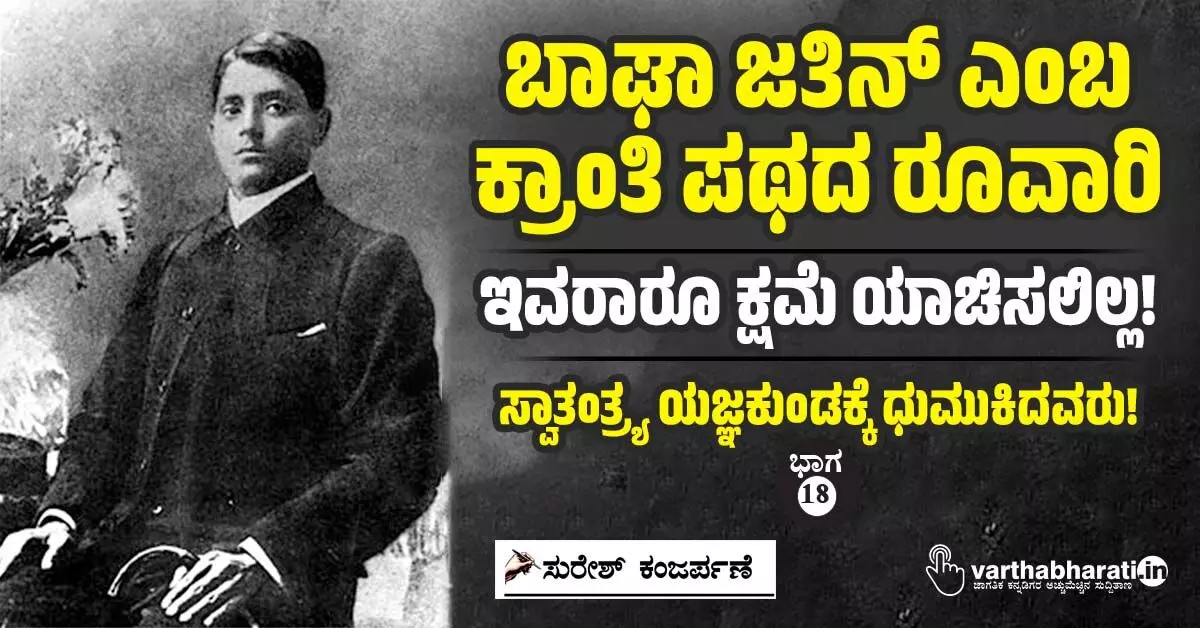
Bagha Jatin, born Jatindranath Mukherjee in 1879 in Nadia district, rose from a modest Brahmin household to become one of India’s most respected revolutionary leaders. British intelligence chief Charles Tegart later remarked that he had never seen a more selfless political activist and even said that, were Jatin British, a statue would stand beside Nelson’s at Trafalgar Square. That outsider praise underlined the depth of Jatin’s influence.
Bagha Jatin’s formative years and public purpose
Jatin lost his father at a young age and was raised in his mother’s ancestral home. Literary and religious influences shaped his early outlook. His mother read the works of writers such as Bankim Chandra Chatterjee to him, and he encountered the ideas of Swami Vivekananda while studying for his BA in Kolkata. Vivekananda encouraged discipline and physical vigour, prompting Jatin to support the establishment of akharas, or training halls, alongside figures such as Sister Nivedita.
Early episodes demonstrate the mix of courage and moral authority that defined his public image. One famous incident saw Jatin single-handedly kill a tiger that had attacked locals. Authorities awarded him a silver plaque in recognition, and he acquired the popular nickname Bagha Jatin, or Tiger Jatin.

Organising for political change
Jatin was among the founders of the Anushilan Samiti, a key incubator of youthful revolutionary activism in Bengal. He worked closely with Aurobindo Ghosh and, later, Rash Behari Bose. Highly effective as an organiser, Jatin established dozens of local committees across Bengal and Odisha and extended the network into Bihar and what is now Uttar Pradesh. His structure favoured decentralised cells that could operate autonomously while sharing a clear purpose.
Under Jatin’s leadership, members of these branches combined social service with political preparation. They ran night schools, offered homeopathic medicine and took part in agricultural relief work during disasters. Such activities built local support and helped recruit new activists for political work.
Jatin’s approach balanced community engagement with militant readiness. He supervised workshops where explosives and weapons were developed, and his organisation carried out a string of bank robberies in 1908 to fund operations. Attempts were made on high-ranking colonial officials, and by 1909–1910 several key administrators were killed. Authorities arrested Jatin on occasion but released him for lack of evidence, even as suspicion grew about revolutionary sympathies within certain Indian regiments of the British Army.
International links and plans for wider action
While imprisoned, Jatin continued to cultivate networks and strategic plans. He connected with leaders who would spread the movement beyond Bengal. Contacts with Rash Behari Bose helped extend revolutionary organising into Punjab. Jatin also followed developments abroad, recognising that global conflicts might create an opening against British rule. By the end of 1913 he and his allies were preparing plans inspired by the 1857 uprising and coordinating with overseas groups such as the Ghadar movement in North America, which was accumulating arms and preparing cadres for action.
Jatin insisted that revolutionary work include practical relief during crises and sought to broaden support by involving soldiers and civilians alike. His blend of community assistance, political education and militant planning helped shape the next generation of Indian revolutionaries.
Remembered for courage and organisational skill, Bagha Jatin remains a prominent figure in India’s struggle for independence. His methods and alliances demonstrated a willingness to combine local mobilisation with international coordination in pursuit of national freedom.
Key Takeaways:
- Bagha Jatin emerged as a leading Indian revolutionary, admired even by British officials for his courage and selfless political activism.
- He helped found the Anushilan Samiti and expanded revolutionary networks across Bengal, Odisha, Bihar and beyond.
- Jatin organised social relief, night schools and militant preparation, forging links with Ras Bihari Bose and the Ghadar movement.
- By 1913 he and allies planned a large-scale uprising modelled on 1857 and sought international coordination against British rule.








