











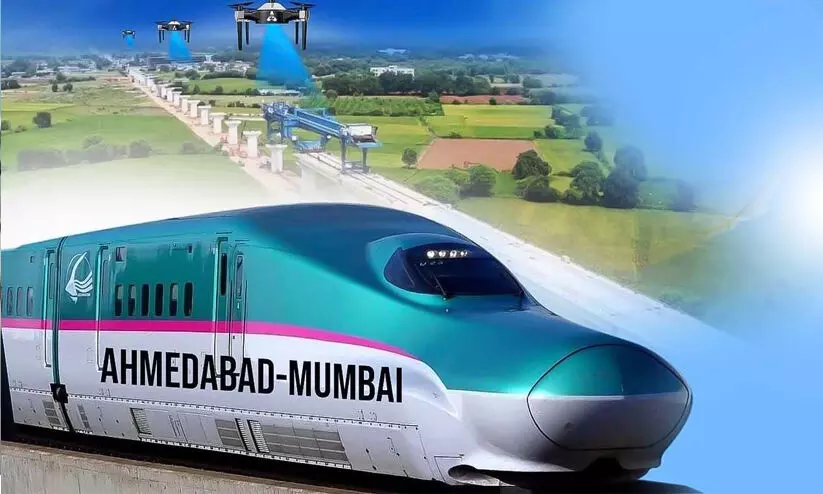
India will begin commercial service on its first bullet train on 15 August 2027, Railway Minister Ashwini Vaishnaw announced, marking a significant milestone in the country’s push to modernise passenger rail. The initial service will operate on the Surat–Bilimora section in Gujarat, with subsequent phases bringing larger portions of the Mumbai–Ahmedabad corridor online.
Mumbai-Ahmedabad high-speed rail: phases and progress
The Mumbai–Ahmedabad high-speed rail corridor spans 508 kilometres and is being built using Japan’s Shinkansen technology. Trains on the line will run at up to 320 kilometres per hour, reducing travel time between Mumbai and Ahmedabad to about two hours. The project will pass through Gujarat, Dadra and Nagar Haveli, and Maharashtra and include major stations at Ahmedabad, Vadodara, Bharuch, Surat, Vapi, Thane and Mumbai.
The rollout will proceed in stages. Following the Surat–Bilimora launch, the Vapi–Surat and Vapi–Ahmedabad sections will be brought into operation. Work will then continue on the Thane–Ahmedabad portion, with the final phase completing the full Mumbai–Ahmedabad link.

Officials report that more than 85 percent of the corridor alignment is elevated on viaducts and that over 326 kilometres of construction has already been completed. The project includes 25 river crossings, 17 of which are finished. Civil works on the Surat–Bilimora section, including track laying, are in the final stages.
Construction was delayed by lengthy land acquisition issues, but the project regained momentum with Japanese technical and financial support. Minister Vaishnaw highlighted the role of this bilateral cooperation and said the success of earlier Indian train services, such as the Vande Bharat Express, has helped build public confidence in rail modernisation.
Economists and transport planners say the corridor will have a considerable economic impact. Faster connectivity between two of India’s major economic hubs is expected to stimulate trade, reduce travel time for business commuters, and encourage investment along the route. Improved connectivity is also likely to spur development in intermediate cities and industrial clusters.
Technically, the adoption of proven Shinkansen systems aims to ensure high safety and reliability standards. Operating at 320 kilometres per hour will require strict maintenance regimes and specialised infrastructure, including dedicated tracks and signalling systems. Project managers have emphasised readiness planning for operations, staff training and testing ahead of the commercial launch.
Although the initial service will be limited to the Surat–Bilimora sector, residents and commuters along the corridor can expect phased improvements as work continues. The government has framed the bullet train as a flagship infrastructure achievement that demonstrates India’s capacity to absorb advanced technology through international partnerships.
As the 15 August 2027 start date approaches, attention will turn to final safety certifications, timetable announcements and ticketing arrangements. If delivered on schedule, the Mumbai–Ahmedabad high-speed rail will represent one of South Asia’s most ambitious passenger rail upgrades to date and a landmark in India’s transport modernisation drive.
Key Takeaways:
- India’s Mumbai-Ahmedabad high-speed rail will begin service on 15 August 2027, initially running between Surat and Bilimora.
- Built using Japanese Shinkansen technology, trains will travel at up to 320 kilometres per hour, cutting the Mumbai–Ahmedabad journey to about two hours.
- More than 85% of the 508-kilometre alignment is on viaducts; over 326 kilometres of construction is complete despite earlier land acquisition delays.
- Japanese technical and financial assistance has been central to progress, reinforcing India’s rail modernisation effort.








