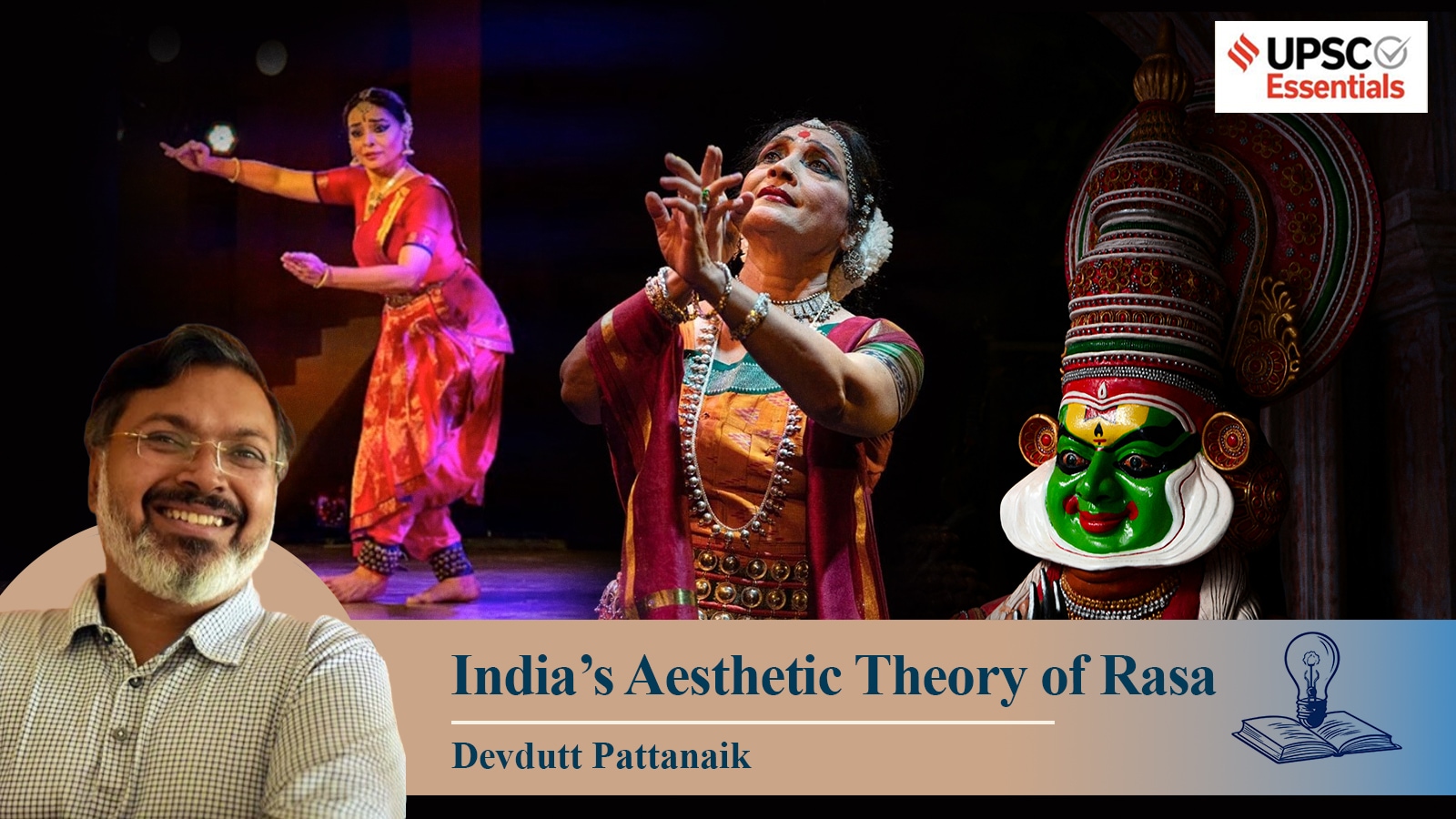
Devdutt Pattanaik revisits a classical Indian idea to explain how art produces shared emotional experience. Ancient theorists coined the term rasa, literally meaning “juice”, to describe the aesthetic flavour that art releases in a spectator. Rather than a private feeling, rasa is a universal mood that arises when the viewer momentarily sets aside their individual identity and participates in a collective emotional state.
Indian rasa theory and its modern relevance
The earliest systematic account appears in the Natya Shastra, attributed to Bharata around 200 CE. Bharata argued that drama, dance and poetry combine plot, gesture and mental states to generate distilled emotions. These are not the performer’s personal responses but conventionalised emotional types. His list of eight rasas—love, sorrow, rage, humour, fear, disgust, courage and wonder—provided a vocabulary for performers and audiences to recognise and receive aesthetic experience.
Subsequent traditions adapted this core idea. Tamil poetic theory aligned rasa with ecological settings and social situations, mapping emotional states to landscapes and life phases. The performer’s position on stage signalled not only feeling but also context, creating a rich interplay between place and mood. Over time the theory moved beyond stage drama into poetry, music and dance manuals across India.

Abhinavagupta, writing in Kashmir around 1000 CE, reframed rasa in philosophical terms. He argued that the aesthetic state resembles a glimpse of universal bliss because it temporarily dissolves the ego. By adding shanta, or the mood of peace, as a ninth rasa, Abhinavagupta linked aesthetic appreciation to a spiritual dimension. This reinterpretation pushed rasa from a technical tool for artists to an experience with metaphysical implications.
Comparisons with classical Greek thought clarify the difference. Aristotle focused on plot, character and catharsis—how a narrative outcome produces emotional purification. Indian thought emphasises inner experience and the flavour of emotion. Where Aristotelian drama resolves through action and moral consequence, rasa privileges the spectator’s internal shift and the shared mood that art elicits.
The medieval period broadened rasa’s reach. Poets and theorists such as Anandavardhana developed theories of suggestion, or dhvani, identifying indirect meaning as central to aesthetic effect. Manuals like Mammata’s Kavyaprakasha integrated rasa into literary practice. In performance traditions from Kathakali to Bharatanatyam, and in north Indian music where raga and time point to mood, artists retained rasa as a guiding principle.
Under colonial study, scholars sometimes equated rasa with Aristotelian aesthetics. Indian critics countered by emphasising rasa’s distinct psychology of emotion. Today the concept informs film studies, performance criticism and comparative aesthetics. Filmmakers and composers continue to use rasasvada—the relish of rasa—to craft scenes that invite viewers to surrender individual perspective and enter a communal emotional plane.
Pattanaik’s account serves as a reminder that the Indian approach to art seeks not only to depict actions or teach morals but to produce a shared inner state. For practitioners and audiences alike, rasa remains a practical vocabulary and a philosophical claim about why art moves us.
Key Takeaways:
- Indian rasa theory explains how art evokes universal, non-personal emotions by dissolving the spectator’s ego.
- Bharata’s framework links emotion (rasa) to dramatic elements; Abhinavagupta later reframed it as a spiritual, blissful experience.
- The theory migrated from ritual and drama into Tamil poetry, regional music and modern film, shaping contemporary Indian art practice.