











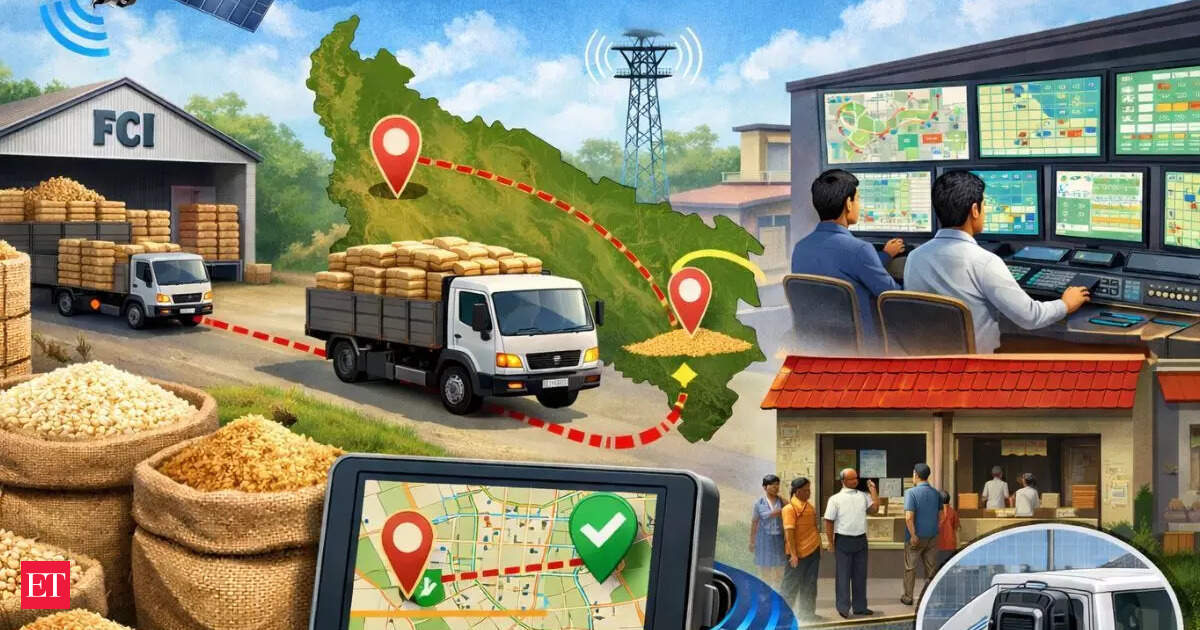
Uttar Pradesh has introduced a GPS-based tracking system to curb theft, leakage and diversion of food grains distributed under the Public Distribution System (PDS), the state government said in an official release. The initiative combines real-time vehicle tracking with a single-stage doorstep delivery model to ensure consignments reach fair price shops intact and on time.
GPS tracking food grain Uttar Pradesh and how it works
The system equips more than 5,000 transport vehicles with GPS devices, allowing authorities to monitor movements from Food Corporation of India (FCI) depots to fair price shops in real time. Every event — the point of origin, intermediate halts and arrival within stipulated time windows — is recorded in a central control system, the government said. This end-to-end visibility aims to prevent diversion, black marketing and other leakages that have long plagued the supply chain.
During the 2025-26 Kharif marketing season the state made GPS mandatory for paddy procurement. Officials have fitted devices in 3,773 vehicles that move paddy from procurement centres to rice mills across all districts. A further 1,428 vehicles transporting coarse grains such as maize, sorghum and millet have been connected to the tracking platform, extending transparency to the entire procurement-to-storage chain.

Delivery model and governance changes
Uttar Pradesh has abolished block warehouses and shifted to a single-stage doorstep delivery framework. Under the model, consignments now travel directly from FCI depots to fair price shops. Contractors appointed through e-tenders handle transportation and distribution, which reduces human intervention and increases accountability. Government officials say the combination of competitive contracting and GPS monitoring forms the backbone of a more transparent PDS.
The state reports that, so far in the 2025-26 financial year, it has allocated roughly 803,000 tonnes of food grains and coarse grains to selected beneficiaries. In addition, some 36,850.35 tonnes of sugar have been earmarked for Antyodaya cardholders. Authorities say GPS tracking has helped ensure these supplies arrive without cutbacks and within scheduled timeframes.
Implications for efficiency and fraud prevention
Officials argue that technology-led oversight reduces opportunities for theft and diversion and simplifies audit trails. Real-time data enables quick intervention when vehicles deviate from planned routes or schedules. The state intends to use the system’s logs to verify contractor performance and to inform disciplinary action or contract adjustments where necessary.
Analysts note that while GPS monitoring cannot eliminate all forms of fraud, it raises the cost and complexity of diversion schemes, making them less attractive. The move also reflects a broader trend among Indian states to harness digital tools in the delivery of subsidised food and welfare services.
For beneficiaries, the immediate benefit is improved reliability of supply. For policymakers, the reforms offer a data-driven mechanism to measure distribution efficiency and identify persistent bottlenecks. If sustained and complemented by independent audits, the changes could provide a meaningful boost to the integrity of the PDS in Uttar Pradesh.
Key Takeaways:
- Uttar Pradesh has deployed GPS tracking to monitor food grain movement, reducing theft and diversion under the PDS.
- GPS tracking food grain Uttar Pradesh enables end-to-end monitoring across more than 5,000 vehicles and mandates devices for paddy procurement in 2025-26.
- The state moved to single-stage doorstep delivery from FCI depots to fair price shops, abolishing block warehouses and cutting human intervention.








