











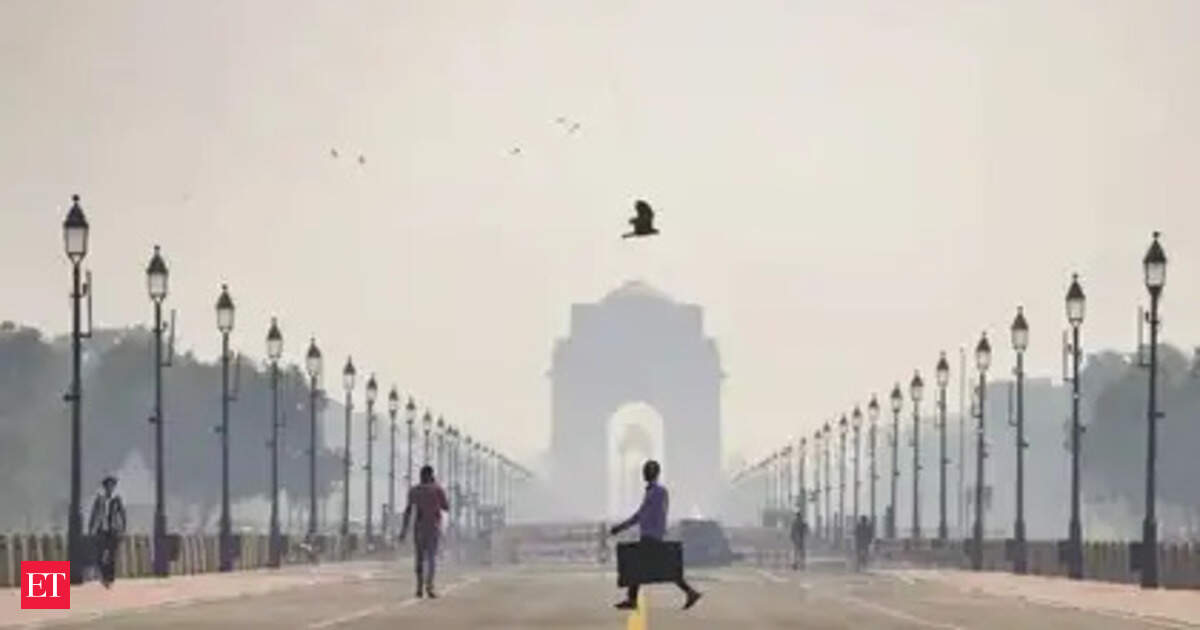
The Commission for Air Quality Management (CAQM) on Friday announced the revocation of Stage III restrictions under the Graded Response Action Plan (GRAP) across the Delhi-NCR region after authorities recorded a noticeable improvement in air quality.
The national capital registered mixed readings during the day. Delhi’s Air Quality Index (AQI) was reported at 386 earlier on Friday, but officials said the figure fell to 236 at 4pm, signalling a downward trend. The Central Pollution Control Board (CPCB) however recorded a 24-hour average AQI of 380, which remains in the ‘very poor’ category. Several monitoring stations continued to report very poor or severe pollution levels, with Anand Vihar showing the highest reading at 423.
Delhi air quality trends and data
Area-wise readings supplied by authorities included Dwarka Sector 8 at 338, IGI Airport 259, ITO (CPCB) 326, JLN Stadium 362, Mundka 347 and NSIT Dwarka (CPCB) 411. In total, 26 monitoring stations registered ‘very poor’ air quality and 11 recorded ‘severe’ levels. Dense fog and lingering smog reduced visibility in several parts of the city, prompting airlines to issue travel advisories and disrupting daily routines.

“Keeping in view the prevailing trend of air quality, the CAQM Sub-Committee on GRAP decides to revoke all actions as envisaged under Stage-3 of the extant GRAP, with immediate effect, in the entire NCR,” an official told PTI. The commission emphasised that the decision was taken in response to improving measurements and is based on prevailing trends rather than a permanent change in policy.
Stage III curbs previously included a ban on non-essential construction and demolition activities, as well as restrictions on stone crushing and mining operations. The measures also limited the entry of older diesel goods vehicles into Delhi and curtailed the movement of certain older passenger vehicles in the region. Under Stage III, schools up to Class 5 were required to shift to a hybrid learning model and offices were permitted to operate at 50 per cent staff strength. With the revocation, those particular Stage III restrictions have been lifted, although actions under Stages I and II remain active across the NCR.
The CAQM was clear that construction and demolition sites that had been shut due to violations will not be allowed to resume operations unless they receive explicit permission from the commission. That position underscores the regulator’s aim to prevent a rapid return to conditions that could reverse recent gains.
Environmental authorities cautioned that the improvement may not be uniform across the region and pockets of severe pollution persist. The CAQM and CPCB monitor conditions closely and retain the option to reinstate Stage III or escalate measures should meteorological conditions or emissions push air quality back toward dangerous levels.
The temporary easing will provide immediate relief for construction firms, transport operators and schools affected by the stricter curbs, while residents may see modest improvements in outdoor conditions. Officials urged continued adherence to pollution-control advisories, reduced use of personal fire sources, and prompt reporting of violations to help sustain the trend toward cleaner air.
Key Takeaways:
- CAQM revoked Stage III GRAP restrictions across Delhi-NCR after a clear improvement in air quality trends.
- Official readings showed an AQI fall to 236 by 4pm, though the 24-hour average remained in the ‘very poor’ category.
- Stage I and II measures remain in force; halted construction sites closed for violations cannot resume without commission permission.
- Authorities warned pockets of severe pollution persist and may prompt reimposition of curbs if conditions worsen.








