











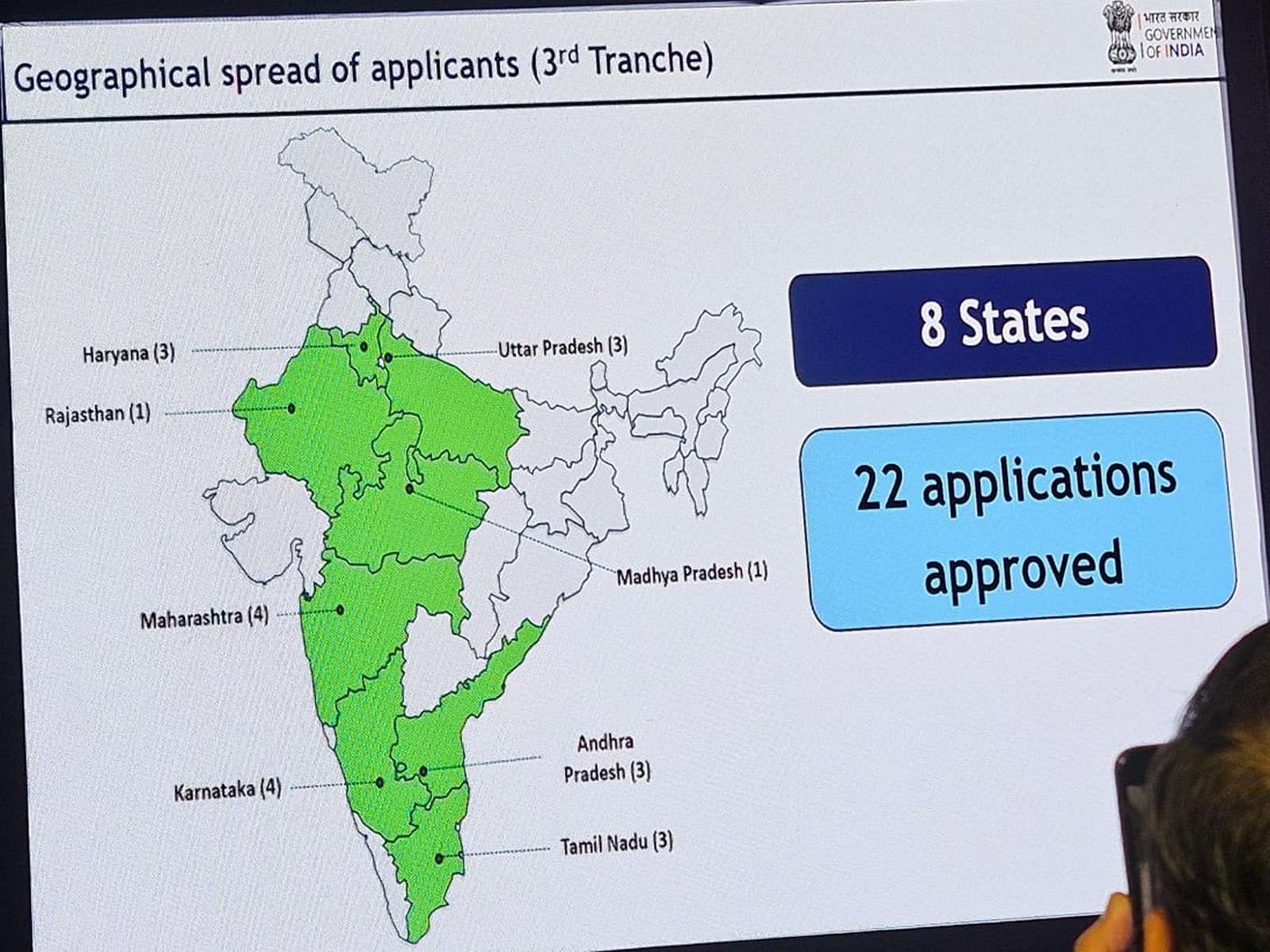
The Indian government has approved the third tranche of projects under the Electronics Components Manufacturing Scheme (ECMS), clearing 22 applications with a combined proposed investment of Rs 41,863 crore. The approvals were announced at a ceremony attended by Ashwini Vaishnaw, Union Minister for Electronics and Information Technology, and senior officials from the ministry.
Electronics Components Manufacturing Scheme drives investment and jobs
The approved projects span a wide range of components that are critical to domestic electronics production, including printed circuit boards, lithium battery cells, connectors, camera and display modules, aluminium extrusions and mobile phone sub‑assemblies. Officials said the tranche will strengthen local value chains for consumer electronics, mobile devices, automotive electronics and industrial applications.
Ministry figures show that the third tranche is expected to generate substantial direct employment across multiple states. Notable approvals include Vital Electronics, which will establish a multi‑layer PCB facility in Maharashtra creating 110 jobs, and Motherson, whose Tamil Nadu project is projected to create 5,741 positions. Amara Raja‑ATL will develop advanced components operations in Haryana with an estimated 3,550 jobs, while Tata Electronics will undertake mobile phone manufacturing in Tamil Nadu and create around 1,500 roles.

Other beneficiaries include NPSPL Anode Material, which plans battery materials production in Andhra Pradesh with 600 jobs, and Kunshan Q Tech, which will manufacture camera modules and is expected to employ about 700 people. AT&S India and ILJN Ascent will expand India’s high‑density interconnect PCB capacity with facilities in Karnataka and Uttar Pradesh, creating 1,207 and 1,540 jobs respectively. Samsung will set up a display module sub‑assembly unit, and Amphenol High Speed Interconnect India will produce connectors in Karnataka for 186 workers.
The government said the approvals bring the total ECMS-sanctioned projects to 46, with cumulative investment intentions of Rs 54,557 crore. Earlier tranches and approvals had already signalled strong interest from domestic and international firms, with 249 applications received in the scheme’s initial phase and substantial projected production figures.
Policy aims and wider economic impact
The ECMS is part of a broader strategy to build resilient electronics manufacturing capacity in India and to link domestic producers with global value chains. The initiative supports the government’s target for India’s electronics manufacturing sector to reach US$500 billion in manufacturing value by 2030‑31. The Union Cabinet approved overall scheme funding of Rs 22,919 crore to bolster components production and reduce dependence on external suppliers.
Analysts say the scheme’s emphasis on components and sub‑assemblies is intended to unlock deeper levels of localisation in the electronics supply chain, moving beyond device assembly to the production of critical inputs. That transition is likely to attract further investment in supporting industries, create skilled manufacturing jobs and improve export competitiveness.
Officials noted that approved projects are spread across a broad geographic footprint, supporting regional industrial growth in states including Tamil Nadu, Karnataka, Maharashtra, Andhra Pradesh, Haryana, Uttar Pradesh, Rajasthan and Telangana. With additional tranches expected, the ECMS is positioned to be a key driver of India’s ambition to become a major global electronics manufacturing hub.
Key Takeaways:
- The government approved 22 projects under the Electronics Components Manufacturing Scheme (ECMS) with Rs 41,863 crore in investments.
- Projects cover PCBs, lithium cells, camera and display modules, connectors and mobile sub‑assemblies, strengthening domestic supply chains.
- The tranche is expected to create thousands of jobs across Tamil Nadu, Karnataka, Maharashtra, Andhra Pradesh, Haryana, Uttar Pradesh, Rajasthan and Telangana.
- The ECMS aims to integrate Indian firms into global value chains and expand electronics manufacturing capacity.








