











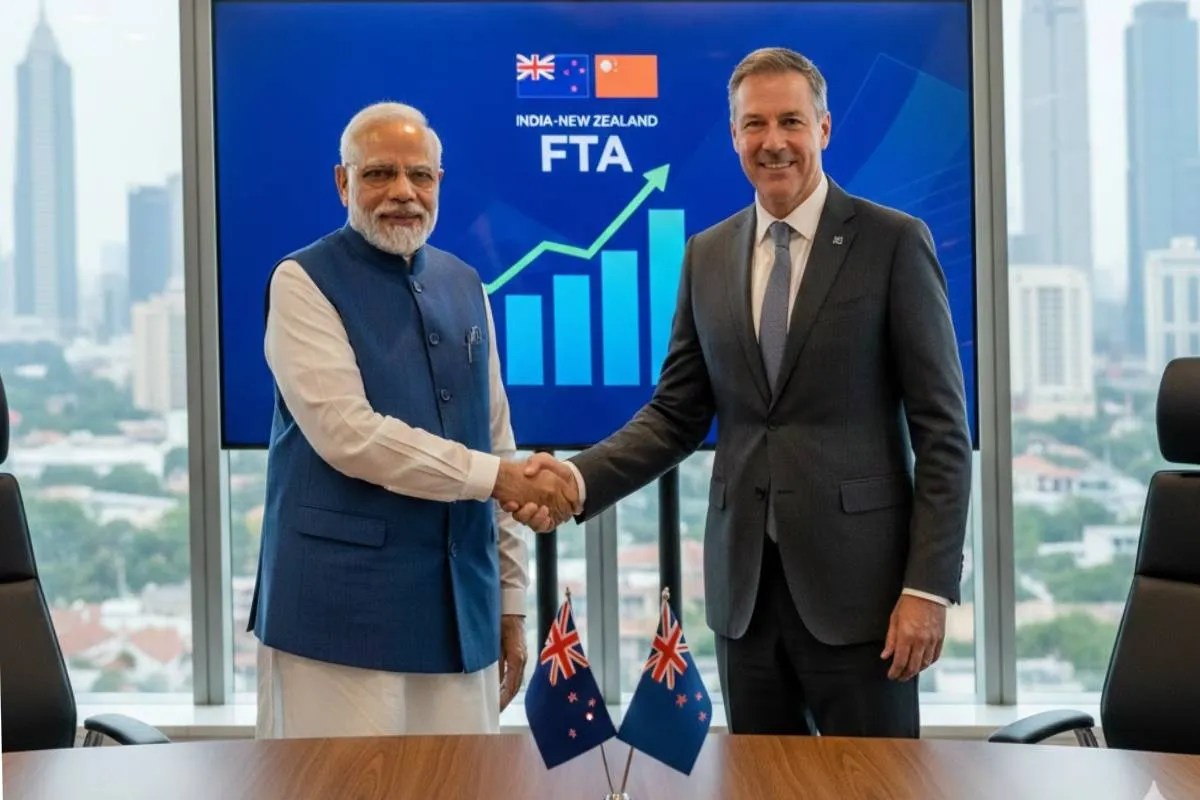
India and New Zealand finalised a free trade agreement in December 2025 after nine months of negotiations, signalling a targeted shift in India’s trade strategy towards selective, high-quality bilateral pacts. While bilateral trade volumes remain modest compared with larger FTAs, the pact carries outsized strategic value by deepening India’s economic engagement in the Indo‑Pacific and building rules-based ties with a high‑income OECD economy.
India New Zealand FTA: strategic and economic impact
The agreement grants Indian exporters zero tariffs on 100 per cent of exports to New Zealand, creating immediate opportunities for labour‑intensive and manufactured goods such as textiles, footwear, engineering products, pharmaceuticals and processed foods. Services liberalisation, faster approvals for pharma and medical devices, and regulatory mutual recognition are central elements that could expand market access for Indian service providers and attract New Zealand investment into India’s infrastructure, agri‑tech, education and green energy sectors.
Negotiators framed the deal as balanced liberalisation. Sensitive sectors such as dairy were safeguarded, reflecting New Zealand’s domestic political concerns. For India, the strategic reward lies less in short‑term tariff gains and more in the precedent the agreement sets: confidence to negotiate regulatory cooperation, mobility provisions and higher standards with developed partners while protecting key domestic interests.

Officials and private sector forecasts suggest the agreement could catalyse up to $20 billion in cumulative investment over 15 years, contingent on implementation and complementary policy measures. For New Zealand exporters, the pact offers orderly access to one of the fastest growing large markets, although domestic debate about distributional effects and sectoral exclusions could complicate parliamentary approval and long‑term political buy‑in.
Several implementation risks remain. Tariff asymmetry is striking: average applied tariffs in New Zealand are roughly 2.3 per cent compared with India’s average of around 16 per cent. Without proactive market development and promotion, Indian suppliers may not fully exploit preferential access. Non‑tariff measures—sanitary and phytosanitary standards, technical regulations and logistics bottlenecks—could blunt the practical benefits unless regulatory cooperation is operationalised and customs facilitation is strengthened.
Domestic capacity also matters. Past FTAs have shown uneven utilisation rates, particularly among micro, small and medium enterprises. India’s institutional outreach, awareness programmes for exporters, and alignment of industrial policy will determine whether the preferences translate into trade growth and diversification.
In geopolitical terms, the pact signals India’s calibrated approach to opening markets. It emphasises targeted engagement with developed partners while preserving policy space for sensitive sectors. If governments and business groups coordinate implementation, this agreement could serve as a model for India’s future bilateral deals in the Pacific. The immediate test, however, will be execution: converting tariff lines on paper into expanded supply chains, services flows and investment on the ground.
Key Takeaways:
- India New Zealand FTA opens duty-free access on 100% of Indian exports to New Zealand, deepening India’s Indo‑Pacific engagement.
- The deal emphasises services liberalisation, mobility provisions and regulatory cooperation, with potential investment of up to $20bn over 15 years.
- Key risks include tariff asymmetry, non-tariff barriers and domestic political resistance in New Zealand over dairy and immigration.








