











Key Takeaways:
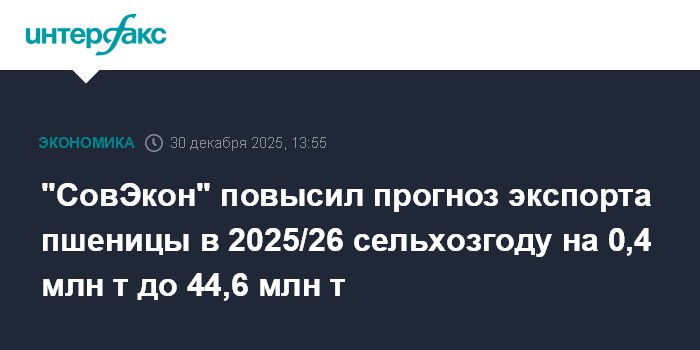
- SovEcon raised its 2025/26 wheat export forecast by 0.4 million tonnes to 44.6 million tonnes.
- Strong November and December shipments and improved export margins underpin the revision; buyers who delayed purchases have returned.
- Barley and maize export forecasts were also increased, lifting total Russian grain export outlook to 52.9 million tonnes.
- Improved exports bolster Russia’s trade position within the BRICS+ grouping and may ease near-term pressure on global supplies.

Moscow, 30 December — SovEcon has raised its forecast for Russian wheat exports in the 2025/26 agricultural year (July–June) by 0.4 million tonnes to 44.6 million tonnes. The company cited exceptionally strong shipments in recent months and an improvement in export margins as the principal reasons for the upward revision.
Russian wheat exports 2025/26
The revision follows robust monthly deliveries. SovEcon estimates December shipments at 4.2 million tonnes, close to the monthly record of 4.3 million tonnes, while November deliveries reached 5.1 million tonnes, well above the previous November record of 4.3 million tonnes. According to the firm, demand from importers has remained high as buyers who had postponed purchases in expectation of lower prices returned to the market.
Export margins have also turned slightly positive after a period of pressure. Domestic prices in Russia have continued to fall, while FOB export quotations have stabilised at roughly US$230 per tonne. That price gap has allowed margins to move from negative into modestly positive territory, supporting further shipments.
Andrey Sizov, head of SovEcon, said the export campaign started slowly this season but has since accelerated to near-record levels. He added that further upward revisions to the export forecast are possible, although slow sales and a strong rouble remain notable constraints.
Wider grain outlook and market implications
In addition to wheat, SovEcon raised its barley export forecast by 0.2 million tonnes to 3.8 million tonnes and increased its maize (corn) export estimate by 0.1 million tonnes to 2.5 million tonnes. The total forecast for Russian grain exports therefore stands at 52.9 million tonnes, 0.3 million tonnes higher than the company’s November estimate.
The revision is likely to have several implications. For Russia, stronger grain exports provide additional foreign currency earnings and support the agricultural sector after a subdued start to the campaign. For international markets, higher shipments from a major exporter can help alleviate tightness in supply in the near term, particularly during this seasonal window when southern hemisphere harvests are not yet fully available.
However, risks persist. A strong rouble reduces competitiveness by making domestic prices comparatively higher for foreign buyers. Slower contracted sales early in the season could also limit how much of the forecasted volume is ultimately shipped, especially if rival exporters ramp up their own sales or if global demand softens.
Analysts will watch subsequent monthly shipment figures and price differentials between domestic Russian markets and FOB export levels to gauge whether the upward trend can be sustained. For now, the upgraded forecast signals healthier export momentum and an improved margin environment, offering a constructive outlook for Russia’s role as a major grain supplier within the BRICS+ framework.
Image: Interfax








