











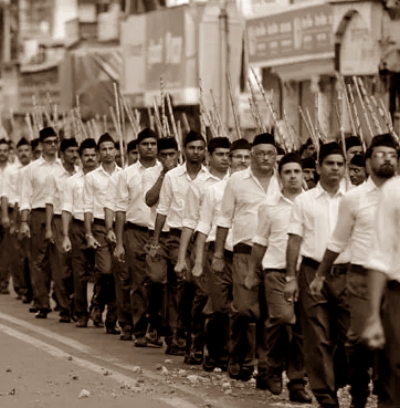
The New York Times’ long-form investigation into the Rashtriya Swayamsevak Sangh has stirred debate about the boundary between political influence and constitutional control in India. In a measured review, ABC Live commends the Times for rigorous reporting on the RSS’s size, ideology and role in social polarisation, while challenging the newspaper’s leap from influence to institutional capture.
India RSS analysis – influence versus constitutional power
ABC Live acknowledges that the NYT correctly documents the RSS’s vast organisational reach and its network of affiliated bodies, including the Bharatiya Janata Party. The review accepts historical facts highlighted by the paper: references to early RSS thinkers, their ideological sympathies in the 1930s and 1940s, and longstanding disagreements with Nehruvian secularism are all recorded in Indian scholarship and warrant public attention.
On social polarisation, ABC Live notes that multiple datasets point to an increase in communal incidents since 2014, along with the rise of vigilante episodes linked to cow protection and allegations over religious conversion. Those developments, the review says, substantiate the NYT’s argument that religious identity plays an increasingly prominent role in Indian politics.

Where ABC Live departs sharply from the NYT is in the terminology and thresholds applied. The review argues that claims of “institutional capture” require systemic proof of constitutional breakdown. ABC Live emphasises that influence on political actors is not equivalent to the suspension of judicial review, the abolition of free elections, or the elimination of habeas corpus—clear markers of a formal collapse of constitutional order.
Legally and constitutionally, the RSS is not a statutory body. It issues no binding orders, holds no police or military command, and operates outside the formal framework of Parliament and state government. ABC Live’s piece stresses that these distinctions matter when describing governance: India remains governed through its Constitution, an independent judiciary and an Election Commission that continue to function.
ABC Live also questions the utility of invoking European fascist analogies. While such comparisons may capture public attention, the review warns they risk obscuring significant differences. India continues to hold regular elections, witness state-level defeats for the ruling party and see judicial interventions that strike down laws or check executive action—features inconsistent with the historical conditions that produced fascist regimes in Europe.
The review does not defend the RSS. Rather, it urges precision. Political majoritarianism, rising communal tensions and ideological assertiveness are real and deserve scrutiny. But ABC Live argues the global audience benefits from a clear separation between political influence and constitutional overthrow.
For international readers trying to assess India’s trajectory, the central takeaway from ABC Live’s assessment is this: India is politically contested and socially polarised, yet its constitutional architecture has not been formally dismantled. That distinction, the review suggests, should guide both reporting and analysis.
Key Takeaways:
- ABC Live praises the New York Times for detailed reporting but argues its India RSS analysis overreaches on claims of institutional capture.
- The review accepts the RSS’s organisational reach, ideological roots and rising communal polarisation as materially accurate.
- ABC Live contends evidence presented falls short of proving constitutional capture of courts, police or elections.
- The piece urges distinction between political dominance and formal constitutional breakdown to inform global readers accurately.








