











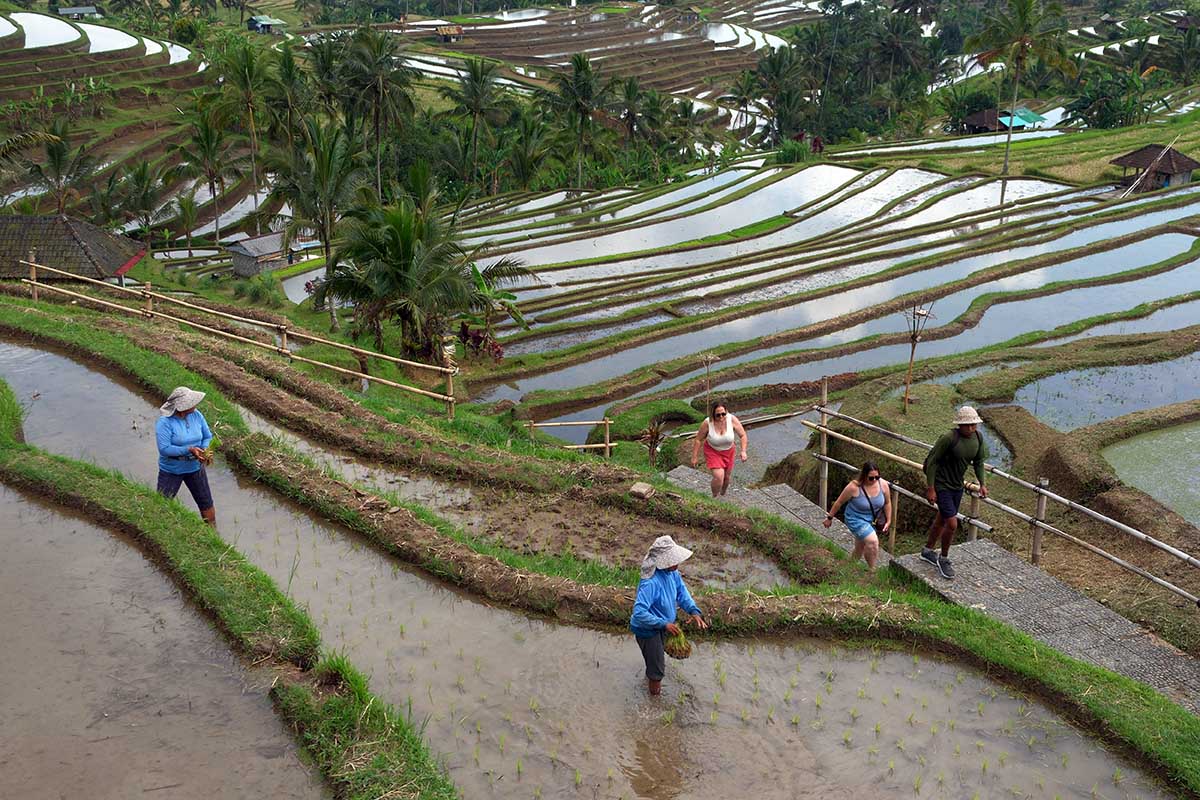
Visitors to Desa Jatiluwih in Tabanan, Bali, witnessed farmers planting red rice seedlings during the traditional ngajak nandur ceremony on Friday 2 January 2026. The community event, carried out through gotong-royong or collective labour, is a living example of how local customs sustain both social cohesion and agricultural practice.
Jatiluwih local wisdom sustains community and environment
The Jatiluwih local wisdom emphasises cooperation between villagers and respect for the land. The planting ceremony brings families together to share labour and knowledge, reinforcing a way of life that has been passed down through generations. The rice terraces around Jatiluwih form part of Bali’s Subak irrigation system, itself recognised for embodying the Tri Hita Karana principle linking people, nature and the spiritual world.
Participants plant seedlings of red rice, a traditional variety valued locally for its taste and resilience. The practice demonstrates sustainable farming methods that rely on communal decision making rather than industrial inputs. Local farmers maintain irrigation infrastructure, plan planting cycles collectively and rotate crops according to seasonal rhythms, all of which help protect soil health and water resources.

Visitors support cultural tourism and rural livelihoods
Tourists who attend the ngajak nandur ceremony have a direct window into village life and agricultural heritage. Observing the ritual fosters appreciation for the skills and organisation required to manage terraced landscapes. Income from tourism provides an additional stream of revenue for households, complementing rice cultivation and encouraging younger residents to remain engaged with traditional practices.
Local guides and small enterprises benefit when visitors choose community-led experiences over mass tourism. Workshops, guided walks and homestays connect visitors with farmers and cultural custodians, helping to translate local knowledge into sustainable livelihoods. This model aims to balance visitor interest with the need to conserve fragile terraces and maintain the integrity of communal farming systems.
Preservation efforts and wider significance
Preserving Jatiluwih’s practices is not only a matter of cultural conservation but also of environmental stewardship. The Subak system’s community-managed water networks are a practical adaptation to the island’s topography and climate. By keeping traditional planting calendars and sharing labour through gotong-royong, villages reduce reliance on costly external inputs and maintain biodiversity in rice varieties.
Officials, cultural advocates and tourism operators face the challenge of managing visitor flows so that ceremonies remain authentic and meaningful. Efforts to document and support the knowledge holders, provide training in sustainable visitor management and invest tourism revenue back into local infrastructure can help sustain the practice for future generations.
As Jatiluwih continues to attract visitors seeking cultural depth and responsible travel experiences, the village offers a clear example of how local wisdom can contribute to rural resilience. The ngajak nandur ceremony is at once a cultural celebration, an agricultural necessity and a living demonstration of the community values that underpin Bali’s rice terraces.
Key Takeaways:
- Jatiluwih local wisdom showcases a communal rice-planting tradition that blends culture and sustainable farming.
- Tourists observe farmers planting red rice seedlings during the annual ngajak nandur ceremony in Tabanan, Bali.
- The practice supports agritourism and preserves the Subak system rooted in Tri Hita Karana philosophy.








