











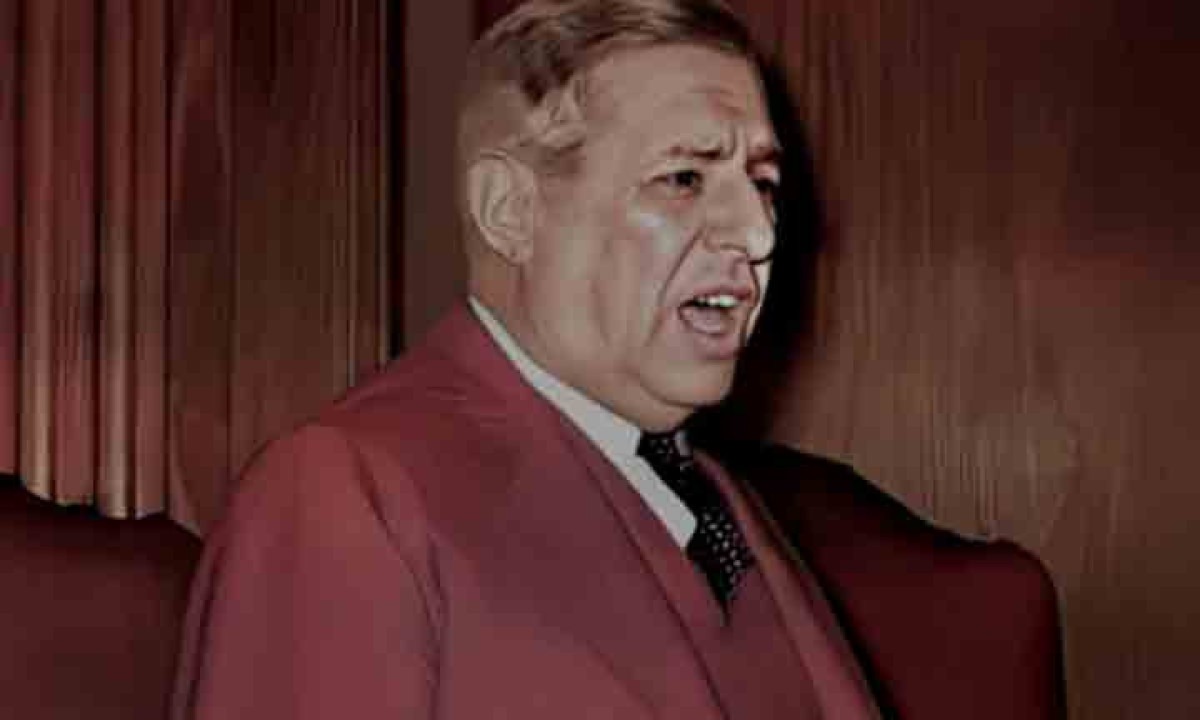
Assis Chateaubriand remains one of Brazil’s most consequential media figures. Rising from provincial beginnings, he forged a communications empire that reshaped journalism, broadcasting and the cultural life of the country.
Assis Chateaubriand and Brazilian media
Born Francisco de Assis Chateaubriand Bandeira de Mello in Umbuzeiro, Paraíba, he took the name Chateaubriand from his father’s admiration for the French writer. Trained in law at the Faculdade do Recife, Chateaubriand turned early to journalism, writing for regional titles such as Gazeta do Norte and Diário de Pernambuco before moving to Rio de Janeiro. His reporting for Correio da Manhã and as a correspondent for Argentina’s La Nación helped establish his reputation.
In 1924 Chateaubriand acquired and then directed O Jornal, using capital from coffee barons to begin assembling what became Diários Associados. Through a series of acquisitions he incorporated leading newspapers across Recife, Rio and São Paulo, and expanded into radio and, later, television. By the 1930s Diários Associados was recognised as the largest media group in Latin America.

Chateaubriand pursued an aggressive expansion strategy, focused on circulation and reach. His flagship magazine, O Cruzeiro, achieved record print runs and became one of Brazil’s most popular publications. The arrival of TV Tupi on 18 September 1950 — the first television station in Brazil and in Latin America — marked a new phase. The broadcaster introduced a mass medium that altered how information and entertainment reached Brazilian audiences.
Beyond the newsroom, Chateaubriand cultivated influence in politics and diplomacy. He was an active participant in the 1930 movement that brought Getúlio Vargas to power. Later he won election to the Senate for Paraíba in 1952 and for Maranhão in 1955; both contests were accompanied by allegations of electoral fraud. Between 1957 and 1960 he served as Brazil’s ambassador to the United Kingdom, appointed by President Juscelino Kubitschek.
Controversy followed Chateaubriand throughout his career. Critics likened him to Charles Foster Kane, the media magnate of Orson Welles’s film, reflecting concerns about his concentration of power and political sway. Yet his role as a patron of the arts also drew praise. From the late 1920s he organised initiatives to promote the visual arts and, in 1947, with Pietro Maria Bardi, he founded the Museu de Arte de São Paulo (MASP), bringing important European works to Brazil.
Chateaubriand’s personal life was complex; he married Maria Henriqueta Barrozo do Amaral and fathered several children. A stroke in 1960 left him partially paralysed, but he continued to write using an adapted typewriter. He died in São Paulo on 4 April 1968 at the age of 75.
His legacy has endured in books, film and popular celebration. Fernando Morais’s 1994 biography Chatô, o rei do Brasil became a best‑seller and was adapted into a 2015 film. Carnival and other cultural forms have also commemorated his image, underlining how his impact reached beyond media into national memory. While debates about the democratic implications of his influence persist, Chateaubriand’s role in shaping Brazil’s twentieth‑century media and cultural institutions is unmistakable.
Key Takeaways:
- Assis Chateaubriand built Diários Associados into Latin America’s largest media conglomerate, spanning newspapers, radio and television.
- He launched TV Tupi in 1950, the first television station in Brazil and Latin America, transforming national broadcasting.
- Chateaubriand combined media influence with political roles, serving as senator and ambassador amid controversies and allegations of electoral fraud.
- As a patron of the arts he co‑founded MASP and left a lasting cultural legacy celebrated in biographies, film and carnival.








