











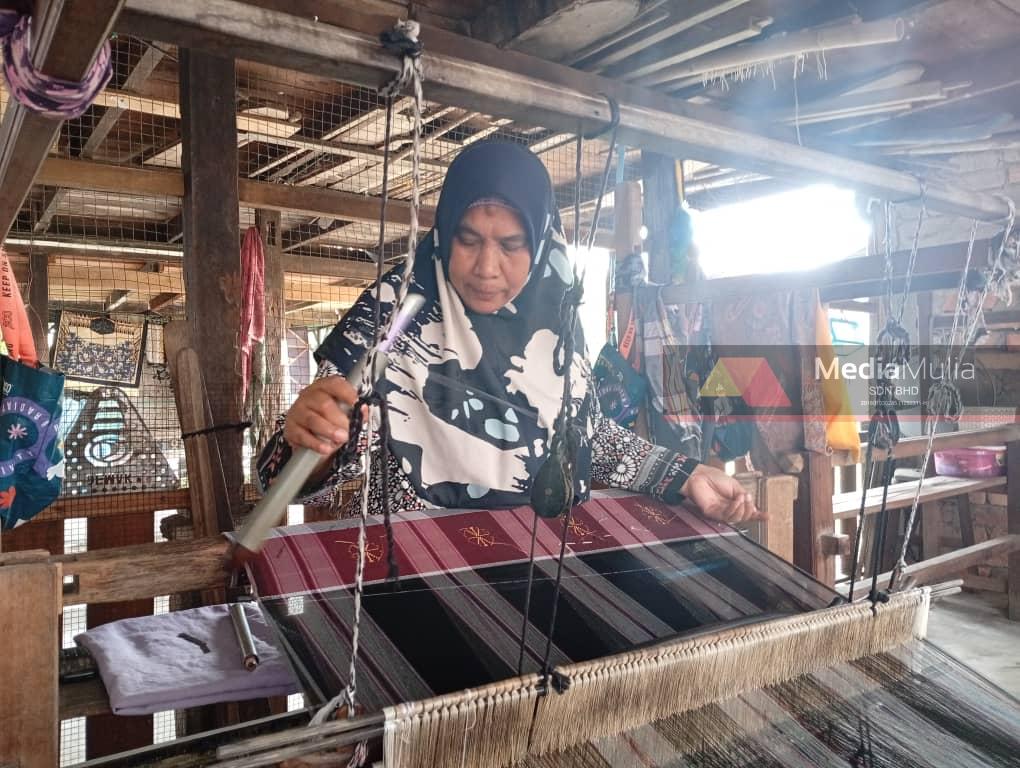
Gayah Awang, 56, sits at her loom in Kampung Pasir Panjang, Kuala Terengganu, and works with the confidence of someone who has spent decades mastering a skill. Despite losing her sight in her teens to the genetic condition retinitis pigmentosa, Gayah continues to produce intricate songket textiles, a traditional Malay brocade celebrated for its metallic threads and patterned motifs.
blind songket weaver Malaysia
Gayah began weaving at the age of 12, learning the craft within her family. Today her hands move with practised precision as she manipulates loseng and other weaving tools. Her concentration and technique prompt admiration from neighbours and visitors who often find it hard to reconcile her blindness with the quality of her work.
Songket weaving is both an art and a livelihood in parts of Malaysia. The craft requires meticulous attention to pattern and rhythm, and Gayah’s continued practice represents not only personal resilience but also the survival of a cultural tradition. Five of her seven siblings are affected by the same condition, adding a generational dimension to the challenges the family faces.

Members of Gayah’s community describe her as determined and patient. She attributes her persistence to a sense of duty to her family’s heritage and to the joy she derives from weaving. The physical act of weaving provides routine and purpose as well as a means to contribute to household income through the sale of songket pieces.
Artisans such as Gayah play a role in keeping local handicrafts viable. Their work attracts interest from collectors, cultural groups and tourists, and it may feed into broader efforts to showcase regional crafts. Maintaining skills across generations is vital to the continuity of songket weaving, and stories like Gayah’s highlight both the vulnerability and the endurance of that knowledge.
Support for traditional artisans can take many forms, from training programmes and market access to inclusion in cultural events that raise the profile of handicrafts. While the article does not detail specific initiatives in Kuala Terengganu, Gayah’s example underscores how targeted assistance could bolster artisans who face physical challenges or limited resources.
Gayah’s legacy is as much about skill as it is about identity. Songket is often associated with ceremonial wear and occasions, and the craft has deep roots in Malay cultural expression. As younger generations encounter modern alternatives, the work of weavers who continue traditional methods becomes increasingly important for cultural preservation.
Visitors to Kampung Pasir Panjang who meet Gayah often leave impressed by her dexterity and by the intricacy of the textiles she produces. Her story is a reminder that artistic skill and cultural knowledge can persist in the face of adversity. For Gayah, weaving remains a living link to her family and to a community tradition that she hopes will be passed on.
While the challenges facing her family are significant, Gayah’s determination and the support of neighbours give cause for optimism. Her craft offers practical benefits and a form of cultural continuity that enriches the wider community in Kuala Terengganu and beyond.
Key Takeaways:
- Gayah Awang, a blind songket weaver from Kuala Terengganu, continues a family craft despite losing her sight to retinitis pigmentosa.
- The profile highlights the skills of a blind songket weaver Malaysia and the role of traditional weaving in preserving cultural heritage.
- Five of Gayah’s seven siblings also suffer the same genetic condition, underscoring personal and familial challenges.
- Her story points to the importance of supporting artisan communities to sustain traditional Malay textiles.








