











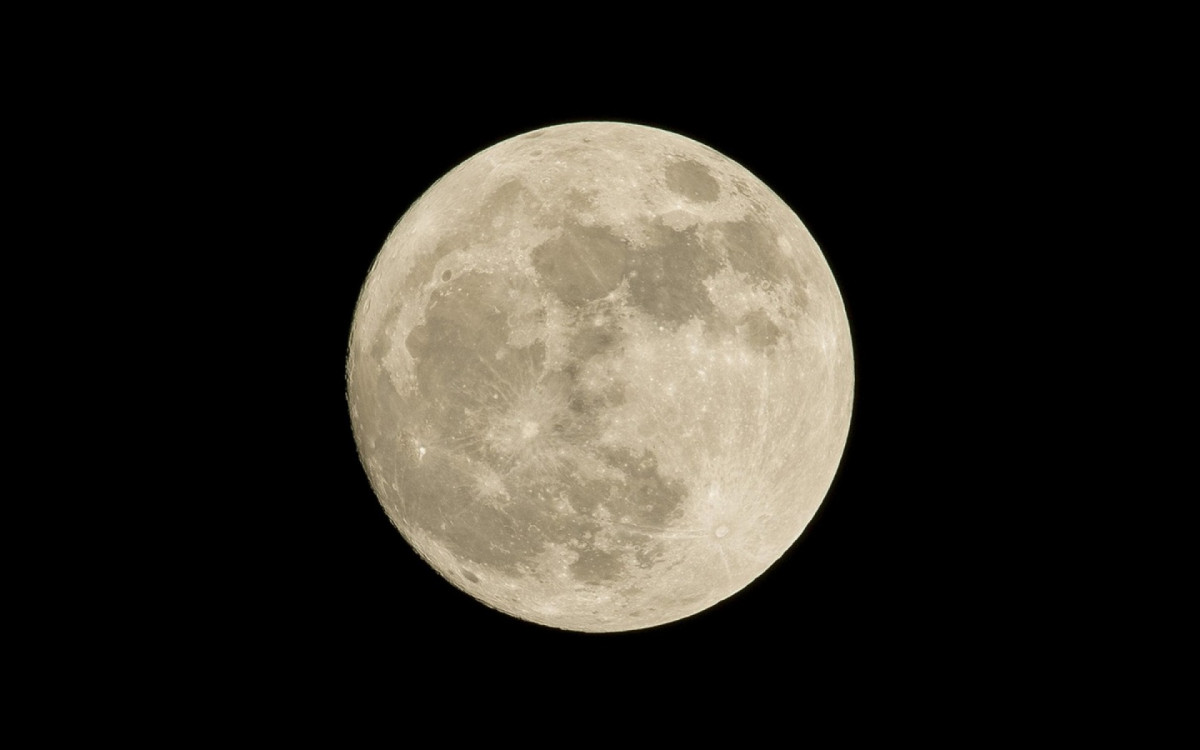
The full moon that will appear on Saturday 3 January is technically a Perigee Full Moon, commonly referred to as a Supermoon, because the Moon will be at a point in its orbit that brings it closer to Earth. Astronomers in Brazil emphasise that although the satellite will be nearer, the change in apparent size is slight and most people will not notice a difference with the naked eye.
According to Rodolfo Langhi, coordinator of the Observatory of Astronomy at Universidade Estadual Paulista (Unesp), the January full moon reaches a diameter of about 32.92 arc minutes. That is roughly 6% larger and 13% brighter than an average full moon, but the human eye finds it difficult to perceive such a small change without comparative measurements or photographic equipment.
Perigee Full Moon explained
Each month the Moon passes through two key points in its elliptical orbit. Perigee denotes the closest point to Earth and apogee the farthest. When the Moon is full near perigee it is called a Perigee Full Moon. Langhi likened the effect to holding a ball at arm’s length and moving it slightly closer. The apparent size changes, but only by a small amount.

“When the Moon is at perigee it is a little larger, but to the naked eye it is very hard to distinguish,” Langhi said. He noted that specialists who observe the Moon regularly may detect the difference, but most casual skywatchers will not perceive a dramatic enlargement.
The January Perigee Full Moon was as close as about 362,312 kilometres from Earth on the first day of the year. By contrast, the smallest full moon of 2026, the Micromoon expected on 31 May, will lie at roughly 406,135 kilometres. The numerical difference explains the slight variation in apparent diameter.
João Batista Canalle, a physicist and astronomy professor at the State University of Rio de Janeiro (UERJ), described the event as physically unremarkable. He stressed that calling the phenomenon a Supermoon can be misleading because it suggests a dramatic change in size. “It is the same full moon as always. The difference is almost irrelevant astronomically,” he said.
Canalle compared the Moon’s perigee and apogee to the Earth’s varying distance from the Sun during the seasons. Although Earth comes slightly closer to the Sun at certain times, the difference does not make the Sun appear noticeably larger to observers. The same logic applies to the Moon’s small orbital variations.
Observers who wish to appreciate the Perigee Full Moon should look for clear skies and a low horizon, where the Moon can appear visually more striking due to atmospheric effects rather than orbital distance. Photographers can capture comparative images to demonstrate the size difference, but for most the event offers a pleasant opportunity to enjoy a brighter, somewhat larger full moon.
In short, the January full moon is an interesting astronomical moment with measurable differences, yet it remains, to most viewers, the familiar and steady presence that has guided cultures for millennia.
Key Takeaways:
- The Perigee Full Moon, often called a Supermoon, occurs when the Moon is nearer to Earth and can appear up to about 6% larger and 13% brighter.
- Brazilian astronomers say the difference is subtle and unlikely to be noticed by casual observers without instruments.
- The January full moon will be roughly 362,312 km from Earth, compared with the Micromoon in May at about 406,135 km.
- Observers are advised to enjoy the sight but avoid expectations of a dramatically larger Moon.








