











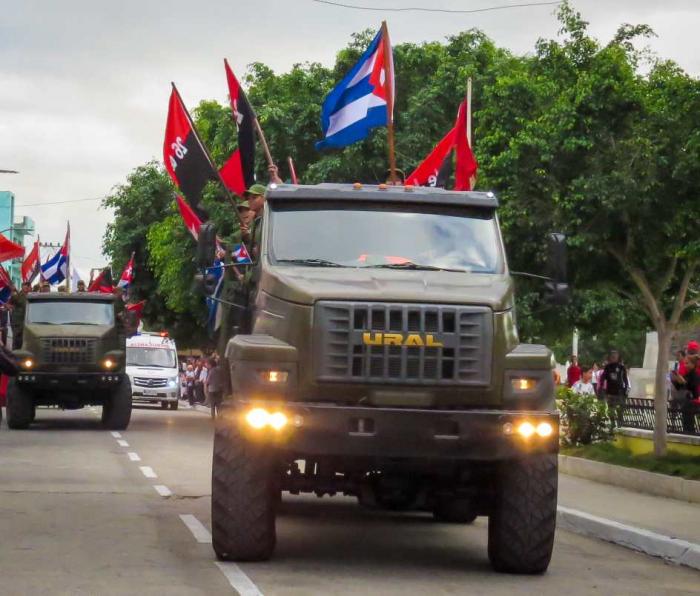
Under the same bright January sun that once marked a turning point in Cuba’s history, the streets of Bayamo filled on 2 January as young people re-enacted the famed Caravana de la Libertad. The procession, which originally ushered Fidel Castro and his supporters through the city in 1959, was staged as a living tribute to the revolutionary legacy and as a demonstration of intergenerational commitment to public services and social gains.
Bayamo Caravan of Freedom
The event followed the historic route and was accompanied by the Bayamo Concert Band, whose historic hymns provided the soundtrack as the city displayed flags and banners. Senior provincial and municipal officials presided over the ceremony, and two veterans of the 1959 campaign, Colonel Rafael Corrales Urquiza and Captain Juan Estrada Viamonte, attended as witnesses to the original entry.
Speakers framed the re-enactment as more than nostalgia. Daiteré de los Ángeles Cabrales Acosta, a young participant, said the caravan brought “school, health, land and dignity,” adding that the gains they defend are tangible services: the doctor who treats her family and the teacher who educates local children. Several young people received membership cards for the Union of Young Communists in a symbolic affirmation of continuity.

Michel Carlos Santiesteban Hernández, first secretary of the Party in Bayamo, connected the 1959 triumph with contemporary challenges. He recounted the decisive moment in the Club Cautillo when Fidel secured the unconditional surrender of battista forces and highlighted the transformation since: he cited a historical illiteracy rate of 22 per cent in the city and the fact that 18,000 children were once out of school.
While celebrating those social advances, Mr Santiesteban Hernández warned that the principal obstacle remains the economic blockade. He urged resilience, quoting Fidel’s admonition that the future will not fall like manna from the sky and must be won by work and intelligence.
The ceremony concluded with the traditional slogans “Patria o Muerte, Venceremos!” echoing over the square, a refrain that linked the revolutionary victory of 1959 to the participants’ hopes for overcoming present difficulties.
The original Caravan of Freedom set out from Santiago de Cuba on 2 January 1959 and made Bayamo one of its first major stops before proceeding through Holguín, Las Tunas, Camagüey and Santa Clara, arriving in Havana on 8 January. Fidel addressed crowds from the balcony of Bayamo’s historic town hall during the early hours of 3 January, and the following day coordinated with Camilo Cienfuegos to consolidate the movement’s advance.
Organisers of the modern re-enactment emphasised that the procession is intended as a living symbol of continuity: a public reaffirmation by a new generation that it will defend the social achievements of the revolution while confronting the economic and logistical difficulties facing Cuba today.
As the caravan passed familiar streets, the city’s present and past converged: veterans who remembered 1959 stood alongside young caravan participants who pledged to carry the torch forward. The event offered a reminder that historical memory and civic mobilisation remain central features of Bayamo’s public life.
Key Takeaways:
- Youth in Bayamo re-enacted the Bayamo Caravan of Freedom, linking the 1959 revolutionary march to present-day civic engagement.
- The ceremony featured historical music, veteran witnesses and the distribution of Union of Young Communists membership cards.
- Local leaders highlighted advances in education and health while calling for resilience amid the economic blockade.








