











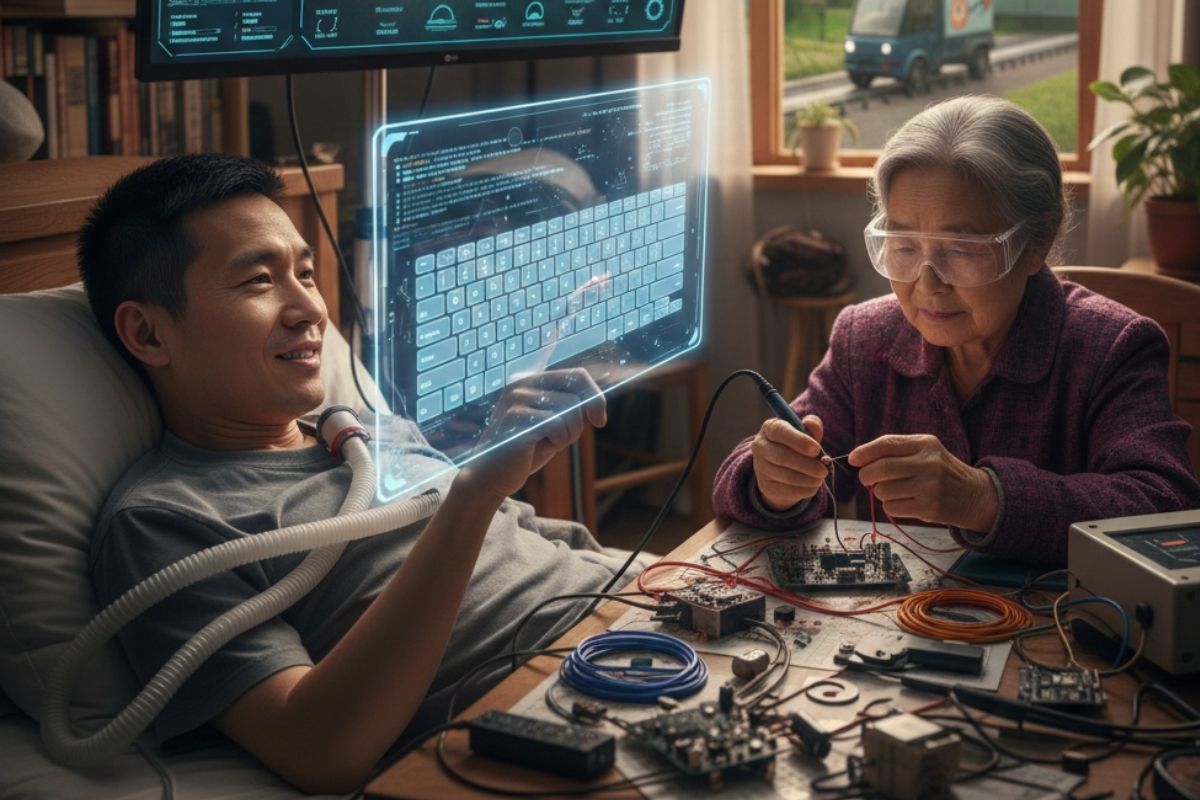
Li Xia, a 36-year-old from Chongqing, has turned an apparently impossible situation into a functioning business. Confined to bed and dependent on a ventilator, Li can move only one finger and one big toe. Nonetheless, he has built a successful start-up that runs a profitable smart farm, demonstrating how determination and technology can combine to create economic opportunity.
Chinese disabled entrepreneur turns adversity into innovation
Li’s project began as a personal mission to remain active and economically productive despite severe disability. Through months of planning, collaboration with technicians and caregivers, and the use of adaptive interfaces, Li established a small-scale smart farming operation that automates planting, irrigation and monitoring. Today the enterprise produces consistent yields and generates revenue, showing that physical limitations do not have to preclude entrepreneurship.
The smart farm uses sensors and remote-control systems to monitor soil moisture, temperature and crop health. While specific technical details of Li’s setup are not public, the model follows an increasingly common approach in which low-cost automation and data-driven controls reduce the need for manual labour. For Li, the combination of off‑the‑shelf hardware, customised controls and reliable support from technicians made day‑to‑day management possible from his bed.

Beyond the technical achievement, Li’s story is significant for what it suggests about inclusion. Disabled entrepreneurs face barriers to finance, training and market access. Li’s success highlights how assistive technologies and tailored support can lower those barriers, enabling people with disabilities to start and grow businesses. In addition, the smart farm demonstrates a scalable concept: similar systems could be adapted for smallholders, urban growers or community projects across other BRICS+ countries.
The economic impact is clear at the micro level. Li’s start-up now produces a steady income stream for him and pays for ongoing technical maintenance and caregiving support. At a macro level, stories like this feed into broader policy debates about how governments and private sector partners can support inclusive entrepreneurship. Investments in accessible technology, vocational training and microfinance tailored to disabled founders would amplify outcomes like Li’s.
Li’s journey has resonance for China and the wider BRICS+ alliance. Member and partner countries that promote accessible innovation can unlock under‑utilised talent pools while advancing food security through precision agriculture. The convergence of low-cost sensors, automation and connectivity is lowering entry costs for small, tech-enabled agricultural enterprises, creating new livelihood options where traditional labour models might be impractical.
There are also practical lessons for entrepreneurs and policymakers. First, adaptive interfaces and modular automation can make management feasible even with severe physical constraints. Second, collaboration with local technicians and service providers is often essential to translate ideas into sustainable operations. Third, access to markets — whether local farmers’ markets, co‑ops or online platforms — ensures that production turns into stable revenue.
Li’s achievement is an example of resilience meeting opportunity. While his is a single case, it underlines the potential for technology-enabled inclusion to create economic value. As BRICS+ countries pursue growth and technological adoption, supporting disabled entrepreneurs with appropriate tools and policies would be a pragmatic way to expand participation in the digital and agricultural economies.
Key Takeaways:
- Chinese disabled entrepreneur Li Xia built a profitable smart farm despite severe paralysis.
- Li, 36, from Chongqing, manages operations with limited physical movement and adaptive technology.
- The startup demonstrates how assistive tech and determination can unlock economic opportunities for people with disabilities.
- The story highlights potential lessons for inclusion and tech-driven small business growth across BRICS+ nations.








