











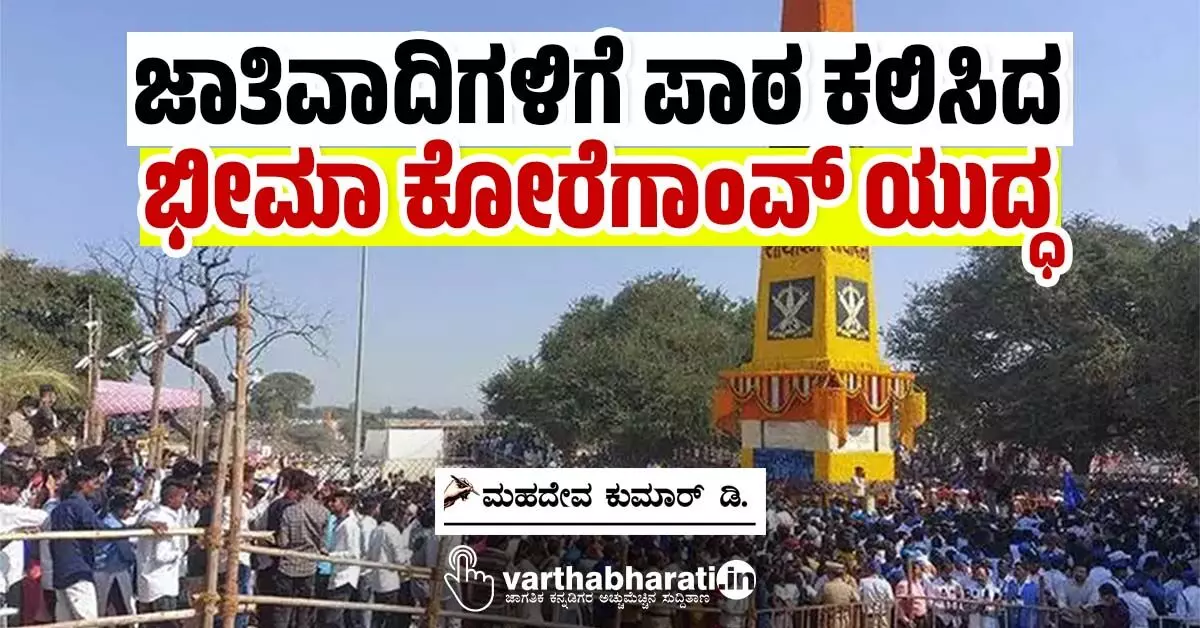
On the night of 31 December 1817, a fierce confrontation began at Koregaon Bhima on the banks of the Bhima river. By dawn on 1 January 1818, a small contingent of Mahar soldiers serving in the Bombay Native Infantry had repelled a vastly larger force sent by the Peshwa, an action that has since been recalled as a pivotal moment in the community’s history.
Koregaon Bhima battle remembered
The Mahar contingent comprised around 500 infantry, supported by a modest number of cavalry and artillery, while the Peshwa’s force reportedly included tens of thousands of horsemen and several thousand infantry. Despite these odds, the Mahar soldiers fought with determination and discipline. Contemporary accounts describe intense combat over a short period, after which the Peshwa’s troops withdrew in disarray.
For many Mahars, who had endured generations of exclusion under the prevailing caste order, service in the colonial army had offered not only economic stability but also new social standing. The opportunity to confront the Peshwa’s forces became, for some, a statement of dignity against centuries of oppression. The battalion’s commander, who had engaged in talks with the Peshwa before the battle, reportedly rejected conciliatory offers when he concluded that the Peshwa’s attitude would not change the community’s treatment.

The aftermath of the fighting had symbolic resonance. Reports from the period emphasise the bravery shown by the Mahar soldiers and the disproportionate losses suffered by the larger force. The result not only frustrated the Peshwa’s campaign of dominance but also strengthened the Mahars’ sense of self-worth and collective identity. The engagement at Koregaon Bhima has since been commemorated in local memory as an assertion of rights and a rejection of caste-based humiliation.
Historians note that the battle occurred in the wider context of shifting power in western India. The Peshwa’s authority, already under pressure from internal challenges and advancing colonial interests, faced an added setback in the failure to overcome a small but resolute battalion. For the British forces that fielded Mahar soldiers, the episode underscored both the effectiveness of locally recruited regiments and the complexities of regional politics.
Across later generations, Koregaon Bhima came to symbolise resistance to social exclusion, and annual remembrances have kept the memory of the battle alive. While the precise numbers and some details vary between sources, the central narrative remains consistent: an outnumbered battalion held its ground and, in doing so, offered a new narrative of pride for a community that had long been marginalised.
Today the battle is recalled not only as a military encounter but as an episode with lasting social consequences. It highlights how military service, colonial reorganisation and local resistance intersected to change social relations in parts of western India. The Koregaon Bhima battle, through commemoration and historical study, continues to resonate as a chapter in the broader story of social change in the region.
Key Takeaways:
- The Koregaon Bhima battle on 31 December 1817–1 January 1818 saw a small Mahar force resist the Peshwa’s army, altering local power dynamics.
- Mahars serving in the Bombay Native Infantry showed high morale and disciplined resolve despite long-standing caste discrimination.
- The encounter elevated the Mahars’ social confidence and symbolised a challenge to oppressive practices under the Peshwa regime.








