











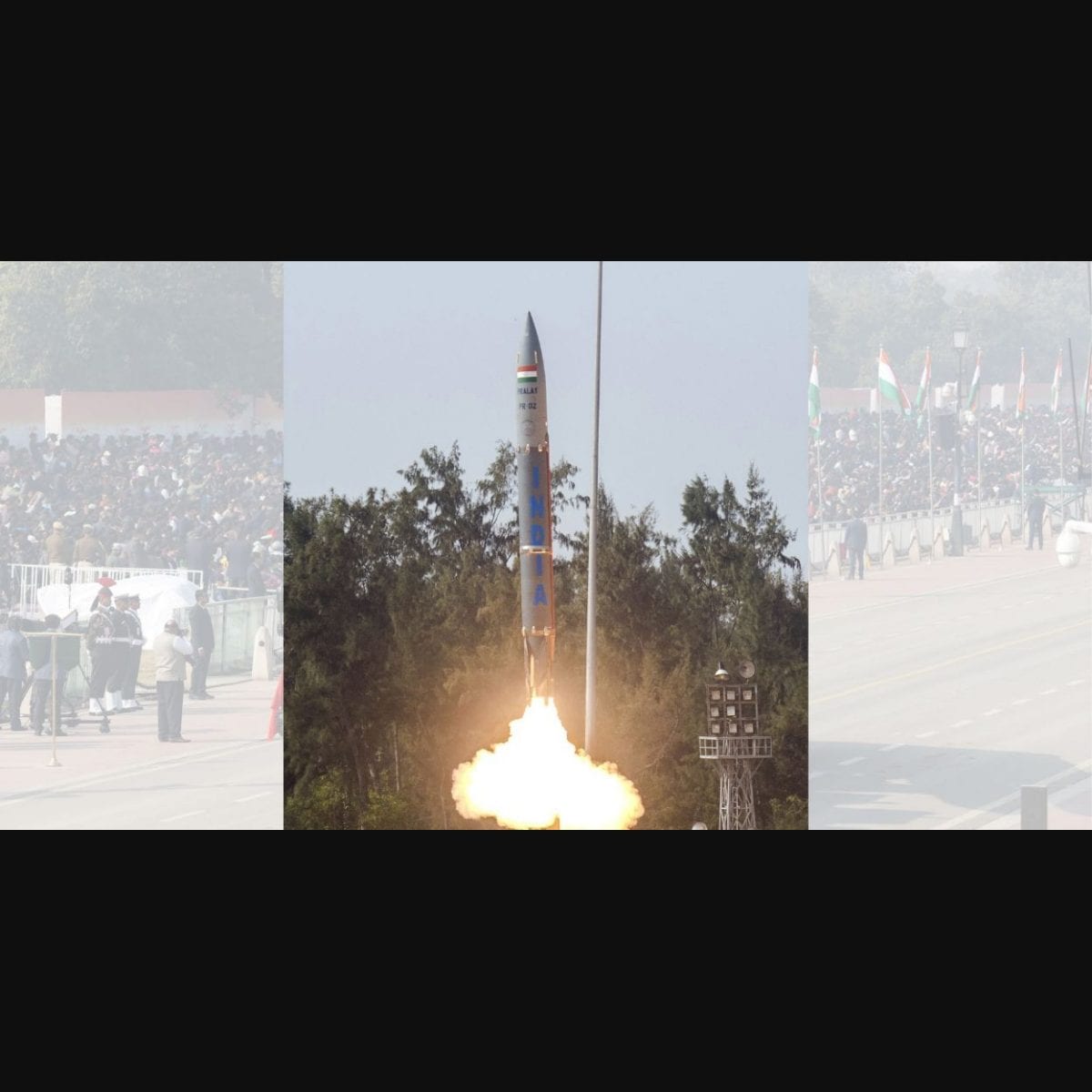
India carried out a successful test of the indigenously developed short-range quasi-ballistic missile Pralay at the Chandipur test range in Odisha, marking a notable advancement in the country’s tactical strike capability. The trial demonstrated the missile’s ability to launch multiple rounds from the same vehicle in quick succession, a salvo technique designed to saturate and defeat enemy air-defence systems.
Pralay missile test confirms salvo and manoeuvre capabilities
Defence sources said two missiles were launched from a single launcher within minutes of each other. Onboard sensors and ship-based monitoring confirmed that the missile’s guidance and control systems performed within expected parameters. The Pralay missile’s flight profile includes low-altitude phases and abrupt terminal manoeuvres, features intended to reduce detectability and complicate interception by surface-to-air and anti-ballistic systems.
Developed by India’s Defence Research and Development Organisation (DRDO), Pralay is classified as a short-range quasi-ballistic missile with a reported range of between 150 and 500 kilometres. It can carry a conventional warhead weighing between 500 and 1,000 kilograms. These characteristics make it suitable for precision strikes against theatre-level targets rather than strategic intercontinental roles.

Officials noted that the test stressed the missile’s ability to strike high-value military targets such as command-and-control centres, radar installations and logistics hubs. The salvo launch tactic—firing multiple missiles in rapid sequence from the same launcher—serves both to overwhelm an adversary’s air-defence network and to increase the probability of at least one warhead breaching defences.
Analysts say the success of this Pralay missile test adds a layer of tactical flexibility to India’s deterrence posture, particularly along sensitive borders where air-defence architectures are complex. The missile’s speed, manoeuvrability and payload options make it a useful instrument for theatre commanders seeking to degrade an opponent’s defensive or command infrastructure without escalating to strategic-weapon use.
Military officials emphasised the indigenous nature of the programme. DRDO engineers have prioritised accuracy and survivability in contested environments, calibrating guidance systems to function under manoeuvre and countermeasure conditions. Data from the trial indicated the missile met its flight and terminal guidance objectives.
The government released imagery from the test with attribution to official channels, underlining the transparency of the trial and its role as a deterrent message. While the missile enhances India’s conventional strike options, officials reiterated that its deployment and use would be governed by strategic policy and operational requirements.
Observers expect further validation tests as the system moves towards operational integration with armed forces’ formations. The demonstration of salvo launch capability is likely to prompt regional planning adjustments among neighbouring states while reinforcing New Delhi’s stated aim to strengthen indigenous defence manufacturing and operational readiness.
Key Takeaways:
- India successfully conducted the Pralay missile test at Chandipur, showcasing salvo launch capability to overwhelm air defences.
- The Pralay missile test confirmed precision guidance, manoeuvrability and a 150–500 km range with 500–1,000 kg payload capacity.
- The trial strengthens India’s theatre-level strike options against strategic targets such as command centres and radar installations.








