











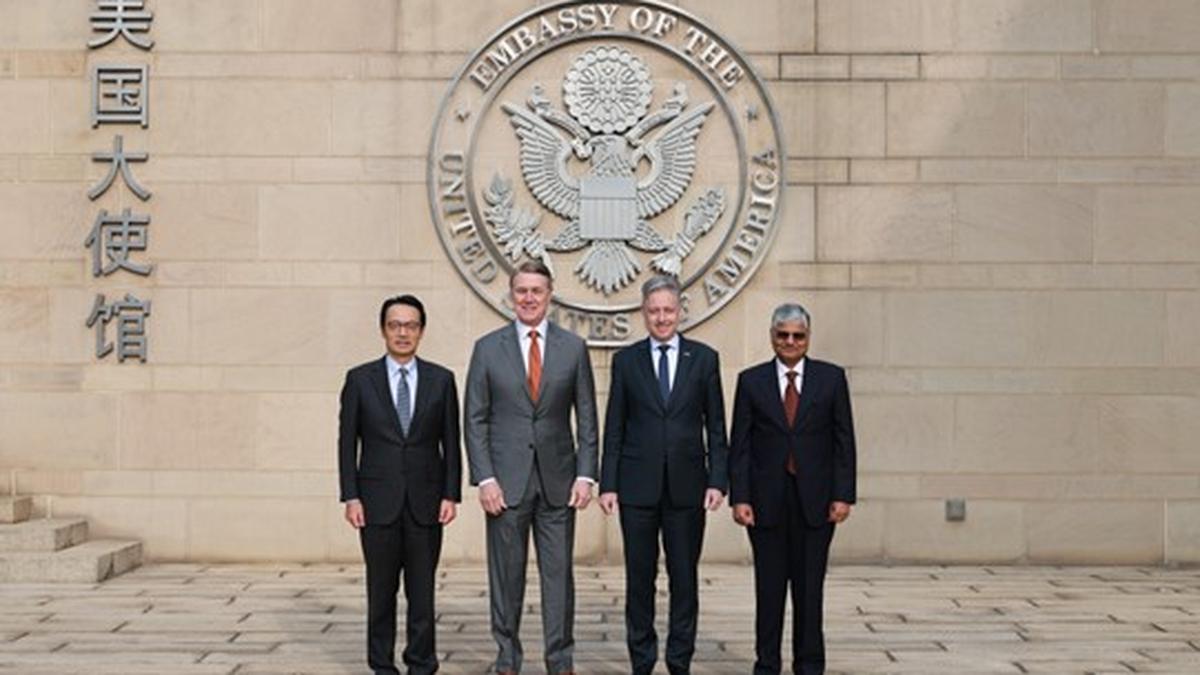
Envoys from the Quadrilateral Security Dialogue — the United States, India, Australia and Japan — met in Beijing this week in a rare publicised gathering that drew attention for taking place on Chinese soil.
The meeting, held on Tuesday at the US Embassy in Beijing, was shared on the social platform X by the US Ambassador to China, David Perdue, who posted a photograph of the four envoys and described the Quad as “a force for good in maintaining a free and open Indo-Pacific region.” The photograph includes India’s ambassador to Beijing, Pradeep Kumar Rawat.
Quad meeting in Beijing signals diplomatic engagement
Officials involved characterised the gathering as a routine diplomatic exchange among partners with shared interests in regional security and stability. For observers, the public nature of the meeting and its location in Beijing make the event notable, given Beijing’s long-standing unease with the Quad framework.

The Indian embassy in Beijing has not issued a comment on the meeting. China, which has repeatedly criticised the grouping, has not provided an immediate public reaction to this particular encounter.
Chinese officials have previously warned against what they describe as clique politics and bloc confrontation. In response to a Quad foreign ministers’ meeting in January, Chinese Foreign Ministry spokesperson Mao Ning said China advocates cooperation that is not directed at third parties and that group politics will not bring lasting peace and security to the region.
Diplomats from the Quad countries say their collaboration is aimed at addressing shared challenges such as maritime security, disaster response and supply-chain resilience rather than targeting any single country. The meeting in Beijing, therefore, can be read as an effort to keep lines of communication open while maintaining coordinated approaches to regional issues.
Giving rare visibility to such an encounter in Beijing may carry several objectives. For the Quad partners, it demonstrates the grouping’s willingness to engage in diplomacy even when operating in proximity to a critical interlocutor. For China, the event presents a test of how it wishes to respond publicly to partnerships it views with suspicion.
Analysts caution against reading too much into a single meeting. While the photograph and statements highlight unity among the Quad partners, they do not indicate any immediate policy shifts. Instead, the meeting is likely part of ongoing diplomatic exchanges that complement bilateral ties among the four nations.
As regional competition continues to shape policymaking across the Indo-Pacific, such gatherings will be watched closely by capitals and commentators. The Quad meeting in Beijing adds a visible chapter to the evolving pattern of engagement and rivalry in the region, underscoring the complicated diplomacy that accompanies strategic competition.
The photograph shared by Ambassador Perdue and the brief public statements provide a snapshot of this moment. Further communications from the Indian embassy or a formal response from Beijing may clarify the substance and purpose of the meeting in the days ahead.
Key Takeaways:
- Quad envoys, including India’s ambassador, held a rare publicised Quad meeting in Beijing at the US Embassy.
- US Ambassador David Perdue posted the photo and emphasised the Quad’s role in maintaining a free, open Indo-Pacific.
- China has criticised the Quad in the past and reiterated opposition to bloc politics, while the Indian embassy has not commented.
- The Quad meeting in Beijing signals diplomatic engagement amid broader regional tensions.








