











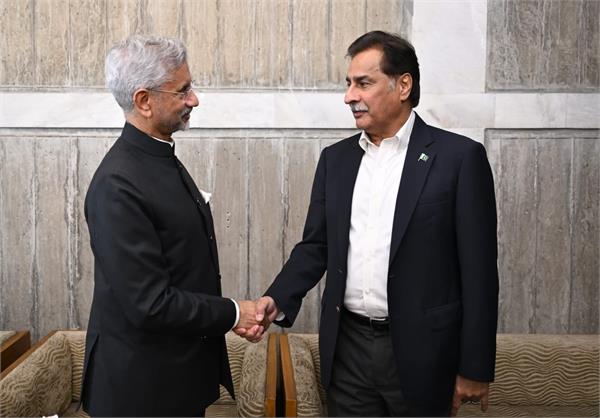
Indian External Affairs Minister S. Jaishankar and Sardar Ayaz Sadiq, Speaker of Pakistan’s National Assembly, exchanged greetings and a handshake in Dhaka on Wednesday at the funeral of former Bangladeshi prime minister Khaleda Zia. Photographs of the informal encounter were shared on social media by Muhammad Yunus, the chief adviser to Bangladesh’s interim government.
India Pakistan meeting in Dhaka marks first contact since May 2025
The encounter is notable because it represents the first visible contact between senior representatives of India and Pakistan since the four-day conflict that erupted in May 2025. That confrontation followed a high-profile militant attack in April and India’s subsequent “Operation Sindoor”, which targeted militant positions. Relations between the two countries deteriorated sharply in the months that followed.
According to officials present in Dhaka, the exchange was brief and strictly informal. There were no scheduled bilateral talks, nor were any statements issued by either delegation. Mr Jaishankar was in Dhaka to pay respects at Ms Zia’s funeral and met her family, presenting a condolence letter from Prime Minister Narendra Modi. Mr Sadiq was among the international dignitaries attending the funeral.

Diplomats and regional analysts said the handshake should be read as a modest but meaningful sign that channels of communication remain open at senior levels, even when formal diplomacy is constrained. “In situations of heightened tension, such personal contacts can play a stabilising role and create scope for future dialogue,” one analyst commented on condition of anonymity.
The context of the meeting underscores its sensitivity. The May 2025 clashes had led to a hardening of positions across both capitals, with public rhetoric and troop postures drawing international concern. In that environment, any face-to-face exchange between officials of the two countries is likely to draw close attention from policymakers and the media.
Bangladesh’s role as host for the funeral brought both delegations to Dhaka, creating an opportunity for incidental contact. Officials in New Delhi have not described the encounter as a preliminary step to negotiations, and Islamabad’s public response was similarly muted. That reticence suggests both sides are treating the meeting as a limited, symbolic interaction rather than the resumption of formal diplomacy.
Experts say the diplomatic significance lies in the signal rather than substantive content. If sustained, even low-key engagements could help reduce misperceptions and lower the risk of escalation. Observers noted that international funerals and summits have historically provided settings where leaders can test the waters for dialogue without committing to immediate follow-up.
For now, the message from Dhaka is cautious optimism. The meeting does not alter the strategic calculus of the region overnight, but it does reopen the possibility of contact. Officials on both sides will likely monitor reactions and consider whether further, more formal exchanges might be feasible in coming weeks.
Photographs from the event circulated widely on social media, accompanied by brief captions identifying the participants. As with other high-profile diplomatic moments, the images prompted commentary across broadcast and digital platforms, reinforcing the diplomatic value of even short personal interactions in times of tension.
Key Takeaways:
- Indian External Affairs Minister S. Jaishankar and Pakistan National Assembly Speaker Sardar Ayaz Sadiq exchanged a handshake in Dhaka during the funeral of former Bangladeshi prime minister Khaleda Zia.
- The meeting, shared on social media by Bangladesh’s interim government adviser, is the first senior-level contact since the May 2025 conflict between India and Pakistan.
- Jaishankar also met Khaleda Zia’s family and handed over a condolence letter from Prime Minister Narendra Modi, but no formal talks took place.
- Observers view the encounter as a cautious, constructive step towards re-establishing diplomatic communication after a period of heightened tensions.








