











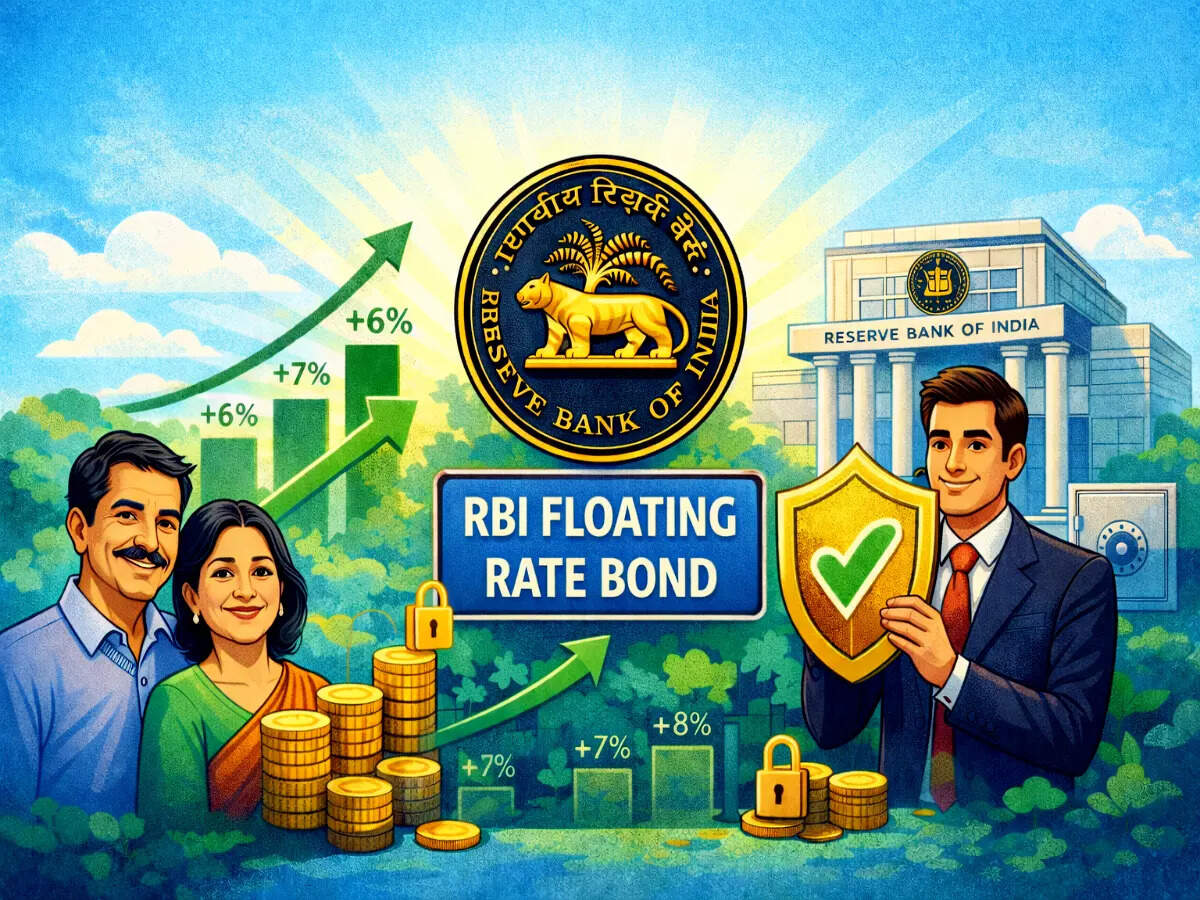
The Reserve Bank of India’s floating rate bond is drawing attention from investors seeking low-risk income after recent cuts to benchmark rates pushed many bank fixed deposit yields lower. Offering an effective rate of 8.05% per annum for the current reset period, the bond carries the sovereign guarantee of the Government of India and provides semi‑annual interest payments, making it a compelling option for conservative portfolios.
RBI floating rate bond and how the rate is set
The bond’s coupon is tied to the National Savings Certificate (NSC) rate plus a fixed spread of 0.35%, with resets every six months on 1 January and 1 July. For the July–December 2025 window, and continuing into January–June 2026, that mechanism produced an 8.05% annual coupon. Because the rate adjusts to shifts in broader government savings yields, investors gain protection against periods when fixed rates decline.
Unlike long‑term fixed deposits, whose rates are locked at the point of purchase, the floating structure means returns move with market conditions rather than remaining static for years. The bond’s semi‑annual payouts also create a steady income stream that many retirees and income‑focused investors prefer.

Why investors are comparing bonds and fixed deposits
Following a 125 basis‑point cut in the repo rate during 2025, many banks reduced FD rates. Current long‑term FD offers among large banks typically sit in the 6–7% range, while some private banks and smaller lenders still advertise higher slabs for particular tenures. Even so, those FD rates are fixed for the term and can underperform if market yields rise.
In contrast, the RBI floating rate bond’s sovereign backing means almost no default risk. Financial advisers point out that, for investors with excess cash or those approaching long‑term objectives, reallocating part of the fixed‑income allocation into floating bonds can secure a higher real return than many FDs while preserving capital.
Practical features and limits
The bond has a low entry threshold—investors can start with Rs 1,000—and there is no upper investment limit. That contrasts with small savings schemes such as the Senior Citizen Savings Scheme (SCSS) and the Sukanya Samriddhi Yojana (SSY), which offer competitive rates but impose caps and eligibility rules. SCSS and SSY yield rates can exceed the RBI bond in specific periods, yet their maximum investment ceilings or account restrictions make them unsuitable as a wholesale capital preservation tool.
For many investors the RBI floating rate bond will function best as the low‑volatility component of a diversified portfolio. Wealth managers recommend using it for capital preservation or predictable income objectives—for example, retirement income planning or fixed‑horizon liabilities of around seven years.
How to position the bond in a portfolio
Advisers typically suggest pairing sovereign floating bonds with growth assets and liquid buffers: maintain equities or equity funds to drive long‑term growth and keep liquid funds to cover short‑term needs. The bond then serves as a steady anchor, providing regular income and protecting principal against credit risk.
In short, India’s RBI floating rate bond offers investors a sovereign, low‑risk option that adapts to changing interest rates. Its combination of semi‑annual payouts, a rate reset mechanism tied to NSC plus a spread, and an unrestricted investment ceiling makes it worth considering for conservative allocations and retirees seeking predictable income.
Key Takeaways:
- RBI floating rate bond currently yields 8.05% per annum, with semi‑annual payouts and sovereign backing.
- The coupon is linked to the NSC rate plus a 0.35% spread and is reset every six months.
- No maximum investment limit and a low minimum of Rs 1,000 make it attractive compared with capped small savings schemes.
- Suitable for capital preservation and retirement income; pair with equities for growth and liquid funds for emergencies.








