











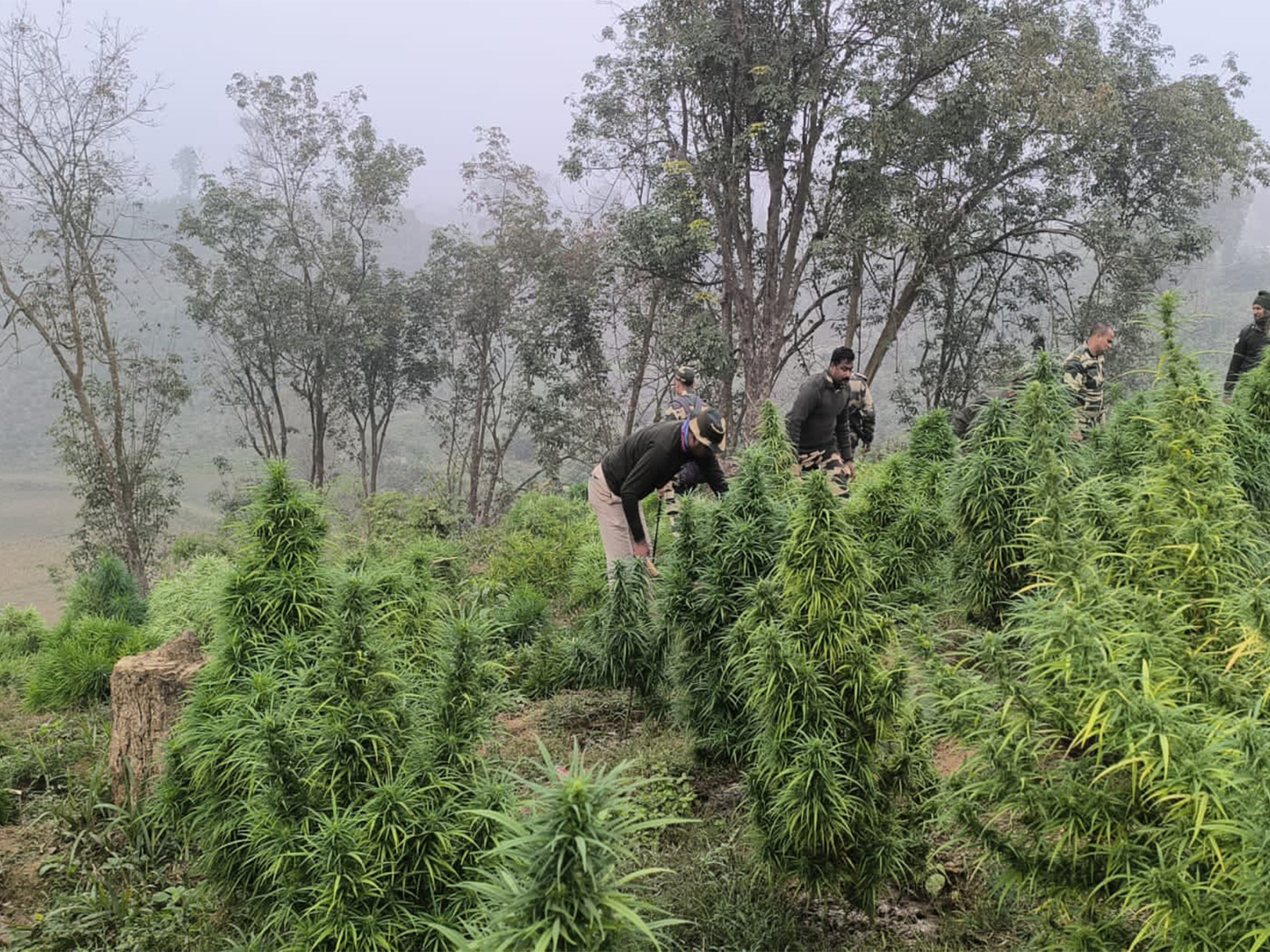
Security forces in Tripura carried out a major operation that resulted in the destruction of an extensive illegal ganja cultivation across forest land in the Sepahijala district, officials confirmed. Acting on specific intelligence, the coordinated raid took place from 8:00am to 4:30pm and targeted plots in North Kalamchoura, South Kalamchoura and Anandapur Ghatigarh.
Tripura ganja plantation destroyed after multi-agency raid
Personnel from local police stations, several Border Security Force battalions and units of the Tripura State Rifles joined forest and excise officials to uproot and destroy approximately 19 lakh pre-mature cannabis plants. Authorities said the illegal cultivation covered nearly 650 acres of forest land and placed the market value of the seized crop at about Rs 100 crore.
The operation brought together teams from Kalamchoura, Sonamura and Bishramganj police stations; BSF battalions 42, 43, 49, 69 and 81; TSR 7th, 9th, 11th, 14th and the 14th Women Battalion; the Sonamura Sub-Divisional Forest Department; the District Civil Magistrate, Sonamura; and the Sepahijala Excise Department. Commandants of the 81 and 42 Battalions led the field, supported by senior district police and DIB officers.

Officials described the action as a significant blow to organised narcotics cultivation in the district. By acting on credible intelligence and coordinating across agencies, they said the authorities were able to remove a large quantity of illegal crop before it matured and entered illicit markets.
“This joint operation demonstrates our commitment to protect forest land and curb drug-related activities,” a senior official said. The forceful removal of such a widespread plantation, they added, will help deny criminal groups access to local resources and reduce potential harm to communities in the region.
Authorities also noted the environmental and public-safety dimensions of the raid. Illegal cultivation often involves clearance of forested areas and places pressure on natural habitats. The seizure and destruction of the crop were therefore presented as measures to restore the integrity of protected land while tackling organised crime.
Law enforcement sources indicated that follow-up investigations will aim to identify networks behind the cultivation and any links to larger distribution chains. Officials stressed that further joint actions are likely as part of an ongoing drive against narcotics production and trafficking in Tripura.
Residents in adjoining areas welcomed the raid, saying that the visible presence of security personnel during the operation reassured local communities. District administrators reiterated that preserving forest land and ensuring public safety remain priorities.
While authorities celebrated the immediate success, they cautioned that intelligence-led operations will be essential to prevent re-emergence of large-scale illegal cultivation. The multi-agency approach used in Sepahijala will form the template for similar actions elsewhere in the state.
Officials concluded that continuous monitoring of vulnerable forest tracts, stronger enforcement of forest and excise laws, and community cooperation are key to sustaining the gains achieved in the operation. They pledged to maintain pressure on those who exploit land and local livelihoods for illegal profits.
Key Takeaways:
- Joint security forces uprooted about 19 lakh pre-mature plants from a 650-acre illegal ganja plantation in Tripura.
- The Tripura ganja plantation had an estimated market value of roughly Rs 100 crore and was destroyed on the spot.
- The operation involved multiple police stations, BSF battalions, TSR units, forest and excise officials and lasted over eight hours.








