











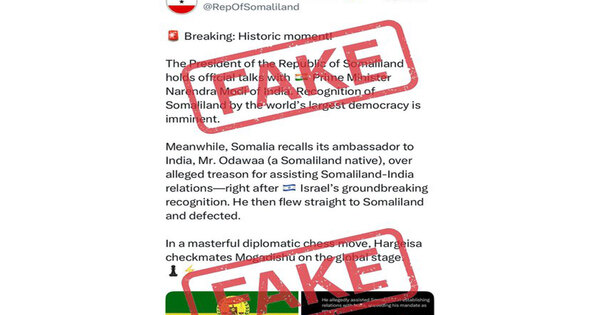
The Indian Ministry of External Affairs on Saturday moved quickly to quash social media posts that claimed New Delhi had held formal talks with Somaliland and was preparing to recognise the self‑declared republic. The MEA FactCheck unit labelled the online material “fake news” and shared screenshots it said showed fabricated visuals and captions purporting to show official engagement between Prime Minister Narendra Modi and Somaliland President Abdirrahman Mohamed Abdullahi.
India Somaliland recognition response
The clarification followed the circulation of viral messages suggesting that India, which counts as the world’s largest democracy, was poised to recognise Somaliland. The MEA also rejected reports that Somalia had recalled its ambassador to India in protest, saying those accounts had no basis in fact.
Federal authorities in New Delhi provided no indication of any formal diplomatic move. The swift denial highlights the sensitivity of recognition matters and the risk that misleading posts can inflame regional tensions or distort diplomatic relations.

Somaliland declared independence from Somalia in May 1991 after the collapse of Somalia’s central government. It has long maintained its own institutions, currency and security forces, yet it lacks broad international recognition. Israel formally recognised Somaliland on 26 December 2025, a move that has fed wider debate over the territory’s international status.
Recent weeks have seen competing narratives. Somalia’s President Hassan Sheikh Mohamud told international media that Somaliland had accepted several conditions in return for recognition, including hosting military facilities and resettling displaced Palestinians. Somaliland’s foreign ministry has denied reaching any agreement on military bases or population resettlement, saying its contacts with Israel were diplomatic and conducted in accordance with international law.
Reports that Somaliland would join the Abraham Accords and that its president would visit Israel have also circulated. Israeli officials have indicated a willingness to broaden diplomatic ties, while Somaliland leaders have suggested more recognitions may follow. Analysts note Somaliland’s strategic position near the Gulf of Aden may be a factor in international interest.
The issue has produced local unrest. Demonstrations against recognition moves were reported across Somalia on and after 30 December, including in Mogadishu, Baidoa and Dhusamareb. Regional and international bodies, such as the African Union and the European Union, have reiterated that Somalia’s territorial integrity should be respected and urged restraint.
For India, the incident underscores the importance of careful public messaging and rapid fact checking. By promptly denying the posts, the MEA limited the spread of an incorrect narrative that could have diplomatic repercussions. New Delhi’s response also reflects a broader caution among states when confronted with unilateral recognition claims in contested territories.
As the situation develops, official statements remain the primary source for accurate information. Observers say that any change in recognition status by additional states would be a deliberate diplomatic decision, likely accompanied by formal announcements rather than social media reports. In the meantime, New Delhi’s denial has restored clarity on India’s position amid competing claims and heightened public interest.
Key Takeaways:
- India’s MEA FactCheck dismissed viral posts claiming India would recognise Somaliland as false.
- Claims included purported talks between PM Narendra Modi and Somaliland’s president and Somalia recalling its envoy; MEA called them fake.
- Somaliland remains unrecognised by most states despite Israel’s recent recognition; regional tensions and protests have followed.
- Somalia and Somaliland issue conflicting statements over diplomatic arrangements and alleged security deals.








