











Key Takeaways:
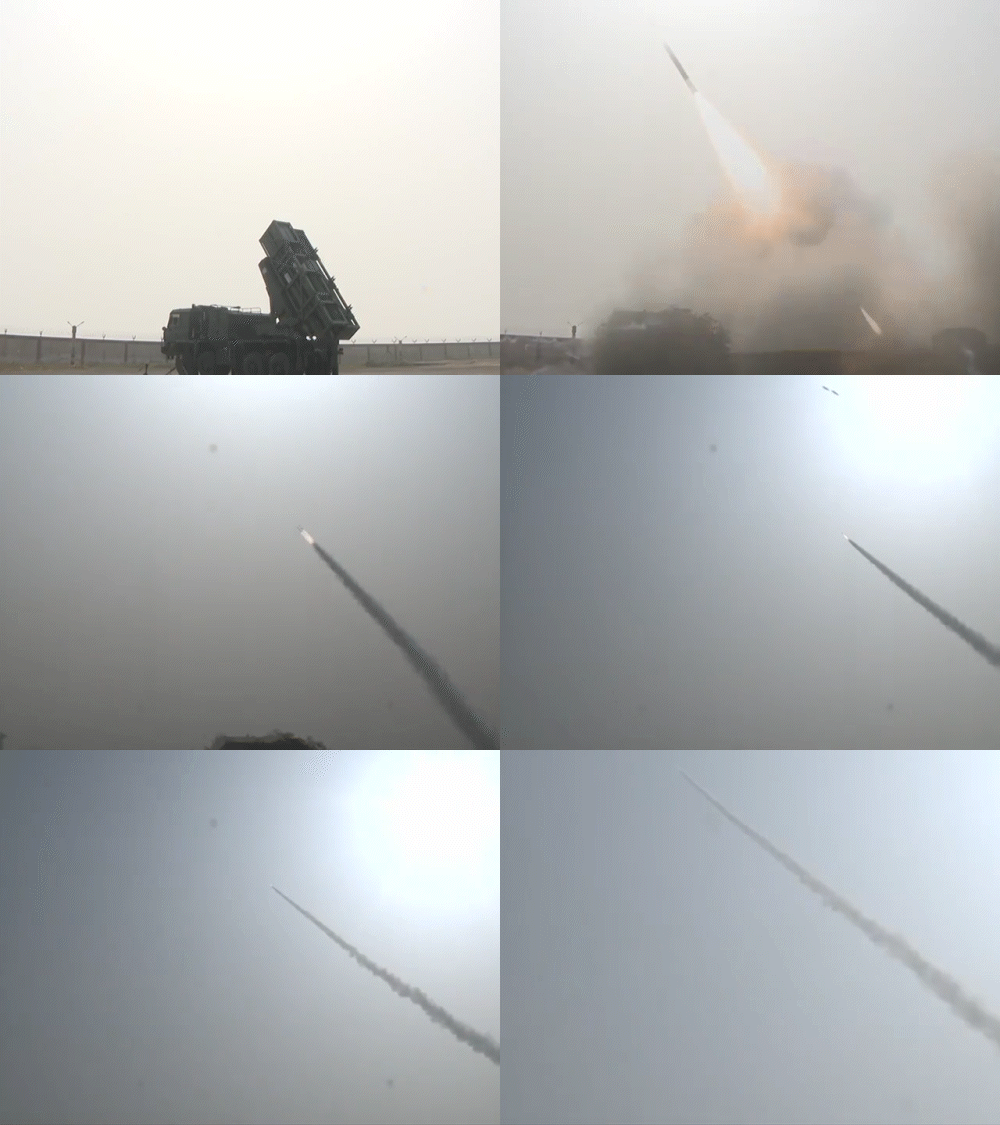
- India completed the first flight test of the Pinaka LRGR-120, reaching its 120 kilometre maximum range with a precise strike.
- Defence Acquisition Council granted approval the same day to induct the system and cleared ₹79,000 crore in related procurements.
- The rocket, developed by DRDO partners including ARDE and HEMRL, was launched from an existing Pinaka launcher, proving cross-compatibility.
- Pinaka LRGR-120 enhances long-range precision strike capability and has export interest from countries including Armenia and several European states.

India on Monday carried out the first successful flight test of the Pinaka long-range guided rocket (LRGR-120) from the Integrated Test Range at Chandipur, Odisha. The rocket was fired to its maximum rated range of 120 kilometres and hit the designated target with high accuracy, officials said.
Pinaka LRGR-120: Test details and capabilities
The Defence Research and Development Organisation (DRDO) oversaw the trial, which validated all planned in-flight manoeuvres and demonstrated reliable tracking by range-deployed monitoring systems throughout the flight corridor. The launcher used for the test was an existing Pinaka multi-barrel rocket launcher, confirming that LRGR-120 rounds can be fired from current operational launchers without additional major modifications.
Designed jointly by the Armament Research and Development Establishment (ARDE) and the High Energy Materials Research Laboratory (HEMRL), with support from other DRDO centres, the LRGR-120 incorporates guidance features that enable GPS-assisted navigation and precision impact at long stand-off distances. The Pinaka system is a truck-mounted multi-barrel rocket launcher; each vehicle typically carries 12 rocket tubes, allowing rapid salvo fire for concentrated strike effects.
Strategic approval and procurement
In a significant policy move, the Defence Acquisition Council (DAC) met on Monday afternoon and granted approval to induct the LRGR-120 into the Indian armed forces. The DAC meeting also cleared purchases totalling approximately ₹79,000 crore covering missiles, rockets and radar systems. The package includes long-range guided rockets for the Pinaka system and an integrated drone detection and interdiction system (MK‑II) for frontline units.
Defence Minister Rajnath Singh congratulated DRDO for the achievement, saying the long-range guided rocket will strengthen the armed forces’ strike capabilities. Defence Secretary and DRDO Chairman Samir V. Kamat also praised the teams involved for delivering the mission successfully.
Operational implications and export prospects
The successful test enhances the Pinaka family’s role as India’s indigenously developed multi-barrel rocket launcher (MBRL) for long-range precision fires. The guided variant gives commanders greater flexibility to engage time-critical and high-value targets at extended ranges while reducing collateral effects through improved accuracy.
Pinaka systems have already seen export success; Armenia has purchased the system and several European nations, including firms in France, have expressed interest. The LRGR-120’s compatibility with existing launchers improves logistics and lowers the barrier for both domestic scaling and foreign sales.
Test managers from the Integrated Test Range and the Proof and Experimental Establishment coordinated the launch and monitoring. Officials noted that the trial met all mission objectives and that the rocket’s flight profile and terminal accuracy were within the expected parameters.
The LRGR-120 adds to a growing suite of indigenous defence technologies that the government aims to deploy to modernise forces and support defence exports. With DAC approval secured, the armed forces can begin formal induction planning and subsequent production or procurement cycles for the new guided rockets.








