











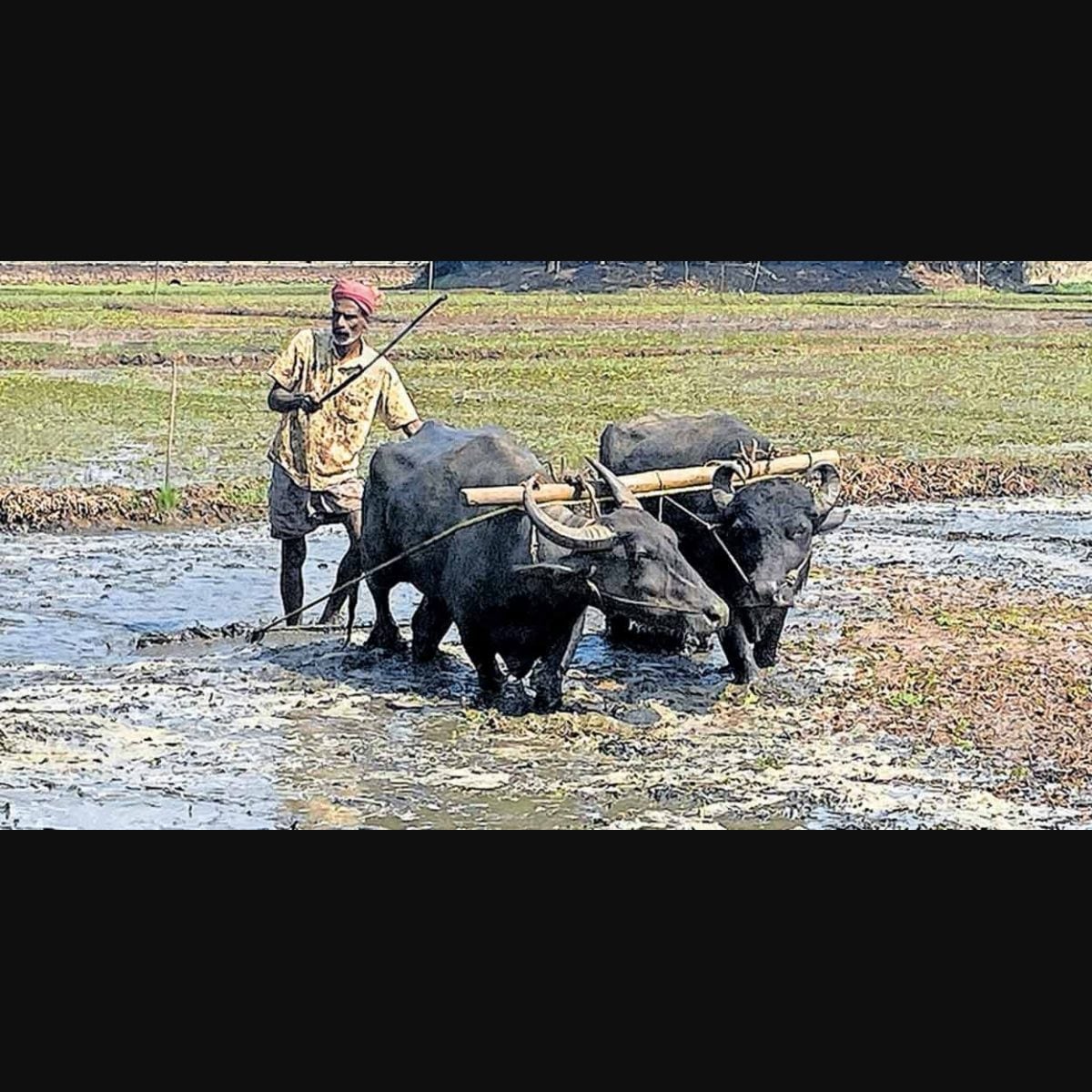
Chennithala, Alappuzha district — As the final preparations for the summer paddy season finish, farmers in Chennithala are turning to a time‑honoured method to ready their fields. In places where access roads are poor and deep canals make mechanised planting impractical, buffalo teams are still used to plough and level paddy land.
buffalo ploughing in Kerala
The practice, commonly seen in low‑lying stretches of Kerala, involves experienced ploughmen guiding buffaloes across wet plots to break clods and flatten the surface before planting. For many landowners in Chennithala, tractors cannot be brought onto plots because of narrow paths and large water channels. Farmers therefore rely on the animal‑drawn plough both out of necessity and preference.
Local ploughmen charge around ₹1,200 per acre and can prepare an acre in approximately two hours, villagers say. Babu and Santhosh, two of the regular workers from Thripperunthura Thenguthara, said they enter the fields every season and handle the work despite the hardships it sometimes brings. “We know these fields and the animals. We get them ready quickly and reliably,” Babu said.

Beyond the practical advantages, the method carries cultural value. Buffalo ploughing preserves skills passed down through generations and provides seasonal employment in areas where mechanisation has limited reach. It also represents a low‑input approach that requires minimal fuel and maintenance compared with tractors, offering a degree of resilience for smallholders facing uncertain input costs.
Agricultural extension officers say such traditional methods remain relevant in pockets of Kerala where geography and infrastructure limit mechanised farming. “Where there is no road access for tractors, animal power remains a viable option,” one officer commented. Farmers point to the reliability of experienced ploughmen and the animals as a reason they continue to choose this method, particularly for plots with difficult access.
While agricultural modernisation across India has led many growers to adopt tractors and mechanised equipment, local conditions in parts of Alappuzha favour the retention of older practices. The seasonal rhythm of paddy cultivation, combined with community knowledge and available labour, means buffalo ploughing is unlikely to disappear overnight.
Farmers and plough teams are adapting pragmatically; they combine traditional techniques with modern inputs such as improved seed varieties and fertiliser where feasible. Observers say this hybrid approach helps maintain productivity while respecting local conditions.
For residents of Chennithala, the sight of buffaloes working the flooded fields remains a familiar and welcome part of the agricultural calendar, signalling both continuity and the start of a new season.
Key Takeaways:
- Farmers in Chennithala, Kerala, use buffalo ploughing to prepare paddy fields where tractors cannot operate.
- Service is offered at ₹1,200 per acre; one acre is prepared in about two hours by experienced ploughmen.
- The practice preserves traditional skills and provides a sustainable, low‑tech solution for difficult terrain.
- Local farmers such as Babu and Santhosh sustain the seasonal demand despite modernisation pressures.








