











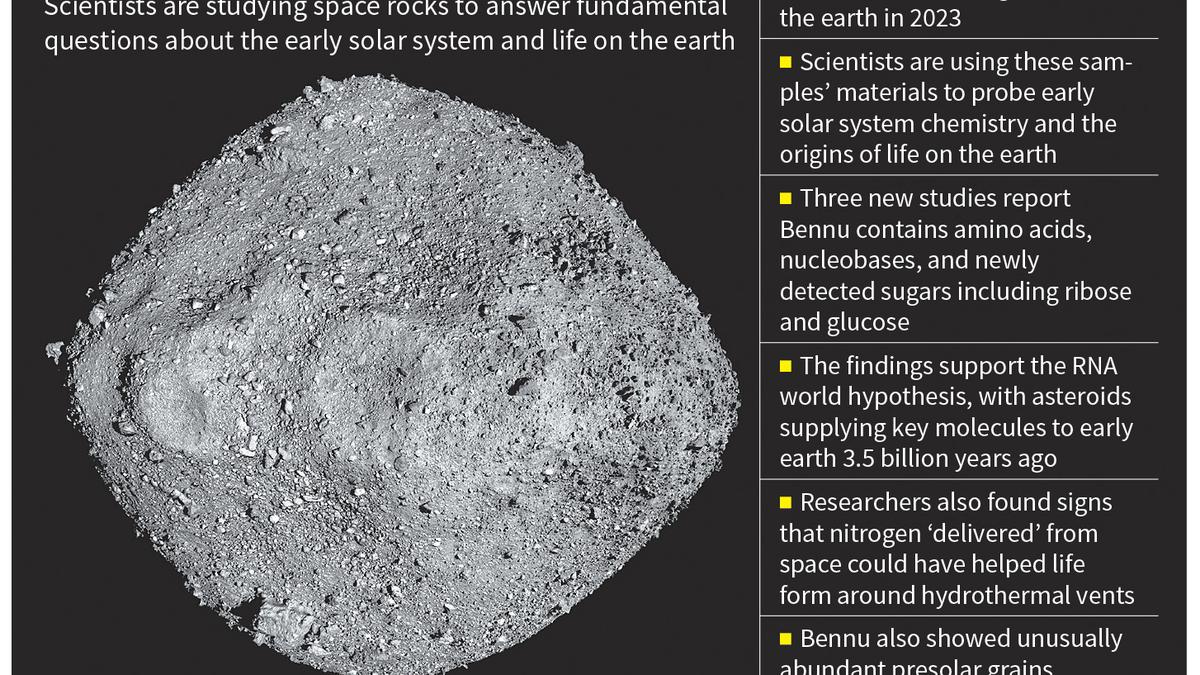
In a series of papers published on 2 December, international teams reported that samples returned from asteroid Bennu contain a suite of molecules long suspected to be critical to the origin of life. NASA’s OSIRIS‑REx mission collected surface material from Bennu in October 2020 and delivered the samples to Earth in September 2023. Analysis by laboratories in the United States and Japan, with contributions from Indian researchers, has now revealed sugars, amino acids, nucleobases and previously unseen polymer material.
Bennu asteroid samples reveal sugars, polymers and supernova dust
The most striking finding is the detection of ribose, the sugar that forms the backbone of RNA, and glucose, which fuels metabolism. Scientists at Tohoku University led the analysis that identified these six‑carbon sugars. Until now, larger sugars had not been observed in asteroid samples, only smaller carbohydrate molecules. The discovery closes an important gap in the inventory of organic compounds present on Bennu, joining earlier reports that the samples include all five nucleobases found in DNA and RNA and several amino acids.
Researchers say conditions in the parent body of Bennu could explain the formation of such complex sugars. Low temperatures, pockets of liquid brine, and suitable pH levels during formation may have enabled five‑carbon molecules to convert into six‑carbon sugars. Protected interior pockets that avoided exposure to solar radiation and terrestrial contamination preserved these compounds until collection.

In parallel, a second team reported nitrogen‑ and oxygen‑rich polymers on Bennu. The material, identified as carbamate polymers, would have been soft and gummy when formed and may have hardened over billions of years. These long polymer chains have not been observed in asteroid samples before and provide a plausible source of nitrogen for prebiotic chemistry, addressing a longstanding question in origin‑of‑life research.
Scientists note that these findings lend support to the RNA world hypothesis, which proposes that RNA molecules once served both as genetic material and as catalysts before the evolution of DNA and proteins. The presence of sugars and nucleobases on an asteroid that orbits between Earth and Mars strengthens the idea that meteorite and asteroid impacts could have delivered key organic ingredients to the early Earth more than 3.5 billion years ago.
A third study examined presolar grains preserved in the Bennu material. These microscopic dust particles formed in stellar environments before the Sun and carry isotopic signatures of their stellar origins. The concentration of presolar grains in the Bennu samples is at least six times higher than in previously studied asteroids and meteorites, with an unusually large fraction originating from supernovae. The result raises fresh questions about the local conditions where Bennu’s parent body accreted and whether similar concentrations will be found in other samples.
Indian scientists contributed to the analysis and peer review of the studies, highlighting the international nature of modern sample‑return science. Experts say further study of Bennu’s samples will refine timelines for chemical processing on small bodies and help determine how widely distributed these life‑building materials were in the inner solar system.
The Bennu findings underscore the value of sample‑return missions. By bringing pristine material to Earth for detailed laboratory work, researchers can identify complex organics and presolar signatures that remote observations alone cannot resolve. The discoveries do not prove life came from space, but they strengthen the case that asteroids could have delivered crucial molecular ingredients that made life on Earth possible.
Key Takeaways:
- NASA’s OSIRIS‑REx returned samples from asteroid Bennu containing sugars, amino acids and nucleobases.
- Researchers, including an Indian team, identified ribose and glucose alongside novel nitrogen‑ and oxygen‑rich polymers.
- Presolar grains, with unusually high supernova dust content, suggest Bennu’s parent formed in a supernova‑rich region.








