











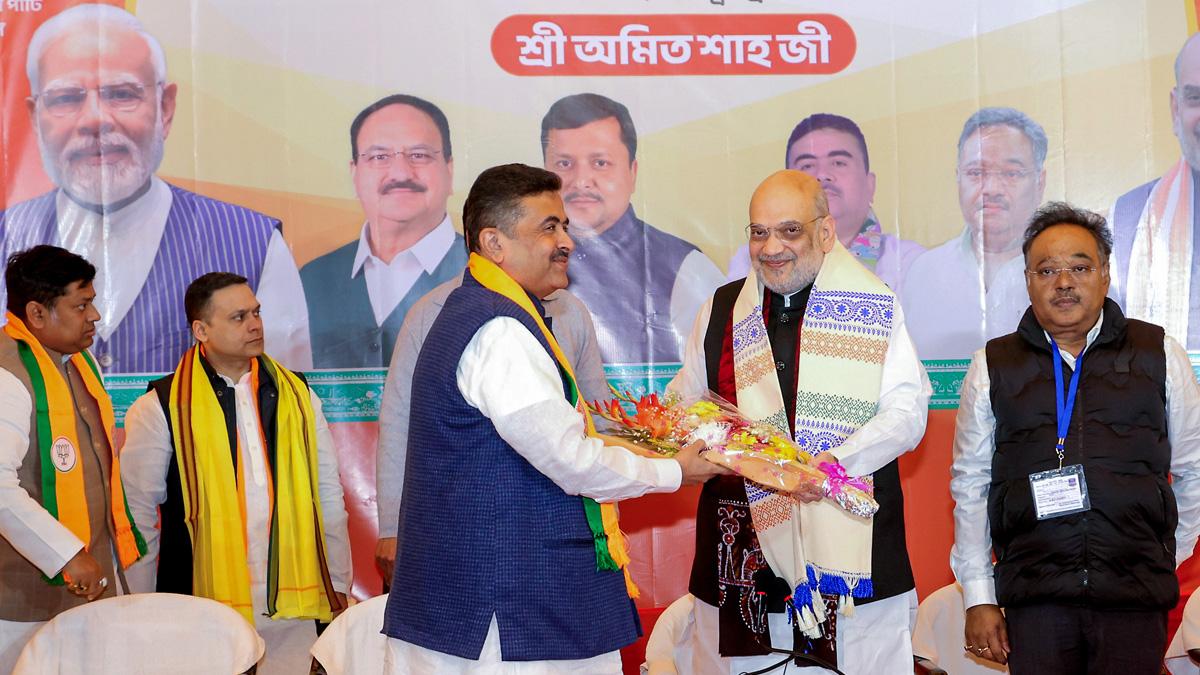
Union Home Minister Amit Shah has directed the Bharatiya Janata Party to sharpen its focus on grassroots mobilisation in West Bengal as the state prepares for a crucial round of elections. The central leadership has set clear performance benchmarks for local units and emphasised the vital role of booth-level workers in securing votes.
Bengal polls Amit Shah
At a high-level meeting with state and regional leaders, Shah urged party workers to intensify outreach activities across wards and panchayats. He spelled out quantifiable targets for membership drives, voter contact programmes and booth preparedness, signalling a more disciplined and data-driven campaign approach.
The meeting also saw the return of Dilip Ghosh to an active organisational role in the state. Ghosh, a former state president and a prominent campaigner, has been tasked with strengthening party networks and overseeing booth-level coordination. The central leadership made clear that his reinstatement is intended to boost ground operations rather than unsettle local structures.

Officials present at the meeting said Shah stressed unity within the party and urged leaders to resolve local disputes swiftly to present a cohesive front. Training programmes for booth workers and volunteers are to be scaled up, with an emphasis on voter outreach, issue-based engagement and rapid response to local developments.
Strategists at the meeting highlighted the importance of small-scale, sustained interventions in communities. Rather than relying solely on high-profile rallies, the BJP will concentrate resources on door-to-door campaigns, local grievance redressal and targeted communication tailored to different demographic groups.
Senior party sources added that performance metrics would be monitored at frequent intervals. These include the number of voter contacts per booth, volunteer mobilisation figures and the readiness of party workers to handle election-day duties. The aim is to convert organisational discipline into tangible gains at the ballot box.
Political analysts say the strategy reflects a learning curve for the BJP in West Bengal, where the ruling regional party has retained strong local networks and a loyal voter base. By prioritising booth-level strength and local engagement, the central leadership hopes to erode the incumbent’s advantage in key constituencies.
The reinstatement of Ghosh carries both organisational advantages and risks. Supporters point to his experience and grassroots connect. Critics warn that high-profile interventions must be carefully calibrated to avoid factional tensions. The central leadership appears to be balancing these considerations by emphasising coordination and measurable outcomes.
Observers also noted the timing of the directive. With the election approaching, the BJP’s intensified push seeks to consolidate volunteers, refine candidate selection and improve ground-level intelligence on voter sentiment. The focus on training and booth readiness signals a move away from purely personality-driven campaigns.
Rediff Video Desk uploaded the original footage of the meeting on 31 December 2025. The central leadership’s message was clear: organisational discipline, united leadership and persistent local engagement will shape the BJP’s campaign in West Bengal.
As parties prepare for a hard-fought contest, the outcome will depend not only on high-profile messaging but on the effectiveness of sustained grassroots work in the months leading up to polling day.
Key Takeaways:
- Amit Shah has ordered intensified grassroots outreach and set performance benchmarks for BJP cadres in West Bengal.
- Dilip Ghosh has been reinstated to strengthen on-ground mobilisation and booth-level coordination.
- The central leadership stressed party unity, worker training and candidate selection to counter the ruling regional party.
- Focus shifts to booth-level work and measurable targets as BJP prepares for a hard-fought state election.








