











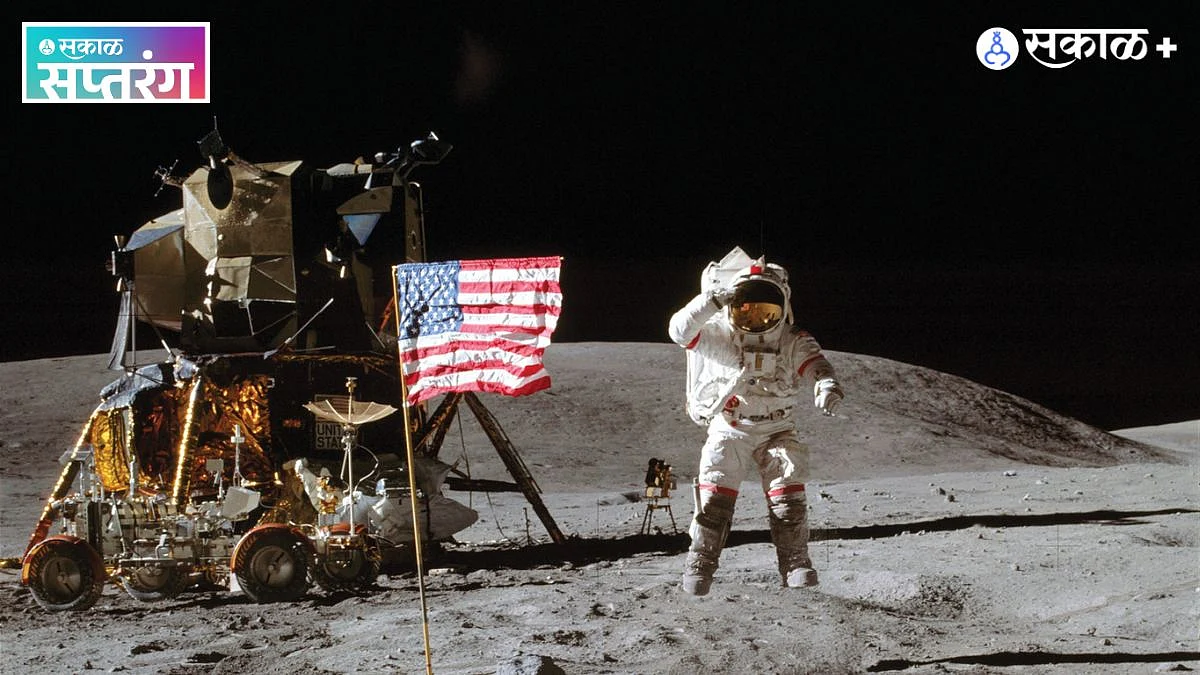
Scientific and photographic evidence continues to support the Apollo moon landings, with recent observations from India’s 2021 Chandrayaan mission helping to settle long-standing doubts. While conspiracy theories about a staged landing endure in popular culture, multiple independent lines of verification point decisively to real human missions to the lunar surface.
Moon landing evidence backed by independent observations
Several objective data points corroborate the Apollo missions. Scientists placed laser retroreflectors on the Moon during three Apollo missions. Ground teams can fire laser pulses at these retroreflectors and measure the time it takes for light to return, allowing the Earth–Moon distance to be measured to millimetre precision. Lunar rock samples returned by Apollo have been distributed to laboratories around the world for analysis. The mineralogy and cosmic-ray exposure ages of those rocks match expectations for material formed on the Moon, not material manufactured on Earth.
Other nations tracked Apollo radio transmissions in real time. The Soviet Union, then a geopolitical rival of the United States, monitored the missions and acknowledged the transmissions. More recently, high-resolution imagery from space agencies has shown the locations where Apollo modules touched down and left equipment. India’s Chandrayaan orbiter captured images of the Apollo landing sites in 2021, adding another independent data source to the record.

Explaining common sceptical claims
Popular objections have been raised for decades, but experts say each has a straightforward explanation rooted in physics and photography. Conspiracy theorists point to the US flag appearing to wave in footage. In the lunar vacuum there is no atmosphere, so movement comes from the astronauts handling the flag and from residual motion of the flag’s horizontal support. Without air to damp such motion, it can continue briefly before stopping.
Claims that stars are missing from lunar photographs omit a simple photographic fact. Camera exposure settings used to capture brightly lit lunar surface and astronauts naturally wash out faint background stars. Similarly, the absence of dramatic blast craters under the lunar landers is explained by the nature of lunar regolith and gentle descent profiles. The descent engines throttled down as modules approached the surface, and the compacted regolith does not respond like loose, Earth-like soil to low-thrust exhaust.
Other supposed anomalies, such as odd shadows or differing illumination, are consistent with a single, very bright light source—the Sun—combined with a highly reflective surface and rugged terrain producing varied shadow lengths and directions.
Public perception and the persistence of myths
Investigations by journalists and scientific outreach programmes, including testing on televised science shows, have rebutted many false claims. Nonetheless, sensational narratives retain appeal because they suggest secret knowledge and offer emotional excitement. High-profile endorsements of conspiracies by public figures amplify those views and make facts harder to communicate.
For policymakers, scientists and educators the lesson is clear. When misinformation takes hold, prompt public explanation and visible independent verification are essential. The combined weight of physical samples, laser experiments, satellite imagery and international monitoring forms a robust body of moon landing evidence that remains convincing to the scientific community and explains why professional researchers and space agencies regard the Apollo missions as genuine milestones in human exploration.
Key Takeaways:
- Chandrayaan-2 imagery and international tracking confirm Apollo landing sites, strengthening moon landing evidence.
- Independent proofs include retroreflectors, lunar rock samples analysed worldwide and satellite observations.
- Common conspiracy claims—flag movement, missing stars, absence of blast craters—have straightforward scientific explanations.
- Experts and media investigations have repeatedly debunked hoax theories, but myths persist without timely rebuttal.








